






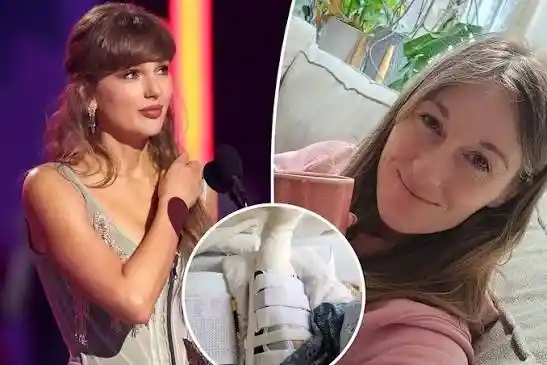
Taylor Swift Donation: How Her $50,000 Gift Helped a $110,000 Recovery Campaign
The Taylor Swift donation of $50,000 to a Connecticut mother struck on Interstate 95 arrived as a headline about generosity, but it functions as something more instructive: a live experiment in how a single large gift behaves inside a small community fundraiser. In our previous investigation into Taylor Swift’s net worth, finances and investments, we traced how that fortune was actually assembled — through master recordings, re-recordings, a $2.078 billion tour gross and a buyback whose price has never been disclosed. This piece follows the money in the opposite direction: out of that structure and into the household ledger of the Ashley Taunton recovery, where the relevant figures are not catalog valuations but gas, groceries, exhausted work leave, and an estimated twelve months of physical therapy. Understanding Taylor Swift finances tells you where the $50,000 came from. Understanding the Taunton family’s balance sheet tells you what it actually does.
The Precise Nature of the Risk She Took
Start with the fact that most social-media summaries get wrong, because it determines everything downstream.
Ashley Taunton did not shield teenagers from an attacker. There was no assault, no criminal act, no intentional threat. She protected a 19-year-old from a second vehicle that hydroplaned on a rain-soaked highway and came toward the crash scene while she was standing in it. The distinction matters because the phrases circulating online — “saved a teen,” “threw herself in front of a car” — flatten the mechanism into melodrama and, in doing so, erase the specific category of danger that injured her.
That category has a name in traffic safety: the secondary crash. The first collision does not end the emergency. It creates a new hazard zone — stopped vehicles, people on foot, debris, degraded visibility, and traffic still moving at highway speed through the same water that caused the initial loss of control. Hydroplaning is not simply a wet road. It occurs when a film of water separates the tire from the pavement and strips away the friction needed to steer or brake. The risk scales with standing water, speed, tire condition and drainage. On the evening of Saturday, July 18, 2026, on I-95 South near Hopkinton, Rhode Island, those conditions produced two separate losses of control within minutes of each other.
Ashley entered the zone between them. That is the risk she assumed, and it is the reason a routine act of roadside assistance produced life-threatening injuries and a recovery measured in months rather than weeks.
The Reconstructed Timeline, and Where the Costs Enter
Ashley Taunton, 42, of Ledyard, Connecticut, was driving home from Newport with one of her daughters during a torrential rainstorm. Her husband Joe told NBC 10/WJAR that a car ahead of them hydroplaned past exit four and went off into the woods. She pulled over, told her daughter to stay in the vehicle and call her father, and went to help.
The first crash involved 19-year-old Vinny O’Rourke, who was driving home with friends when, in his mother Jamie O’Rourke’s account to WPRI, “he hydroplaned on a big puddle and it sent him into the woods.” The teenagers sustained only minor injuries. But they were now occupants of a wrecked car in a storm, on an active interstate.
Here the two available accounts diverge slightly, and the difference is worth naming rather than smoothing over. Joe Taunton told both WPRI and WJAR that Ashley had already pulled one of the boys out of the car when the second vehicle came at them. Ashley herself, speaking to People from her hospital bed on August 23, described the teens as already exiting the vehicle and “a little bit banged up, but seemed relatively okay” when she reached them, with the second car arriving as she was speaking with them. Both versions agree on the decisive action and the outcome. The variation is the ordinary drift between a secondhand account given in the first days of a crisis and a firsthand account given five weeks later. Neither is dishonest; readers should simply know the primary account is Ashley’s.
What both accounts share: she pushed Vinny out of the trajectory and absorbed the impact herself. According to an official crash report Ashley shared with People, the second driver lost control while traveling in the second lane of I-95 South because road conditions were wet and slippery. Her own description of the moment: “It just felt like a big explosion. I just remember being on the ground and I could see my ankle was just hanging there. I went to try to get up and I couldn’t breathe.”
Her daughter reached her and held her hand until first responders arrived. Ashley was taken first to Westerly Hospital, then transferred to Rhode Island Hospital in Providence.
Then came the coincidence that gave the story its emotional architecture. Vinny was the son of a woman Ashley had been friends with for fourteen years. She hadn’t seen him in six years and did not recognize him at the scene. The families discovered the connection only when Jamie O’Rourke encountered Joe and his daughter in the hospital. “Jamie just lost it and was like, ‘Oh my gosh, that was Ashley? She saved my son’s life,'” Ashley recalled.
This detail is narratively powerful and economically irrelevant — which is precisely why it deserves careful handling. It explains how the community learned the details and why the story acquired local momentum. It does not alter the mechanics of the crash, establish anyone’s intent, or tell us anything about cost.
The Medical and Household Burden, With Attribution
The injury picture comes from two sources with slightly different inventories, and both should be attributed rather than merged into a single authoritative list.
Joe Taunton told WJAR and WPRI that doctors found extensive internal injuries including damage to the small and large intestines, multiple liver lacerations, and a ruptured diaphragm that collapsed one lung, plus a severe leg injury that surgeons repaired. He said Ashley had undergone three surgeries and had come off life support. The GoFundMe page, written in the immediate aftermath, described two major surgeries within the first eighteen hours with more scheduled — not a contradiction with “three surgeries,” simply a snapshot taken at a different hour.
People, reporting Ashley’s own account on August 23, listed bilateral internal carotid artery dissection, liver and spleen lacerations, multiple rib fractures, and a ruptured diaphragm. The overlap is substantial; the differences reflect what each speaker emphasized and when. No complete medical record has been published, and none should be expected.
The single most economically consequential medical statement is this one, from People: doctors estimate that recovery, including physical therapy, could take up to twelve months. That is the number that converts a hospital story into a household finance problem.
And the household finance problem was stated plainly by Ashley to USA TODAY on August 29: Joe, the family’s breadwinner, has run out of work leave after caring for her. That single sentence carries more analytical weight than any injury list. It means the family faces the classic double hit of a serious accident in the American system — expenses rising and income falling simultaneously, with the caregiving burden falling on the earner.
By late August, Ashley had progressed to outpatient physical therapy; WPRI reported she was at a PT appointment with her husband when he received the message about Swift’s donation. That is the most recent verifiable marker of her status. “Off life support” and “in physical therapy” are indicators of progress, not of resolution.
Anatomy of the Campaign
The fundraiser is titled “Support Ashley Taunton’s Brave Recovery.” It was organized by Laura Ortelt, a friend, based in Ledyard Center, Connecticut, with Joe Taunton as beneficiary. It is classified as a medical fundraiser, and the goal is $110,000.
The stated uses of funds, quoted directly from the page, are four: daily household bills and expenses; gas and travel costs for commuting back and forth to the hospital; meals and groceries for the kids; and medical expenses not covered by insurance.
Read that list carefully, because it is the most honest financial document in this entire story. Only one of the four categories is medical. The other three are the cost of a household continuing to function while one adult is hospitalized and the other is at the hospital instead of at work. This is the structure that donation headlines systematically obscure: the price of a catastrophic injury is not the hospital invoice. It is the hospital invoice plus fuel, parking, meals eaten out, childcare, lost wages, prescriptions, home modifications, and rehabilitation — an unglamorous stack of small recurring costs that no insurance policy addresses.
The campaign publishes no itemized budget, so no category can be quantified. What can be said is that the $110,000 goal is an operational estimate by organizers of what would relieve pressure during recovery. It is not a certified medical bill, not an actuarial projection, and not a valuation of anything.
The community response also predates the celebrity entirely. WPRI reported that a Meal Train was organized for the family, with volunteers signing up to cook more than three weeks of meals. That is uncompensated labor with real economic value — likely several hundred dollars of displaced grocery and takeout spending — and it appears on no fundraising dashboard.
The Real Weight of the $50,000
Now the arithmetic, and it needs date-stamping at every step, because a crowdfunding page is a live figure, not a balance sheet.
Against the $110,000 goal, $50,000 is 45.5 percent. That is the cleanest and most defensible way to express the donation’s scale, and it is the figure our source document used.
But the more revealing calculation involves timing. USA TODAY reported that as of August 29 — with Swift’s contribution already included — the campaign had raised more than $74,000. By August 30 and 31, multiple outlets were reporting totals clustered between roughly $88,800 and $89,900, against the same $110,000 goal. Our source document recorded $89,746 with approximately 1,200 donations on August 31.
Three inferences follow, and I want to label them as calculations rather than disclosures.
First, if the campaign stood at roughly $74,000 immediately after a $50,000 gift, the pre-Swift base was in the neighborhood of $24,000. That money came from friends, neighbors, a church community and strangers over roughly six weeks. It is the foundation the celebrity donation landed on, not the origin of the fundraising.
Second, the campaign appears to have gained something in the range of $15,000 in the roughly 48 hours after the donation became news. That is the amplification effect made visible. It cannot be attributed dollar-for-dollar to Swift — coverage, timing and organic sharing all interact — but the directional evidence is strong.
Third, and most striking: Ashley told WPRI that Swift’s fans, having spotted the donor name on the public list, began contributing $13 each, a nod to Swift’s favored number. “I had no idea that her fans all rally and do their $13 donation,” she said. Ortelt confirmed the same pattern to USA TODAY. At $13 a donation, roughly $15,000 of follow-on giving implies on the order of a thousand individual contributions.
That is the finding worth pausing on. The $50,000 was the visible transfer. The $13 cascade may be the more interesting economic event, because it demonstrates that a celebrity donation in a public-ledger environment functions as a coordination signal, not merely a payment. GoFundMe lists donor names. That transparency turned one gift into a beacon that mobilized a distributed network of small givers who would never have found a Ledyard fundraiser otherwise.
Set against the $89,746 total, Swift’s contribution represents about 55.7 percent of everything raised — meaning roughly $39,700 came from approximately 1,199 other donations, an average near $33. Both halves matter. A campaign of this shape is a barbell: one very large gift and a long tail of modest ones, with neither sufficient alone.
At that point, the gap to goal was roughly $20,254. Swift’s donation exceeded twice the remaining shortfall. That comparison shows the magnitude honestly without pretending the goal equals the true cost of recovery.
Swift also left a public comment on the page on August 28: “Wishing you the best recovery possible and sending love to your family!” Ortelt, who described herself as a Swift fan of twenty years, told USA TODAY she had to pull over in tears when she saw it. Ashley said she was at physical therapy when she found out: “I was in disbelief.”
The Economics of Attention
A medical fundraiser runs on two inputs: money and attention. Money settles obligations. Attention determines how many people ever encounter the page. Most campaigns fail not because donors refuse but because the campaign is never seen.
Celebrity capital is unusual because it supplies both simultaneously, and the second input is arguably worth more than the first. The $50,000 is finite and spends once. The visibility it purchased converted a regional Rhode Island and Connecticut story into national coverage across USA TODAY, People, Page Six, E! News and CT Insider — and that coverage keeps working after the original transfer clears.
There is a real cost to this mechanism, and it should be stated rather than admired. Attention is not neutral; it reallocates. The reason this story reached millions is not that a mother was gravely injured helping strangers on a highway. Thousands of Americans are catastrophically injured every year with no fundraiser, no coverage, and no cascade. This story traveled because a billionaire’s name appeared on a donor list. That is an accurate description of how the attention economy allocates sympathy, and it is not a flattering one.
The structural implication is uncomfortable for anyone who treats celebrity philanthropy as a solution. A system in which recovery funding depends on whether a famous person happens to notice your GoFundMe is not a safety net. It is a lottery with excellent public relations. Swift’s donation is genuinely useful to one family; it says nothing encouraging about the other families whose pages went unnoticed the same week.
There is also an editorial hazard, which our source document identified sharply: if the coverage ends up being about Swift rather than about Ashley, the attention economy has quietly swapped the subject of the story. The injured person becomes set dressing for a celebrity anecdote. Ashley’s own framing pushes back against that drift. “It feels weird if people call me a hero,” she told People. “I’m just a mom. Somebody was hurting. That’s just what you do.”
Confirmed Versus Unknown
Confirmed and consistent across sources: Ashley Taunton, 42, of Ledyard, stopped during a severe rainstorm on July 18, 2026, to assist occupants of a vehicle that had hydroplaned off I-95 South in Hopkinton. A second vehicle hydroplaned while she was at the scene. She pushed 19-year-old Vinny O’Rourke clear and was struck. She was treated at Westerly Hospital and Rhode Island Hospital for multiple life-threatening injuries and underwent several surgeries. The teenager was the son of a longtime friend, discovered only at the hospital. A GoFundMe organized by Laura Ortelt for Joe Taunton set a $110,000 goal with four stated uses. Taylor Swift donated $50,000, reported by WPRI, WJAR, USA TODAY, People and CT Insider, and confirmed by Ashley and by the organizer.
Not confirmed: the full police report and any determination of fault, the identity of the second driver, whether citations were issued, and any civil or criminal liability. The crash report Ashley shared with People attributes the loss of control to wet and slippery conditions, but no legal conclusion has been published, and Rhode Island’s Department of Public Safety had not responded to press inquiry at the time of that reporting.
Also not confirmed: the total medical cost, the share insurance will cover, the final amount the family will receive, or any accounting of how funds are spent. The twelve-month figure is a physician estimate relayed by the patient, not a fixed schedule.
And not confirmed by any primary source from Swift: why she donated or how she learned of the case. Her representative was contacted by USA TODAY; no explanation has been published beyond the comment on the page. Ashley mentioned to USA TODAY that she often sees Swift’s Rhode Island home from Misquamicut State Beach — a geographic coincidence, offered as color, and emphatically not evidence of a connection. Any theory about motive, image strategy or prior relationship would be invention.
What This Says About Celebrity Medical Crowdfunding
Three durable lessons emerge, and they generalize well beyond this case.
The first is that goals are operational, not diagnostic. A $110,000 target tells you what organizers judged achievable and urgent in the first days of a crisis, when nobody knew the recovery would be estimated at a year. It is not a bill. Treating a funded goal as a solved problem is the most common error in celebrity medical crowdfunding coverage, and it is how families end up with a viral moment in month one and silence in month eight.
The second is that non-medical costs dominate the lived experience. Three of four stated uses on this page are ordinary household continuity. Joe’s exhausted work leave is the clearest illustration: the loss is not a charge from a hospital but the absence of a paycheck. Any analysis that measures the burden only in medical billing misses most of it.
The third is that public donor ledgers change the physics of giving. A named large donation on a transparent platform generates a second wave that a private gift of identical size would not. The $13 cascade is a specific, documented instance of the amplification channel operating independently of the cash channel. For anyone studying how these campaigns actually succeed, that is the mechanism to watch.
A fourth point is really a caution. A campaign of 1,200 donations is not the story of one gift. It is the story of a church community, a Meal Train, neighbors, and roughly $33 at a time from people whose names generate no coverage. The $50,000 can be measured against the goal. It should never be used to diminish anyone who gave less, because nobody outside the family knows what any donation cost the person who made it.
Conclusion: Two Impacts, Two Ledgers
The central question was: what happened to the money, and why?
Here is the answer as precisely as the record permits. A $50,000 gift entered a $110,000 community campaign that had already assembled roughly $24,000 from local supporters over six weeks. It covered about 45.5 percent of the stated goal, exceeded twice the remaining shortfall, and — because the platform publishes donor names — triggered an additional wave of roughly $15,000 in small contributions within about 48 hours, much of it in $13 increments from Swift’s fans. The money is directed not primarily at hospital bills but at keeping a household of five functioning: bills, fuel to Providence, groceries for three children, and whatever insurance declines to pay across an estimated twelve-month recovery.
There were two impacts on I-95 and afterward. The first was physical, and it left injuries that will take a year to work through. The second was media, and it produced resources and visibility. The first happened to Ashley Taunton. The second happened to the story about her.
Which brings the argument back to where it started. In mapping Taylor Swift finances, the recurring discipline was to ask what each headline figure actually measures — that $2.078 billion in ticket sales is gross consumer spending, not profit; that a Forbes estimate is a model, not a bank balance; that an $875,000 price movement on a house is not a return. The same discipline applies at the other end of the pipe, at a scale four orders of magnitude smaller. Fifty thousand dollars is a real transfer with a real destination. It is not a rescue, not a cure, and not a substitute for the community that was already there.
What it buys is the most undervalued asset in any medical crisis: time. Time for Joe to be at the hospital instead of at work. Time for the Ashley Taunton recovery to proceed at the pace her injuries require rather than the pace the mortgage demands. In our earlier investigation, the decisive asset was a catalog of master recordings. Here it is something plainer and harder to price — the months a family gets to spend on healing instead of on arithmetic.
The figure deserves reporting. The structure underneath it deserves explaining.
Editor’s note on figures: GoFundMe totals cited here were reported by multiple outlets between August 29 and August 31, 2026, and ranged from roughly $88,800 to $89,900 against the $110,000 goal. Crowdfunding totals change continuously with donations, refunds and processing. All medical information is attributed to Ashley Taunton, her husband Joe Taunton, or the campaign page — not to any independent clinical record. No determination of legal fault has been published.
Financial Disclaimer: This article is for informational purposes only and is not financial, investment, legal, tax, medical, insurance, or charitable-giving advice. Fundraising totals and other financial figures are time-sensitive estimates based on publicly available information and may change. Readers should independently verify campaign details before donating or making any financial decision.
Sources
- WPRI: Good Samaritan seriously injured while assisting driver after crash
- WPRI: Taylor Swift donates to good Samaritan injured in crash
- NBC 10/WJAR: Social media creator seriously injured after helping crash victims on Interstate 95
- PEOPLE: Mom Pulled Over to Help Teens, Only to Get Hit by Car
- USA TODAY: Taylor Swift donates $50K to heroic mom struck by car while saving teen
- GoFundMe: Support Ashley Taunton’s Brave Recovery
- CT Insider: Taylor Swift donates $50,000 to Connecticut mom injured while helping crash victims
- New Haven Register: Taylor Swift donates $50,000 to Connecticut mom injured while helping crash victims
- Stamford Advocate: Taylor Swift donates $50,000 to Connecticut mom injured while helping crash victims
- E! News: Taylor Swift Donates $50K to Injured Mom Hit By Car During Selfless Act
- Page Six: Taylor Swift donates $50K to heroic mom who nearly died saving teens from horror car crash






Comments
Loading comments...