





Michael Jordan Net Worth: How His Investments and Jordan Brand Built His Fortune
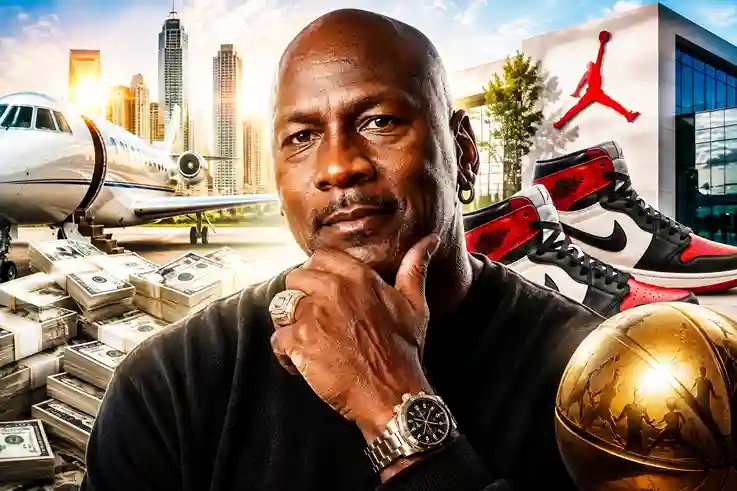
Michael Jordan’s net worth, his investments, and Jordan Brand revenue tell three completely different money stories — and only one of them describes cash that actually lands in his account. That distinction is the single most misunderstood fact in modern sports finance, and it explains almost everything about how a man who earned roughly $90 million playing basketball ended up on the Forbes Billionaires list at number 984.
Start with the number everyone quotes wrong. In its fiscal 2026 results, released for the year ended May 31, 2026, Nike disclosed that sales of Jordan Brand products were $7,034 million — just over $7 billion. Against total company revenue of $46.4 billion, Jordan Brand accounted for roughly 15.2% of everything Nike sold that year. It is one of the largest athlete-linked commercial platforms ever built.
None of that $7 billion belongs to Michael Jordan.
Nike owns Jordan Brand. Nike manufactures it, prices it, markets it, distributes it, and books its revenue. What Jordan owns is a contractual claim on a slice of it — a royalty whose exact rate, deduction structure, and payment formula Nike has never published in the filings reviewed here. Forbes currently estimates that Nike pays him “nearly $300 million per year.” A 2023 Forbes profile put his most recent annual Nike royalty at approximately $260 million. Both are estimates. Neither is an audited figure.
So the honest version of the story is this: the most famous number attached to Michael Jordan’s finances is not his number at all. It is Nike’s. And once you accept that, the far more interesting question opens up — where did the money that is his actually come from, and what did he do with it?
Where the Financial Story Really Started
The setup is almost absurd in hindsight. Jordan entered the NBA in 1984. Across fifteen seasons, six championships, and two retirements, Forbes’ current profile states his career salary totaled $90 million. A 2023 Forbes article reported a slightly different figure — $94 million in salary and signing bonuses combined.
That four-million-dollar gap is not a contradiction worth arguing about. It is a definitional difference: one figure counts salary, the other counts salary plus bonuses. But it is worth flagging early, because it establishes the ground rule for everything that follows. There is no consolidated personal financial statement for Michael Jordan. There is no holding-company filing. Every wealth number in circulation is either an estimate, a valuation of an asset he partly owns, or a revenue figure belonging to somebody else’s company.
The same caution applies to every celebrity fortune that is reconstructed from public records. Taylor Swift’s finances and investments show why ownership and control matter more than a headline estimate: a catalog, royalty stream, or private-company stake can be economically significant without appearing as transparent income on a public balance sheet. In Jordan’s case, the question is not simply how much money he earned; it is which assets he actually owned, which contracts gave him upside, and which valuations remain estimates.
Here is the more revealing detail buried in Forbes’ profile: Jordan was the NBA’s highest-paid player in only two of his fifteen seasons. For most of his career, the greatest basketball player alive was underpaid relative to his commercial value — the consequence of a rookie scale, a salary cap, and a collective bargaining structure that had no mechanism for pricing cultural phenomena.
The money was never going to come from the paycheck. Against that $90 million in career salary, Forbes estimates Jordan has earned $2.4 billion pre-tax from corporate partners including Nike, Hanes, and Gatorade. That is roughly 27 dollars of off-court income for every dollar of on-court income.
The interesting part is that the mechanism which produced that ratio was decided in 1984, before anyone knew it would work.
The First Money and the Decision That Compounded for Forty Years
According to Forbes, Jordan’s original Nike agreement was a five-year deal paying $500,000 per year plus royalties. Nike’s own product-history archive identifies the Air Jordan 1 as a 1985 release designed by Peter Moore.
Look closely at that structure. Five hundred thousand dollars a year was good money for a rookie endorsement in 1984, but it was not life-changing. The phrase that changed everything was plus royalties.
A conventional endorsement monetizes attention. A brand pays a fixed fee for the right to associate with an athlete, the athlete cashes the check, and the relationship ends when the contract does. A royalty monetizes product demand. It converts the athlete from a hired face into a participant in the economics of a product line — someone whose income grows when the business grows, and keeps arriving after the playing career ends.
Forbes attributed figures of roughly $70 million in Air Jordan sales after two months and $100 million by the end of the first year to 2023 research from Temple University. Those numbers should be treated as reported rather than independently confirmed — the underlying institutional page was not accessible during the review that produced the source research for this article. But the broader claim is not in dispute: Air Jordan blew past Nike’s internal projections almost immediately.
The second structural decision mattered just as much, and Jordan did not make it alone. Nike did not build Air Jordan as a signature shoe. It built it as a brand — a distinct commercial identity with its own logo, its own design language, and eventually its own division inside Nike. That choice is why Jordan Brand still generated over $7 billion in fiscal 2026, twenty-three years after Jordan’s final NBA game. A signature shoe dies with the signature. A brand does not.
This is the foundation of the entire Michael Jordan net worth story, and it is worth stating plainly: the most valuable financial decision of his life was made when he was twenty-one years old and involved accepting variable compensation instead of a bigger guaranteed check.
How the Income Machine Changed
Through the 1990s and 2000s, the Jordan commercial platform diversified by counterparty. Gatorade, Hanes, and others paid for access to the same symbolic capital that Nike had monetized first. The revenue base widened. The underlying dependency did not.
Every dollar of that income still rested on one asset: Michael Jordan’s personal reputation and continued cultural relevance. He owned nothing. He operated nothing. He was, in economic terms, an extraordinarily well-compensated licensor with no equity.
That changed in 2006.
An official Hornets-era release described Jordan becoming a part owner of the Charlotte Bobcats and the largest individual owner after Bob Johnson. It was a minority position, and it did not transform his balance sheet. What it did was change his category. For the first time, Jordan was on the capital side of a sports business rather than the talent side.
Four years later, he went all the way. In March 2010, the NBA Board of Governors unanimously approved Jordan’s acquisition of a controlling interest in the Charlotte Bobcats. The NBA’s own later account described the 2010 purchase as approximately $275 million.
And this is where the financial story gets genuinely interesting — because by almost every basketball metric, the investment was a disaster.
The Charlotte Hornets Sale: A Bad Team and a Spectacular Trade
The NBA reported that Charlotte went 423–600 during Jordan’s tenure as majority owner. The franchise did not win a single playoff series in those thirteen years. As of the league’s 2023 report, it had missed the postseason for seven consecutive seasons.
In 2023, the NBA approved the sale of Jordan’s majority stake to a group led by Gabe Plotkin and Rick Schnall. The reported price valued the franchise at approximately $3 billion. Jordan retained a minority interest.
Run the headline arithmetic: $275 million to roughly $3 billion is a multiple of about 10.9 times over thirteen years, which implies an annualized valuation growth rate of approximately 20.2%. That is a remarkable return on a team that never won a playoff series.
That distinction is not unique to sports-team ownership. The difference between a commercial gross and a personal fortune is equally important when analyzing a superstar’s touring business: the amount paid by customers is only the top of a much longer chain that includes promoters, venues, production companies, employees, agents, taxes, and other counterparties. A franchise valuation and a concert gross are both useful measures of scale, but neither one tells you what the individual owner or performer ultimately kept.
But that number needs three serious qualifications, and the sources are unusually candid about all three.
First, it is not Jordan’s return. It is the franchise’s valuation change. The public record does not establish what percentage he bought, what he paid at each stage, how much debt was involved, whether he made capital contributions along the way, what the operating losses were, what he paid in taxes and transaction fees, or what the retained minority stake is worth. A franchise valuation can rise while an owner’s actual cash return is chewed up by capital calls and operating deficits. The 10.9x figure is a valuation bridge, not a personal profit.
Second, the multiple itself is contested. Forbes described the 2023 transaction as a sale at a $3 billion valuation, noted that the franchise had been valued at roughly $1.7 billion in 2022, and separately characterized the sale price as nearly seventeen times the franchise’s estimated value when Jordan became principal owner in 2010. Seventeen times and 10.9 times cannot both describe the same comparison. The gap comes from using different baselines — a media valuation estimate versus a reported transaction price. Neither is wrong; they are measuring different things. Which is precisely the problem with celebrity finance reporting.
Third, and most importantly: the Charlotte Hornets sale proves something uncomfortable about sports economics. Franchise value in the modern NBA is driven by scarcity, national media rights, revenue sharing, and the willingness of billionaires to pay for entry into a thirty-member club. On-court performance is close to irrelevant to that pricing. Jordan made an enormous amount of money on an asset he was, by conventional measures, not very good at running.
The same distribution problem appears at the event level. Our Super Bowl LX revenue analysis follows the money through advertising, tickets, hospitality, local spending, venues, organizers, and surrounding businesses—showing why a large sports-related economic figure rarely identifies a single winner. The Hornets case is the ownership version of that lesson: the league, media-rights market, franchise scarcity, and buyer demand can increase the value of the asset even when the team’s on-court results remain disappointing.
That is the turning point that reshaped his wealth profile. Forbes placed his net worth at $3 billion in 2023, making him the first professional athlete on the Forbes 400. Not because of Nike. Because of a losing basketball team in Charlotte.
The Michael Jordan Investments That Followed the Pattern
Once the ownership logic clicked, Jordan’s investment behavior became remarkably consistent. Nearly every documented position sits in the same neighborhood: businesses where sports culture, data, media, and consumer aspiration reinforce one another.
Sportradar. ESPN reported in 2015 that Jordan had invested in the Switzerland-based sports data company. In 2021, Sportradar announced he had increased his investment and become a special adviser to its board, focused on U.S. market development, product, and marketing. Critically, Sportradar’s Form F-1 registration statement — a regulatory filing, not a press release — disclosed that notable sports-industry investors including Ted Leonsis, Mark Cuban, and Michael Jordan each held a less-than-5% minority interest.
That “less than 5%” is one of the few hard ownership ceilings in Jordan’s entire private portfolio. It is also frustratingly wide. Bloomberg noted at the time of the IPO that a sub-5% stake could have been worth as much as $350 million — an illustration of the ceiling, not a measurement of what Jordan actually held. His exact percentage, cost basis, and subsequent trading activity are not public.
DraftKings. In September 2020, DraftKings announced that Jordan would become a special adviser to the board and receive an equity interest in exchange for strategic advice on product development, marketing, and other initiatives. An SEC exhibit filed the same month independently confirms the appointment. What no public document establishes is the number of shares, the class, the vesting schedule, the strike or purchase price, or whether he still holds any of it. DraftKings is a verified historical equity relationship with an unquantified current value.
Miami Marlins. ESPN reported in 2017 that Jordan joined the Bruce Sherman–Derek Jeter group acquiring the Marlins for a reported $1.2 billion, and that his business manager confirmed he remained part of the investment team as a minority owner. Reporting on the ownership structure indicates Sherman held the largest position. Jordan’s percentage, his contribution, any subsequent dilution, and his current status are not established by the reviewed record. This is the weakest-documented major position in the portfolio.
Cincoro Tequila. Cincoro’s official history says five NBA owners met in July 2016, bonded over tequila, and built a brand: Emilia Fazzalari and Wyc Grousbeck of the Celtics, Jeanie Buss of the Lakers, Wes Edens of the Bucks, and Jordan. The brand launched in 2019 and has since added investors including Derek Jeter, Serena Williams, and Michael Strahan. Cincoro is a genuinely different play from anything else in the portfolio — not a Jordan-branded athletic product, but a premium consumer good built on a founder network and a luxury position. Jordan’s ownership percentage, capital contribution, and any distributions are not disclosed anywhere in the public record.
23XI Racing. Toyota’s 2020 announcement described 23XI as co-owned by Jordan and driver Denny Hamlin, debuting at the 2021 Daytona 500 with Bubba Wallace, with Toyota Racing Development supplying engines and technical support. The team’s own materials identify Jordan, Hamlin, and Curtis Polk as founders and trace the growth from one car to a two-car operation, playoff appearances, and a new Airspeed facility in Huntersville, North Carolina.
23XI is not an endorsement. It is an operating business with payroll, facilities, sponsors, and a competitive product. It is also the position that generated the most dramatic chapter in the recent Michael Jordan investments story.
The Fight That Showed What Sports Ownership Actually Costs
In October 2024, 23XI Racing and Front Row Motorsports sued NASCAR and CEO Jim France, alleging anticompetitive conduct involving racetracks, exclusivity arrangements, parts, cars, and the charter system that governs which teams have guaranteed entry to races. Those were allegations, not findings.
The case went to trial. On December 11, 2025 — nine days in — NASCAR, 23XI, and Front Row announced a settlement. The joint statement said financial terms were confidential and that NASCAR would issue amendments including a form of “evergreen” charters subject to mutual agreement. Reporting on the resolution indicated the teams’ charters were returned for the 2026 season. During the trial, an economist testifying for the plaintiffs had put damages at $364.7 million; that was expert testimony offered in litigation, not an awarded amount, and the actual settlement figure remains undisclosed.
Strip away the racing specifics and the lesson is stark. Jordan is one of the most commercially powerful figures in sports, with capital, lawyers, and enormous public sympathy. He still spent more than a year in federal court fighting over whether his team had a durable right to participate in the sport it competed in. Brand strength does not substitute for contractual control. That is not a lesson most celebrity investment coverage ever gets around to.
What the $7 Billion Number Is Hiding
Now return to Nike, because the fiscal 2026 disclosure contains something the headline figures obscure.
Jordan Brand revenue was $7,034 million in fiscal 2026, down from $7,270 million in fiscal 2025 — a decline of $236 million, or about 3.2% reported, and 5% on a currency-neutral basis. That looks like a modest wobble in a very large business.
But Nike’s annual filing discloses a third year. Jordan Brand products generated $8,701 million in fiscal 2024.
From fiscal 2024 to fiscal 2026, Jordan Brand revenue fell by roughly $1.67 billion — a decline of approximately 19% in two years. That is not a wobble. That is a meaningful contraction in the single largest engine of the Michael Jordan money machine, occurring during a period when Nike overall was executing a broad reset under a new chief executive and deliberately pulling back on some classic-footwear volume.
Does that mean Jordan’s royalty income fell 19%? Nobody outside Nike and Jordan’s representatives can say. The royalty rate, the revenue base it applies to, minimum guarantees, and any floor provisions are not public. Widely repeated claims of a “five percent royalty” do not appear in any primary source reviewed. It is not valid to multiply $7.034 billion by an assumed rate and call the result his income.
What can be said is directional and important: the asset most responsible for Jordan’s recurring cash flow is shrinking, not growing, and Forbes’ own estimate of his annual Nike payment has moved from approximately $260 million in 2023 to “nearly $300 million” currently — figures that point the opposite direction from the brand’s revenue trend. Both cannot be simply extrapolated. At least one of them is doing something more complicated than tracking sales.
The Assets That Don’t Actually Earn
Not everything in the portfolio is an investment, and the honest accounting says so.
The Grove XXIII, Jordan’s private golf course in Hobe Sound, Florida, was designed by Bobby Weed Golf Design on a former citrus grove adjacent to Atlantic Ridge State Park. It is real, it is documented, and it is frequently listed in “Michael Jordan investments” roundups.
There is no public evidence that it generates a return. Construction cost, operating cost, membership revenue, and market value are all unestablished. Its economic function appears to be personal use, relationship-building, and brand signaling — which can be genuinely valuable, but is not the same as a profitable business. Counting it as an investment because it is expensive is exactly the kind of category error that inflates celebrity net worth coverage.
What the Public Story Doesn’t Explain
Forbes displayed a real-time net worth estimate of $4.3 billion for Jordan as of late August 2026, placing him at number 984 on the 2026 Billionaires list, with wealth sourced primarily to the Charlotte Hornets and endorsements. That is $1.3 billion above the $3 billion estimate at the time of the 2023 Hornets sale.
It is tempting to read that as a 43% three-year gain. It is not. Forbes’ methodology incorporates changing private-asset valuations, public equity prices, franchise comparables, and periodic revisions to its own assumptions. A move in the estimate can reflect a change in Forbes’ model as easily as a change in Jordan’s holdings. It is a point-in-time reference, not a verified personal balance sheet.
Here is what the public record genuinely cannot answer, and it is a longer list than most coverage admits. It cannot say what percentage of the Hornets Jordan bought in 2010, what he netted from the 2023 sale after debt, taxes, and fees, or what his retained minority stake is worth. It cannot say what he invested in Sportradar or what he did with the position after the IPO. It cannot say how many DraftKings shares he received or whether he still owns them. It cannot say what he owns of Cincoro, the Marlins, or 23XI, or whether any of them have ever distributed cash to him. It cannot say what the NASCAR settlement paid.
What it can say is that the architecture is documented and coherent, and that the architecture is the actual asset.
The Turning Points, In Order
Six decisions carried disproportionate weight.
The 1984 Nike deal, because royalties instead of a fixed fee tied his income to a product system rather than to his own attention span. The 1985 Air Jordan 1 launch, because building a brand rather than a signature shoe created something that outlived the career. The 2010 move from minority holder to controlling owner of the Bobcats, because it put him on the equity side of a scarce, appreciating, league-protected asset. The 2015–2021 diversification into Sportradar, DraftKings, the Marlins, Cincoro, and 23XI, because it converted reputation into deal access across adjacent markets. The 2023 Hornets sale, because it turned thirteen years of paper appreciation into actual liquidity while preserving upside through a retained stake. And the 2024–2025 NASCAR litigation and settlement, because it revealed that operating ownership carries governance risk that no amount of fame neutralizes.
Notice what is not on that list: any single spectacular investment win. There is no early-stage tech moonshot, no crypto windfall, no venture fund home run. The Michael Jordan net worth story is not a story about picking winners. It is a story about repeatedly choosing structures — royalties over fees, equity over salary, ownership over association — and then waiting a very long time.
The Risk Nobody Puts in the Headline
The portfolio has a concentration problem that its apparent diversity conceals.
Basketball, baseball, stock car racing, sports data, sports betting, and premium tequila sound like six different industries. In risk terms, they are close to one. Nearly every position depends on sports attention, sponsorship budgets, regulated gaming, media rights cycles, and consumer discretionary spending — variables that move together. A prolonged contraction in sports sponsorship or a hostile shift in gambling regulation would touch several holdings simultaneously. Adjacent diversification is not the same as real diversification.
Layer on illiquidity. The retained Hornets stake, the Marlins position, 23XI, and Cincoro are all privately held, with no public market, no disclosed terms, and exit conditions controlled by partners and leagues. Value can be high on paper and difficult to convert.
And then there is the dependency that underwrites all of it. Jordan does not control Nike’s product decisions, NASCAR’s sanctioning framework, Toyota’s technical program, gaming regulators, or spirits distributors. He is a participant in systems other people run. The fiscal 2026 Jordan Brand numbers are the cleanest evidence: the most valuable financial relationship of his life just posted a second consecutive annual decline, and there is nothing he can do about it from the outside.
The Financial Lesson Worth Keeping
The seductive reading of this story is “buy a sports team.” That is the wrong lesson, and it is expensive to learn. The Hornets returned what they returned because of franchise scarcity, a national media rights boom, league revenue sharing, and a specific window in the pricing of major American sports assets. Repeating it requires access to a supply of teams that does not exist and capital most people will never assemble.
The transferable lesson is narrower and much more useful: negotiate to participate in the upside of what you help create, not just to be paid for showing up. Jordan’s fortune traces to a twenty-one-year-old taking $500,000 a year plus a percentage instead of a larger guaranteed number. Everything after that — the ownership stakes, the founder positions, the equity-for-advice arrangements — is the same instinct applied at increasing scale.
The second lesson is about honesty in valuation. A brand’s revenue is not your income. A franchise’s valuation is not your proceeds. A net worth estimate is not a bank balance. Treating those as interchangeable produces a picture that is flattering, widely repeated, and wrong. The most credible description of Jordan’s current position is not a number at all. It is a sentence: a multibillion-dollar, brand-led private investor and sports owner with substantial but incompletely disclosed liquid and illiquid assets.
The third lesson is the one the NASCAR fight taught. Contractual control matters as much as brand strength. Jordan’s most public financial conflict of the last five years was not about revenue or demand or consumer taste. It was about whether the rights underpinning his team’s enterprise value were durable. Every entrepreneur negotiating a distribution agreement, a licensing deal, or a platform relationship is negotiating a smaller version of the same question.
Michael Jordan spent fifteen years being the best in the world at something the market systematically underpaid him for. He spent the four decades since building claims on value that keep producing whether or not he shows up. The money never came from the game. It came from what he negotiated around it.
Financial Disclaimer: This article is provided for informational and educational purposes only. It is based on publicly available information and the cited sources, including official corporate disclosures, regulatory filings, league and company statements, and reputable financial journalism. It does not constitute financial, investment, legal, tax, or accounting advice, and it should not be relied upon as a recommendation to buy, sell, invest, or make any financial decision. Figures described as estimates are not audited and may change. Readers should consult qualified professionals before acting on any information contained here.
Sources
- NIKE, Inc., “NIKE, Inc. Reports Fiscal 2026 Fourth Quarter and Full Year Results,” June 2026 — https://about.nike.com/en/newsroom/releases/nike-inc-reports-fiscal-2026-fourth-quarter-and-full-year-results
- NIKE, Inc., Annual Report on Form 10-K for the fiscal year ended May 31, 2026 (Jordan Brand product sales of $7,034 million, $7,270 million and $8,701 million in fiscal 2026, 2025 and 2024), U.S. Securities and Exchange Commission — https://www.sec.gov/Archives/edgar/data/320187/000032018726000088/nke-20260531.htm
- Forbes, “Michael Jordan” profile (real-time net worth estimate; career salary and endorsement figures; Nike payment estimate) — https://www.forbes.com/profile/michael-jordan/
- Justin Birnbaum, “Michael Jordan Is Now Worth $3 Billion And Joins The Forbes 400,” Forbes, October 2, 2023 — https://www.forbes.com/sites/justinbirnbaum/2023/10/02/michael-jordan-joins-forbes-400-worth-3-billion/
- NBA Communications, “NBA Board of Governors approves sale of Bobcats to Michael Jordan,” March 2010
- NBA.com, “Reports: NBA Board of Governors approves Michael Jordan’s sale of Hornets,” 2023
- ESPN, “Sources: Michael Jordan agrees to sell Hornets stake for $3B,” June 2023 — https://www.espn.com/nba/story/_/id/37863644/sources-michael-jordan-finalizing-charlotte-hornets-sale
- Sportico, “Michael Jordan’s $3B Charlotte Hornets Sale Approved by NBA,” August 2023 — https://www.sportico.com/leagues/basketball/2023/michael-jordan-charlotte-hornets-sale-approved-by-nba-1234731858/
- ESPN, “Derek Jeter, Michael Jordan among group set to buy Marlins,” August 2017 — https://www.espn.com/mlb/story/_/id/20316050/miami-marlins-owner-jeffrey-loria-finalizing-agreement-sell-team-group-including-derek-jeter
- ESPN, “Michael Jordan, other NBA owners invest in sports data firm,” 2015 — https://www.espn.com/nba/story/_/id/13982704/michael-jordan-other-nba-owners-invest-sports-data-firm
- Sportradar Group AG, Form F-1 Registration Statement, U.S. Securities and Exchange Commission, 2021 — https://www.sec.gov/Archives/edgar/data/1836470/000119312521249269/d122309df1.htm
- Sportradar, “Michael Jordan Assumes Advisory Role with Sportradar,” 2021
- Bloomberg Opinion, “NBA’s Jordan, Cuban and Leonsis Go on a Betting Streak,” September 30, 2021 — https://www.bloomberg.com/opinion/articles/2021-09-30/nba-s-jordan-cuban-and-leonsis-go-on-a-betting-streak
- DraftKings Inc., “Michael Jordan Joins DraftKings as Special Advisor to the Board,” September 2020, and related SEC Exhibit 99.1
- Toyota Racing, “Toyota Announces Partnership with 23XI Racing,” 2020
- 23XI Racing, “23XI Racing and Front Row Motorsports Sue NASCAR and CEO Jim France,” October 2024
- NASCAR, “Joint Statement from NASCAR, 23XI Racing, Front Row,” December 11, 2025 — https://www.nascar.com/news-media/2025/12/11/nascar-lawsuit-settlement-23xi-front-row/
- ESPN, “NASCAR settles federal antitrust case filed by 2 teams,” December 2025 — https://www.espn.com/racing/nascar/story/_/id/47276734/nascar-settles-federal-antitrust-case-filed-2-teams
- Autoweek, “NASCAR Reaches Settlement with Teams, Grants Charters,” December 2025 — https://www.autoweek.com/racing/nascar/a69701519/nascar-23xi-front-row-reach-settlement/
- Cincoro Tequila, “Our Story” — https://www.cincoro.com/our-story/
- Cincoro Tequila, “Serena, Jeter, Strahan join Cincoro Tequila investors” — https://www.cincoro.com/cincoro-tequila-adds-serena-jeter-strahan-as-investors/
- Nike, “The History of the Air Jordan 1,” Department of Nike Archives
- Bobby Weed Golf Design, “The Grove XXIII” project page
- Charlotte Bobcats/Hornets, “Michael Jordan to Become Part Owner of the Charlotte Bobcats,” June 2006



Comments
Loading comments...