






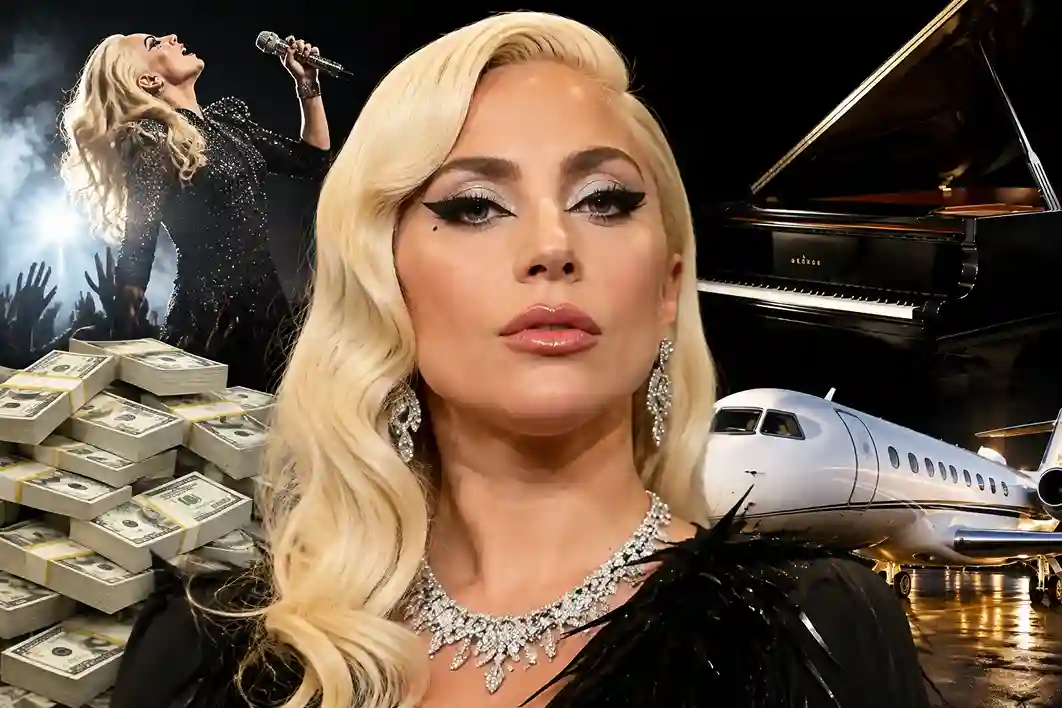
Lady Gaga Net Worth: The $1.17 Billion Touring Machine
Lady Gaga net worth is usually reduced to a single neat number. Look closer and the picture gets messier and far more revealing.
The public record shows Lady Gaga earnings that include $1.17 billion in tracked concert grosses, a beauty brand that completely reworked its distribution strategy, one film that returned more than twelve times its budget, and another that opened to a D CinemaScore. What it does not show is how much of any of that actually ends up in her pocket. That gap between measurable commercial scale and personal capture is the real story behind the Lady Gaga business empire.
The Receipt That Starts Everything
On April 13, 2026, at Madison Square Garden, Gaga closed The Mayhem Ball. Four days later, Pollstar published the accounting: $418.4 million in worldwide grosses from 1.95 million tickets sold across the official run from July 16, 2025 through April 13, 2026, plus the promotional concerts that followed the March 2025 album release. With that, her career gross since she first appeared on Pollstar’s charts in 2007 crossed $1.17 billion from 8.6 million tickets.
For context on how fast that last stretch arrived: Pollstar reported in September 2025 that Gaga had logged 357 headline reports since 2007, selling 7.1 million tickets for $870.8 million. In roughly seven months, one tour cycle added the final push past the billion-dollar line.
Here is the discipline that has to be applied immediately, because almost nobody applies it. A concert gross is what ticket buyers paid. Out of that comes the venue’s cut, the promoter’s share, production costs, crew payroll, transport, insurance, marketing, agency commissions, and taxes across a dozen jurisdictions. A stadium show in Singapore and an arena show in Phoenix have different cost structures, different tax treatments, and different deal shapes. Pollstar’s $418.4 million is a measurement of commercial demand, not a paycheck. Anyone who converts a touring gross directly into a claim about Lady Gaga net worth is performing arithmetic on a number that was never designed to answer that question.
The Number That Doesn’t Quite Add Up
Pollstar reported that The Mayhem Ball’s average ticket price was $214.30 across 92 reported concerts, and that this topped the $135.46 average of the 2022 Chromatica Ball “by 37%.”
Run the division yourself: $214.30 ÷ $135.46 − 1 = 58.2016%.
There is no reason to hide the discrepancy. It may reflect a different denominator, a revised data set, or a simple slip. But it is a useful reminder of how fragile even good specialist data can be once it gets copied into secondary coverage. The defensible statement is narrow: the two reported averages were $214.30 and $135.46, the source characterized the increase as 37%, and the displayed inputs imply 58.2016%.
That gap matters for a second reason. The Mayhem Ball’s box-office strength was, in Pollstar’s own framing, “centered primarily in the price of tickets.” Not exclusively volume. Not purely new audience. Price. And a higher average ticket price does not automatically mean more money reaches the artist dynamic pricing, platinum tiers, VIP packages, and fee structures distribute that increase across several parties before anyone counts it as earnings.
Rewind: Where the Money Machine Actually Started
Strip away the spectacle and the origin story is a distribution problem.
The Recording Academy’s account is straightforward: the stage name came from Queen’s “Radio Ga Ga,” Interscope executive Vincent Herbert took an interest, producer RedOne helped build the breakthrough record, and The Fame arrived in 2008 through Interscope imprint Cherrytree Records. The same account records that radio programmers initially resisted too racy, too dance-oriented, too underground, not marketable.
That resistance is the most economically revealing fact of the early period. A differentiated product with no shelf space is worth nothing. The response was not to soften the product. It was to make the entire presentation visuals, costume, performance, interviews, public appearances function as its own distribution system, bypassing the gatekeepers who could not place the music.
Forbes’ contemporaneous 2009 profile captured the model while it was still forming, reporting that The Fame was the best-selling debut album of 2009 at that point, that her tracks had passed 20 million downloads during the year, and that a 41-city Monster Ball tour was set to begin that November. Those numbers are historical and should not be blended with anything current. The strategic observation is what survives: the product was never only an audio file.
The economic loop that emerged is the actual foundation of Lady Gaga earnings across the next seventeen years. A song creates listeners. An unusual video or costume creates a second layer of attention around the song. That attention lowers the cost of discovering the next release and raises demand for the live show. The live show reinforces the identity that made the music distinctive in the first place. Each element subsidizes the acquisition cost of the others.
The First Real Licensing Bet Was a Perfume Bottle
In June 2012, Coty announced LADY GAGA FAME, released worldwide that September. The Coty release states the fragrance was issued through Gaga’s own Haus Laboratories in association with Coty, describes the black-to-clear liquid, the bottle developed with Nick Knight, and a campaign directed and photographed by Steven Klein.
Two things make this the real starting point of the Lady Gaga business empire as a commercial structure rather than a music career.
First, the Haus Laboratories name was in commercial use in 2012 seven years before the venture-backed cosmetics company most people associate with it. The brand-extension instinct was not a late-career pivot.
Second, it shows the standard celebrity-product architecture in its purest form. The artist supplies demand, identity, and creative direction. The established partner supplies manufacturing, distribution, regulatory competence, and retail relationships. It is fast, it is capital-light for the celebrity, and it produces near-term cash.
What it does not produce, typically, is ownership. And here the public record simply stops. No royalty rate, no advance, no unit sales, no margin, no profitability figure appears in the reviewed sources. Fame cannot honestly be labeled a success or a failure. It can only be labeled what it was: a documented experiment in converting a performance identity into a physical object using someone else’s infrastructure. The trade-off between licensing income now and equity later is real and visible in the strategy but her actual choice set and contract terms are not public, and pretending otherwise would be invention.
Why Touring Quietly Became the Core Business
If you want to understand where the money actually comes from, stop looking at streaming and look at Pollstar’s per-tour breakdown.
The Chromatica Ball in 2022 was her shortest headline tour at 20 performances and her only one staged exclusively in stadiums. It grossed $112.9 million, averaging $5.6 million per show and 41,690 tickets a night from 833,798 sold. The Mayhem Ball grossed nearly four times as much in total but averaged $4.5 million per concert and 21,220 tickets the mathematics of arenas versus stadiums, not a judgment about which cycle was stronger.
The ticket-price trajectory across her career is its own story. The Born This Way Ball averaged $103 per ticket in 2012–2013. The Joanne World Tour averaged $112.19 in 2017–2018. Chromatica hit $135.46. Mayhem reached $214.30. Some of that is market-wide live-entertainment inflation. Some is premium inventory. None of it is proof of what she nets.
The Mayhem cycle also demonstrated something valuable about geography. Two Mexico City shows at Estadio GNP Seguros sold 118,676 tickets for $15.7 million. Four Singapore National Stadium concerts drew 192,807 fans for $40.8 million the highest ticket count of any stadium on the run. And the free Copacabana Beach concert in Rio de Janeiro appears nowhere in the tallies, because no tickets were sold. That single omission is a neat illustration of the limits of box-office data: one of the most visible cultural events of the cycle contributed exactly zero to the measured gross while presumably contributing enormously to catalog streaming, brand value, and future demand in a major market.
Live-event headlines create the same accounting trap outside music. Our Super Bowl LX revenue analysis separates ticketing, advertising, hospitality and local spending to show why event revenue is not the same as profit.
Then there is Las Vegas. Pollstar reported in April 2022 that the Enigma and Jazz & Piano residencies had together produced $67 million from 228,580 tickets across 43 performances as of October 2021. Divide gross by tickets and you get $293.11 per ticket a figure that is not a face value, may include multiple ticket categories and fees, and is certainly not her income.
The residency’s strategic logic is stronger than its raw numbers. It concentrates demand geographically, reuses one production, cuts the logistical drag of a world tour, and creates a recurring premium product. But it is recurring revenue that is not passive income. She still has to show up and perform. The asset exists only for as long as the capability is delivered and it is exposed to one venue, one tourism cycle, and the continued willingness of high-spend customers to fly in.
Hollywood: One Windfall, One Warning
Film is where the portability of the brand got its cleanest test, in both directions.
Box Office Mojo lists A Star Is Born (2018) at $439,943,006 worldwide $215,333,122 domestic and $224,609,884 international against a listed $36 million budget. Divide one by the other and you get a gross-to-budget ratio of 12.22x. That is a descriptive ratio, not a profit multiple; it excludes marketing spend, exhibitor splits, distribution fees, financing costs, and talent compensation.
What made the project unusually valuable in structural terms was her multi-role participation. The Recording Academy describes her as lead actress, songwriter, and producer on the soundtrack, which debuted at No. 1 on the Billboard 200. In theory, that creates several simultaneous income channels from one project: acting compensation, recording income, songwriting and publishing, soundtrack participation, and downstream licensing. The Tiffany campaign a year later shows the tail: National Jeweler reported that the 2019 “Believe in Love” campaign used “Is That Alright?” from the film in an online spot promoting an engagement ring. One song, written for one movie, generating a commercial use in an entirely separate luxury category.
None of the terms are public. The honest conclusion is architectural, not numerical: the deal shape created more places for money to land than a standard acting role would.
Then came Joker: Folie à Deux. The Hollywood Reporter reported that the 2024 sequel opened to $37.8 million domestically, far below expectations, and drew a D CinemaScore the article attributing the collapse largely to poor word of mouth and weak exit scores.
This is the single clearest documented setback in the entire portfolio, and it needs to be assigned to the right level. It was a project-level failure of reception, not evidence about Gaga’s judgment or her personal finances. Star power can reliably manufacture awareness and opening-weekend curiosity. It cannot manufacture product-market fit for a finished film, because in film the product is the entire project. The financial lesson is not “don’t take creative risks.” It is that a diversified creator entering an adjacent category still absorbs risks generated by scripts, directors, marketing, and audience expectation variables she does not control.
The Ownership Layer: What Haus Labs Actually Proves
Haus Labs is the closest thing in the public record to Gaga owning something rather than renting her name to it.
Lightspeed Venture Partners announced its investment in July 2019. The investor’s own account names Gaga as chairwoman and Ben Jones as CEO, credits her with decisions on the color palette, brand video, company values, and executive hiring, and describes an Amazon-exclusive global retail launch timed to Prime Day.
Four assets were assembled: cultural attention and creative direction from Gaga, operating leadership from a professional CEO, capital and recruiting support from Lightspeed, and instant global distribution from Amazon. It was coherent. It was also, in hindsight, built on a category assumption that turned out to be wrong.
Beauty Independent reported that Haus Laboratories went live for pre-order on Amazon on July 15, 2019 and fully live that September and that nearly three years later the brand moved to Sephora, launching at 25 doors on June 9, 2022 before rolling out to over 500 across the US and Canada. In the same reporting, industry sources cited by Women’s Wear Daily put Haus Laboratories’ Amazon sales at $30 million and projected $45 million to $50 million in annual retail sales at Sephora. Those are third-party industry estimates, not company disclosures, and they should be read as directional rather than factual. One distribution consultant quoted in the piece noted that third-party scraping data showed slowing sales and heavy discounting on Amazon around the transition again, an outside inference rather than a financial statement.
The strategic diagnosis in that reporting is more reliable than the numbers, and it is the actual lesson: reach is not discovery. Amazon is an authority in convenience; Sephora is an authority in beauty. Makeup buyers want shade matching, sampling, texture, and social proof before purchase the exact things a search-bar-driven marketplace cannot supply. Distribution, in other words, is not logistics. It is part of the product.
Expansion continued after the reset. A company-distributed March 2024 release states that Haus Labs launched with Sephora across 12 EU countries following a UK launch, taking the brand to 15 countries worldwide as of March 26, 2024, with a 125-product assortment across nine categories. Words like “best-selling” and “viral” in that release are marketing, not audited performance. The current brand site lists face, lip, cheek, and eye ranges, promotes Triclone Skin Tech Foundation and Concealer, cites “patent-pending complexes,” and identifies the operating entity in its footer as HLB90067, Inc. Sephora’s brand page showed 20 results with sample prices around $32 for concealer, $28 for a lip lacquer, and $34 for a blush balm a premium-mass position that says nothing about margin or repeat purchase.
The funding picture never fully resolves. Lightspeed confirms an investment but discloses no amount, valuation, or ownership. Glossy characterized it as undisclosed. Gaingels maintains a public portfolio page with no economics on it. Forbes’ profile says Haus Laboratories raised more than $10 million in venture funds, without round detail, and describes the brand as Amazon-exclusive a description later evidence contradicts.
So: external venture funding is documented, the amount is not reconciled across accessible primary sources, and her personal stake cannot be calculated. Anyone quoting a precise Haus Labs ownership percentage or valuation is guessing.
The Money That Was Never Hers
The Born This Way Foundation belongs in this story precisely because it must be kept out of the personal column.
It is a separate 501(c)(3) with its own governance and reporting. ProPublica’s IRS-derived profile reports 2024 revenue of $6,032,453, expenses of $6,939,064, assets of $9,021,963, and liabilities of $188,452 figures the foundation’s own Form 990 matches. On that basis expenses exceeded revenue by $906,611, or 15.03% of revenue. The audited GAAP statements for the same year present total support and revenue of $8,890,067 and expenses of $8,408,782 while agreeing on assets, liabilities, and net assets. Two legitimate presentations, different bases, and no reason to average them into a single misleading number.
The 2020 One World: Together at Home broadcast is the other public-purpose data point. The World Health Organization announced the global special as curated in collaboration with Lady Gaga in support of health workers and the COVID-19 Solidarity Response Fund; Global Citizen states the initiative announced $127 million in commitments and that funding reached 140 local organizations. That $127 million was raised for beneficiaries. It was never revenue.
The category discipline matters for the same reason the touring discipline matters. Cultural reach can mobilize enormous capital without a cent of it being monetized privately and a portfolio analysis that quietly folds foundation revenue or fundraising totals into Lady Gaga earnings is not analysis, it is inflation.
What the $52 Million Estimate Really Tells You
Forbes lists an estimated $52 million in 2025 highest-paid-musician earnings, as of December 30, 2025, placing her at No. 15 on that year’s list.
Read it for what it is: a reputable outlet’s estimate of one year’s pre-tax earning power, produced without a published line-item breakdown across touring, recordings, film, beauty, and endorsements. It is not an income statement. It does not establish after-tax income, cash holdings, debt, private-company stakes, or anything resembling a verified Lady Gaga net worth.
That distinction between reported earnings and personal wealth also matters when reading other celebrity-finance stories. Our analysis of Taylor Swift’s finances and investments applies the same public-record discipline to a superstar whose catalog, touring and property headlines can easily be mistaken for a verified net worth.
It also sits oddly against the touring data. A tour cycle grossing $418.4 million across two calendar years coexisting with a $52 million annual earnings estimate is exactly the gap between top-line commercial scale and personal capture the space occupied by promoters, venues, production, crew, agents, and tax authorities. That gap is the whole point.
One small caution flag on sourcing: Pollstar refers to Mayhem as her sixth solo studio album while the Official Charts Company records it as her seventh, having landed at No. 1 on the UK Official Albums Chart on March 14, 2025 after a March 7 release. Reputable specialist sources disagree on a trivially checkable fact. Assume they can disagree on harder ones too.
Seven Turning Points, and What Each One Changed
The 2008 Interscope breakthrough built the audience platform everything else would draw on. The 2009 Monster Ball era welded music, imagery, media, and live demand into a single loop the moment the business stopped being a record and started being a system. The 2012 Coty fragrance monetized identity through someone else’s infrastructure and established that the brand could travel into physical goods. The same year, the Born This Way Foundation created an institution deliberately walled off from personal economics. In 2018, A Star Is Born and the Enigma residency launched almost simultaneously, adding film rights and recurring live income in one twelve-month stretch. In 2019, Haus Laboratories moved her from endorsement into equity and into operating risk. And from 2022 to 2024, the Sephora migration and European rollout showed the company treating its route to market as revisable rather than sacred.
The Mayhem cycle of 2025–2026 is the compounding of all of it: new music, chart validation, premium pricing, and the largest documented touring result of her career.
Not all of these were wins. Their significance is in what they reveal about the operating pattern partner first, build later, transfer skills across formats, keep live performance as the cash engine, and maintain a platform wide enough to survive one bad project.
The Risks Hiding Inside the Diversification
The portfolio is diversified across products but concentrated in one person. Music, film, beauty, and licensing all draw on the same underlying asset: her creative labor, reputation, and audience trust. A conventional brand can change spokespeople. A personal brand cannot separate itself from the person.
Execution risk multiplies with each new category, because each one demands capabilities she does not personally hold formulation and inventory in beauty, scripts and distribution in film, promoters and logistics in touring. Distribution risk is proven by the Amazon-to-Sephora reset. Project-selection risk is proven by Joker. And information risk is borne by everyone outside: nearly every relevant entity is private, so margins, ownership, and returns are unobservable. That is not evidence the economics are weak. It is evidence that confident public claims about them are unsupported.
The Lesson Worth Taking
What actually worked here was never a single investment. It was the repeated manufacture of new economic options from the same creative platform and the willingness to change the route to market when the first one underperformed, without changing the identity underneath.
What failed was the assumption that reputation guarantees fit. A D CinemaScore and a discounted Amazon storefront say the same thing in two different industries: attention gets you considered, execution gets you paid.
For anyone reading this as a template rather than a celebrity story, the transferable points are unglamorous. Adjacency beats reinvention, because A Star Is Born used skills she already had. Ownership beats licensing on upside but costs capital, inventory, and operational attention. Channel fit is a product decision, not a logistics decision. Recurring revenue that requires you to show up is not passive income. And gross is not net not in touring, not in film, not anywhere.
The most honest conclusion is also the least satisfying one. The evidence supports neither the “flawless business genius” framing nor the “celebrity vanity project” dismissal. It shows a performer who made consequential bets, converted attention into paid attendance at genuinely rare scale, absorbed documented setbacks, and kept adapting while the numbers that would actually settle the question of Lady Gaga net worth remain, by design, private.
Financial Disclaimer: This article is provided for informational and educational purposes only. It is based on publicly available information and the cited sources, and it does not constitute financial, investment, legal, tax, or accounting advice. Figures described as estimates or reported by third parties have not been independently audited. Nothing here should be relied upon as a recommendation to buy, sell, invest, or make any financial decision.
Sources
Bob Allen, Pollstar News, “Lady Gaga Tops $1 Billion In Career Grosses With ‘The Mayhem Ball’ Tour,” April 17, 2026 — https://news.pollstar.com/2026/04/17/lady-gaga-tops-1-billion-in-career-grosses-with-the-mayhem-ball-tour/
Pollstar News, “Lady Gaga Expands ‘Mayhem Ball Tour’ With North American Dates,” September 9, 2025 — https://news.pollstar.com/2025/09/09/lady-gaga-expands-mayhem-ball-tour-with-north-american-dates/
Bob Allen, Pollstar News, “Lady Gaga Debuts On Artist Power Index With Vegas Return,” April 22, 2022.
Box Office Mojo / IMDbPro, “A Star Is Born (2018)” — https://www.boxofficemojo.com/title/tt1517451/
Pamela McClintock, The Hollywood Reporter, “‘Joker Folie à Deux’ Bombs at Box Office, Slayed by D CinemaScore,” October 7, 2024 — https://www.hollywoodreporter.com/movies/movie-news/joker-folie-a-deux-box-office-d-cinemascore-1236025168/
Lightspeed Venture Partners, “Going Gaga for HAUS LABS,” July 11, 2019 — https://lsvp.com/stories/going-gaga-for-haus-labs/
Beauty Independent, “After Launching On Amazon, Lady Gaga’s Haus Labs Shifts To Sephora,” May 16, 2022 — https://www.beautyindependent.com/launching-amazon-lady-gaga-haus-labs-shifts-sephora-distribution/
MultiVu / Cision, “HAUS LABS BY LADY GAGA LAUNCHES IN EUROPE EXCLUSIVELY WITH SEPHORA, ACROSS 12 EU COUNTRIES,” March 26, 2024 — https://www.multivu.com/players/English/9257751-haus-labs-by-lady-gaga-launches-sephora-eu/
Emma Sandler, Glossy, “Lightspeed Venture’s Nicole Quinn on investing in Lady Gaga’s Haus Laboratories,” July 19, 2019.
Haus Labs by Lady Gaga, official brand site, accessed August 2026. Sephora, “Haus Labs by Lady Gaga” brand page, accessed August 2026. Gaingels, “Haus Laboratories” portfolio page, accessed August 2026.
Coty via PRNewswire, “Lady Gaga To Launch LADY GAGA FAME, The First Fragrance From Haus Laboratories,” June 14, 2012.
Michelle Graff, National Jeweler, “Tiffany Goes Gaga Again in New Ad Campaign,” April 2, 2019.
Daryn McElroy, Recording Academy / GRAMMY.com, “Run The World: How Lady Gaga Changed The Music Industry With Dance-Pop & Unapologetic Feminism,” March 29, 2023.
Dirk Smillie, Forbes, “The Business Of Lady Gaga,” November 25, 2009.
Forbes, “Lady Gaga” profile and “The Highest-Paid Musicians Of 2025,” last updated December 30, 2025 — https://www.forbes.com/profile/lady-gaga/
ProPublica, “Born This Way Foundation — Nonprofit Explorer” — https://projects.propublica.org/nonprofits/organizations/452752227
Born This Way Foundation, “Our Impact,” 2024 Form 990 (filed November 12, 2025), and 2024 Audited Financial Statements (audited June 30, 2025).
World Health Organization, “WHO and Global Citizen announce: ‘One World: Together at home’ Global Special,” April 6, 2020. Global Citizen, “One World: Together At Home.”
Official Charts Company, “MAYHEM — LADY GAGA.” Lady Gaga official website, “Year of MAYHEM” and “The MAYHEM Ball — Live.”





Comments
Loading comments...