






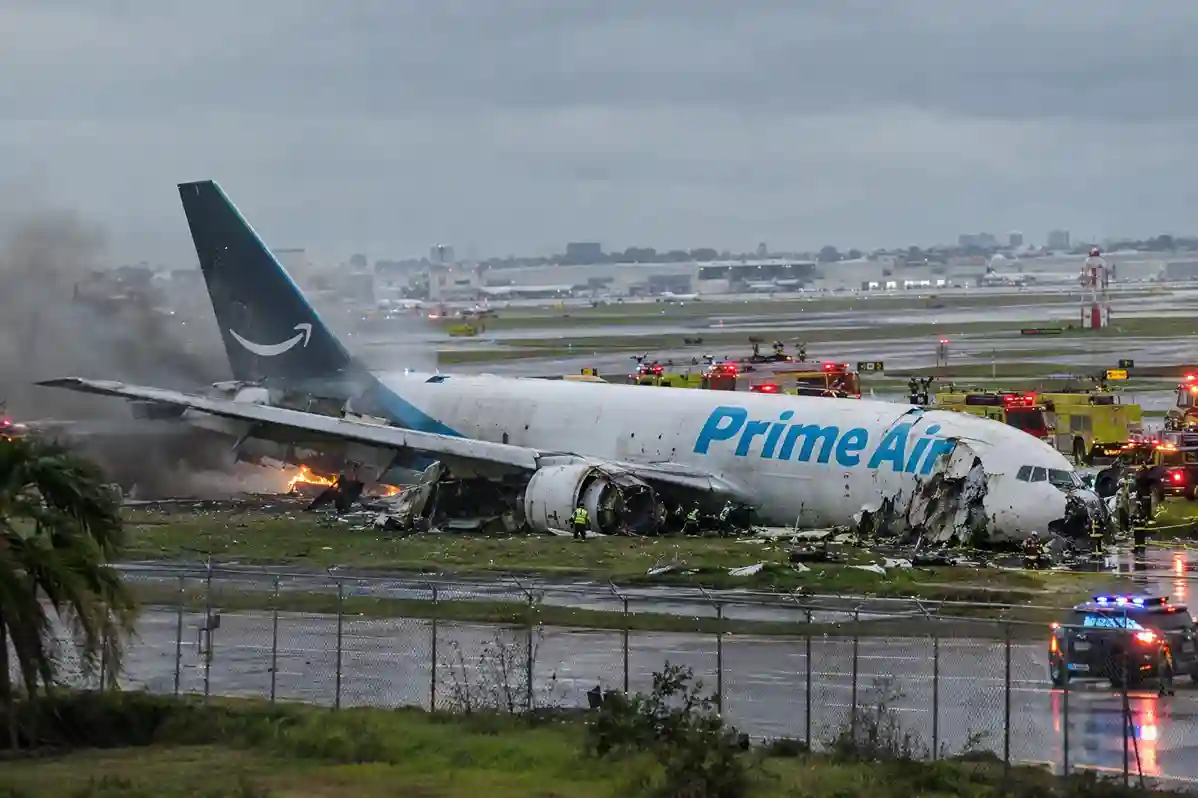
Amazon Air Crash in Miami: What the Evidence Shows and What It Means Financially
The Amazon Air crash in Miami killed five people and injured five others after a Boeing 767 cargo aircraft overran a runway at Miami International Airport. The Miami airport plane crash also shut down airport operations, stranded travelers, disrupted cargo flows, and raised a difficult question about Amazon financial impact: when an aircraft carries Amazon’s brand but is operated by another airline, where does the economic and legal responsibility sit?
The video contains additional information about the news event and its immediate aftermath. This article begins with the reported facts behind that news, then moves into the financial analysis: who absorbs the first losses, how Amazon’s partner-carrier model works, what may determine 21 Air liability, and why the available evidence does not yet justify a precise estimate of the total cost.
The public record is still preliminary. The National Transportation Safety Board has begun its investigation, but no final cause has been established. That distinction matters. A runway overrun can involve approach conditions, touchdown location, speed, braking, weather, aircraft systems, crew decisions, airport design, or a combination of factors. Early video, tracking data, and expert commentary can identify questions. They cannot by themselves determine negligence or assign a damages bill.
What happened at Miami International Airport
On September 6, 2026, an Amazon Prime Air cargo flight overran Runway 30 at Miami International Airport shortly before 2 p.m. local time. The aircraft crossed beyond the paved runway, struck vehicles, and caught fire. Reuters reported that the Boeing 767-300 freighter had departed from San Juan, Puerto Rico, and was operated by 21 Air on behalf of Amazon. Reuters’ initial report identified the aircraft as approximately 32 years old and previously used as a passenger aircraft before being converted to cargo configuration.
The BBC’s report on the investigation stated that five people died and five others were injured, with three of the injured people in critical condition at the time of reporting. The aircraft was a Boeing 767-300 operated by 21 Air, a North Carolina-based cargo airline. More than 200 firefighters responded, and several people had to be removed from vehicles or from beneath vehicles. 1
The initial public account did not immediately establish where every casualty was located. That changed after NTSB Chair Jennifer Homendy described the scene to Associated Press. According to Associated Press’ account of the NTSB briefing, the five people killed were inside a seven-person van belonging to Professional Ocean Service Corp., an airline-cleaning contractor. The same report said the aircraft traveled about 1,300 feet beyond the paved surface and struck an SUV outside airport property.
Those details change the economic analysis. This was not only an aircraft accident involving a flight crew. It was also a ground-impact event involving airport-service workers, contractor operations, road access, vehicles, emergency responders, and businesses located next to the airport.
The first evidence points to questions, not a cause
FlightRadar24 identified the aircraft as registration N1997A, a Boeing 767-33A(ER)(BDSF) operated by 21 Air for Amazon Prime Air. Its technical tracking account reported that the flight departed San Juan at 15:42 UTC and touched down in Miami at 17:53 UTC. The service recorded the aircraft at 112 knots as it exited the usable runway area.
The same source recorded thunderstorms and gusting winds. The published meteorological observation showed wind from 190 degrees at 17 knots, gusting to 26 knots, with thunderstorms and cumulonimbus clouds. The data is relevant, but it is not a final causal finding. ADS-B tracking is not the same as flight-recorder data, and weather at the airport does not prove that weather caused the accident.
Associated Press reported that investigators were examining whether the plane touched down too far down the runway, whether speed and braking were appropriate, whether weather or wind contributed, and whether the aircraft had a mechanical problem. Aviation experts cited by the news agency also raised the question of whether a go-around should have been initiated. These are reasonable investigative questions. They are not findings of pilot error.
The NTSB’s work should eventually test several competing explanations:
•The aircraft may have touched down outside the normal landing zone, leaving insufficient runway to stop.
•Wind, thunderstorms, or a wind shift may have increased the landing challenge.
•A braking, tire, landing-gear, spoiler, reverse-thrust, or other aircraft-system issue may have contributed.
•Crew decision-making may become relevant if the approach was unstable or if a go-around was not attempted when conditions required one.
•Runway safety areas, fencing, road placement, navigational equipment, or airport-adjacent commercial activity may have affected the severity of the ground consequences.
The available record does not establish which of these explanations is correct. It also does not establish that only one explanation will survive the investigation.
The airport disruption was an economic event in its own right
The crash immediately affected more than the flight involved. Reuters reported that all airport flights were halted after the accident and resumed later that evening. CBS News Miami reported the following day that the ground stop had been lifted, two of MIA’s four runways had reopened, and delays and cancellations were still increasing.
Passengers reported being unable to find replacement flights until later in the week. Some slept at the airport after nearby hotels filled. Airlines had to rebook travelers, waive or adjust fees, provide customer support, move crews and aircraft, and recover schedules. Travelers incurred hotel, meal, missed-work, and missed-connection costs. Not every inconvenience will produce a legally recoverable claim, but that does not make the economic loss imaginary.
The airport’s freight role also matters. Reuters cited Miami airport figures of roughly 3.5 million metric tons of freight and 55.3 million passengers in the referenced prior period. MIA is a major gateway for trade with Latin America. A temporary runway closure can therefore affect cargo connections, truck appointments, warehouse schedules, aircraft rotations, and delivery promises even when the physical accident is localized.
The effect is not simply proportional to the hours of closure. Hub operations are scheduled in waves. A disruption at one point can cause missed connections and later delays across a network. That is why a single runway accident can impose costs on airlines and passengers who were not involved in the original flight.
The distinction between direct spending, indirect activity, induced effects, and net benefit is also the central caution in Michael’s Take’s analysis of the Super Bowl’s economic impact. The comparison is not exact, but the analytical lesson transfers: headline activity is not the same as money retained after costs.
Amazon Air is a commercial network, not simply an Amazon-operated airline
The most important fact for the financial analysis appears on Amazon Air Cargo’s official website: “All flights are operated by our direct air carrier partners,” including ATI, ABX, 21 Air, Sun Country, Hawaiian Airlines, Cargojet, ASL, and Quickjet.
That statement describes a partner-carrier model. Amazon organizes demand, logistics, network requirements, and customer expectations. Direct air carriers provide regulated aircraft operations through their own aviation systems, crews, and operational authority. The precise allocation of risk depends on contracts and actual control, not on branding alone.
Amazon’s 2025 Form 10-K filed with the Securities and Exchange Commission describes a broader fulfillment system that includes networks operated by Amazon, co-sourced arrangements, and outsourced arrangements. The filing also says that cost of sales includes inbound and outbound shipping costs, including transportation costs where Amazon is the transportation service provider.
This model can create economic value in several ways. It can provide Amazon with more control over delivery timing, help position inventory closer to customers, reduce dependence on external parcel networks, and connect air capacity to fulfillment-center demand. It also creates fixed and semi-fixed costs: carrier contracts, aircraft capacity, fuel, maintenance, airport handling, technology, safety oversight, insurance, and contingency planning.
The model’s central trade-off is therefore clear. Amazon can gain flexibility without operating every aircraft directly. But it must manage the risk that operational failures occur inside a partner’s regulated system while the public associates the aircraft with Amazon.
That same distinction between revenue, operating cost, and actual profit is central to Michael’s Take’s analysis of Google’s business model, where record revenue and reported earnings still have to be tested against cash spending and capital intensity.
Who bears the economic harm first?
The most severe losses fall on the victims and their families, not on the corporate balance sheets. The five families of the deceased may face funeral expenses, loss of income, loss of household services, and loss of companionship. The five injured people may face emergency care, hospitalization, rehabilitation, lost wages, reduced future earning capacity, and long-term care.
The public record does not provide enough information about the victims’ ages, incomes, dependents, employment status, or medical outcomes to calculate a credible aggregate damages estimate. Any article that inserts a single dollar figure without those inputs would manufacture precision.
The cleaning contractor and its workforce are also exposed. Professional Ocean Service Corp. may face vehicle loss, employee-support expenses, workers’ compensation administration, business interruption, insurance claims, and potential third-party litigation. Workers’ compensation may provide an initial statutory path for employee injuries, but it does not necessarily resolve every issue involving employers, aircraft operators, property owners, insurers, or other parties.
The airport and surrounding businesses bear a different type of loss. They may face access restrictions, damaged equipment, cleanup, lost throughput, security changes, and reputational concerns. Airlines bear schedule-recovery costs. Passengers bear time and out-of-pocket costs. Cargo owners may face delays or damaged shipments.
Amazon and 21 Air face another layer: aircraft damage or loss, cargo handling, investigation support, legal defense, insurance deductibles, possible liability payments, contract disputes, regulatory attention, and reputational exposure. These costs are potentially material to the affected entities, but their total cannot yet be calculated from public information.
What 21 Air liability could mean—and what it does not mean yet
The phrase 21 Air liability should be treated as an open legal issue, not as a conclusion. 21 Air was identified as the operator, and the company’s official statement says it is cooperating with the NTSB, the Federal Aviation Administration, and local authorities. The company also established a family-assistance line.
Potential claims involving an operator could examine crew qualifications, training, dispatch, operational procedures, maintenance, weather decisions, stabilized-approach rules, braking performance, and emergency response. None of those categories proves that 21 Air breached a duty.
Amazon’s role also requires careful analysis. The fact that Amazon’s brand appeared on the aircraft does not automatically make Amazon responsible for every operational act by 21 Air. At the same time, outsourcing operation does not automatically eliminate Amazon’s potential exposure. Relevant questions may include:
•Did Amazon select and monitor 21 Air under defined safety standards?
•Did Amazon control routing, schedule pressure, cargo loading, or operational decisions?
•What did the contract say about indemnity, insurance, incident reporting, and safety audits?
•Did Amazon make representations to shippers, workers, or third parties about the service?
•Were contractor access and ground-safety arrangements governed by Amazon, the airport, the cleaning company, or another entity?
The actual contracts were not available in the sources reviewed. Therefore, the allocation of responsibility remains uncertain.
The airport and public authorities may also become relevant if investigators identify a problem involving runway design, safety areas, markings, fencing, navigational equipment, emergency access, or the placement of roads and parking areas. Associated Press reported that Miami appeared to comply with the applicable requirement for a safety area and was not required to have an engineered-material arresting system under that standard. Regulatory compliance, however, is not identical to a complete answer about whether a design decision contributed to the severity of the event.
The financial impact on Amazon is likely limited at the corporate scale—but that is not the same as trivial
Amazon reported approximately $717 billion in net sales for 2025, up 12% from the prior year, and approximately $109.1 billion in fulfillment expense, up 11%, in its 2025 Form 10-K. Those figures establish the company’s scale. They do not reveal the economics of this flight, the value of the cargo, the aircraft’s insured value, the cost of the carrier contract, or the expected accident reserve.
A useful comparison must separate corporate scale from household impact. If an aircraft loss were, for example, a single-digit or low-double-digit million-dollar event, it could be immaterial to Amazon’s consolidated revenue while still being devastating to the families involved. But the public record does not provide a defensible number for the aircraft loss, claims, or total legal exposure, so this article does not invent one.
The more meaningful Amazon financial impact may come through several channels:
Direct accident costs
These may include aircraft and cargo losses, emergency response, claims administration, legal expenses, family assistance, insurance deductibles, and damaged property. Some costs may be reimbursed by insurance or passed through contractual arrangements. The existence and amount of those recoveries are not public.
Network and service costs
If Amazon temporarily reduces capacity from 21 Air or changes partner requirements, it may need to buy replacement capacity, reroute freight, use alternative carriers, or accept slower delivery. Those costs could be more significant than the aircraft itself if the disruption lasts.
Safety and oversight costs
Amazon may increase audits, training requirements, contractor controls, airport-risk reviews, data monitoring, or insurance coverage. Those expenditures could improve safety and reduce future losses, but they would raise the cost of the logistics system.
Reputational and demand effects
The aircraft carried Amazon branding, so public perception may attach the accident to Amazon even though 21 Air operated the aircraft. That could influence customer trust, employee sentiment, partner negotiations, and scrutiny of Amazon’s logistics practices. No reliable public evidence yet shows a measurable decline in Amazon demand or financial performance because of this event.
Disclosure and litigation risk
If claims become significant, Amazon or related entities may face disclosure obligations concerning contingencies, insurance, or material litigation. Whether a disclosure becomes material depends on the size and probability of losses, which cannot be determined on the current record.
The evidence therefore supports a measured conclusion: the direct financial effect is unlikely to threaten Amazon’s overall solvency or operating model, but the event may still impose meaningful localized, contractual, reputational, and governance costs.
Cargo plane accident economics: the hidden cost is not just the aircraft
The phrase “cargo plane accident economics” captures a broader point. The cost of an accident is a chain, not a line item.
| Cost category | Likely affected parties | What is known | What remains unknown |
| Human injury and death | Families, injured people, employers, insurers | Five deaths and five injuries reported | Individual damages and medical outcomes |
| Aircraft and cargo | 21 Air, Amazon, owner, insurers, cargo interests | Aircraft heavily damaged and fire reported | Aircraft value, cargo value, insurance recovery |
| Ground vehicles and equipment | Cleaning contractor, vehicle owners, airport businesses | Van and SUV damaged or destroyed | Ownership, replacement cost, business interruption |
| Airport operations | MIA, airlines, passengers, cargo customers | Ground stop and continuing delays reported | Total delay hours and aggregate economic loss |
| Legal and regulatory response | 21 Air, Amazon, airport, insurers | NTSB, FAA, and local authorities involved | Claims, reserves, settlements, findings |
| Network substitution | Amazon, partner carriers, shippers | Potentially relevant if capacity changes | Duration and price of replacement capacity |
| Reputation and governance | Amazon, 21 Air, airport | Brand association and public scrutiny | Measurable long-term effect |
The table shows why headline estimates can mislead. The value of an aircraft is observable in principle, but the value of lost time, disrupted cargo, family income, and reputation is distributed across many parties and time periods. Some costs are paid immediately. Others emerge through litigation or operational changes months later.
What the numbers can and cannot tell us
The known numbers are useful but limited:
•Five people were reported killed.
•Five people were reported injured, including three in critical condition in early reporting.
•The aircraft exited the usable runway at a reported 112 knots.
•The aircraft traveled approximately 1,300 feet beyond the paved surface, according to AP’s account of the NTSB chair’s description.
•Amazon reported approximately $717 billion in 2025 net sales and $109.1 billion in fulfillment expense.
•MIA handled roughly 3.5 million metric tons of freight and 55.3 million passengers in the referenced period, according to Reuters’ reporting of airport figures.
None of those numbers alone measures the total economic damage. It would be wrong to multiply the number of victims by an assumed average settlement, treat annual airport traffic as the value of one day’s disruption, or use Amazon’s fulfillment expense as a proxy for Amazon Air’s profit. Revenue is not profit. Fulfillment expense is not air-cargo expense.
Tracking speed is not recorder-confirmed performance. A corporate total is not a household balance sheet. Michael’s Take makes a related distinction in its analysis of YouTube revenue and monetization: a large disclosed revenue line does not automatically reveal standalone profit, cash generation, or return on the underlying investment.
This is the main financial discipline the case requires: keep the inputs in their proper categories.
The investigation’s next decisive evidence
The most important future evidence will likely include the flight-data recorder, cockpit-voice recorder, aircraft maintenance and inspection records, crew training and qualification records, dispatch materials, weather and runway data, air-traffic-control communications, aircraft-loading information, runway measurements, video, debris analysis, and the contracts defining the relationships among Amazon, 21 Air, the airport, and contractors.
The NTSB may also examine organizational factors. A final report often asks not only what happened during the last few minutes but also what conditions made the event more likely or made the consequences worse. That can include training, scheduling, safety-management systems, procedures, equipment, and airport surroundings.
Until those materials are available, the most defensible language is conditional: investigators are examining whether the aircraft landed too far down the runway, whether weather or wind affected the landing, whether aircraft systems worked properly, and whether crew or organizational decisions contributed. The public record does not yet prove any of those explanations.
What readers should learn from this case
The first lesson is that a visible brand and a legal operator are not always the same entity. Amazon’s commercial network relies on direct air-carrier partners. That structure can be efficient, but it requires clear oversight and contractual accountability.
The second lesson is that the largest financial loss may not sit on the largest balance sheet. Amazon can potentially absorb a direct aircraft loss more easily than a household can absorb the death of a wage earner or the long-term cost of a critical injury.
The third lesson is that airport safety is also a ground-business issue. Cleaning crews, warehouse workers, parking areas, access roads, and nearby businesses can be exposed to aviation risk even when they never board an aircraft.
The fourth lesson is that early news is not the same as final explanation. A video may show the aircraft’s path and the scale of the fire. Tracking data may show speed. Weather data may show gusts and thunderstorms. None of those sources, standing alone, determines legal responsibility.
The practical takeaway for analysts is to watch for four developments: the NTSB’s factual findings, disclosures about insurance and litigation, any change in Amazon’s carrier network, and evidence of revised safety or contractor-management standards. Those developments will tell us more about the long-term financial effect than the aircraft’s brand or the first day’s headlines.
The same revenue-versus-cash discipline appears in Michael’s Take’s analysis of Meta’s revenue and free-cash-flow pressure: scale can make a company financially resilient while still exposing it to costly strategic and capital-allocation decisions.
Financial and Legal Disclaimer: This article is provided for educational and informational purposes only. It is not financial, investment, tax, legal, career, aviation-safety, insurance, or other professional advice. The analysis is based on publicly available information believed to be reliable at the time of publication, but data may change and no guarantee is made as to its accuracy or completeness. Readers should conduct their own due diligence and consult a qualified professional before making decisions involving money, employment, contracts, insurance claims, litigation, or investments.
Sources and Methodology
This article uses public, checkable information available as of September 7, 2026. It prioritizes official corporate statements and filings, then uses reputable reporting and specialist tracking data to reconstruct the event and its early economic consequences. Contextual links are placed next to the claims they support.
•Amazon Air Cargo official website: supports the description of Amazon’s direct air-carrier partner model.
•Amazon 2025 Form 10-K at the SEC: supports consolidated sales, fulfillment expense, shipping-cost disclosures, and the broader fulfillment structure.
•21 Air official statement: supports the company’s public statement of cooperation and family-assistance response.
•Reuters reporting on the Miami accident: supports the aircraft, operator, route, casualty, airport, and MIA freight-context reporting.
•BBC reporting on the investigation: supports the early casualty count, operator, emergency response, tracking-speed report, and passenger disruption.
•Associated Press reporting on the NTSB briefing: supports the van, contractor, runway-distance, and early investigative context.
•FlightRadar24 technical account: supports aircraft registration, flight times, tracking-derived speed, and weather observations.
•CBS News Miami operational update: supports the continuing delays, cancellations, runway reopening, and passenger impacts.





Comments
Loading comments...