





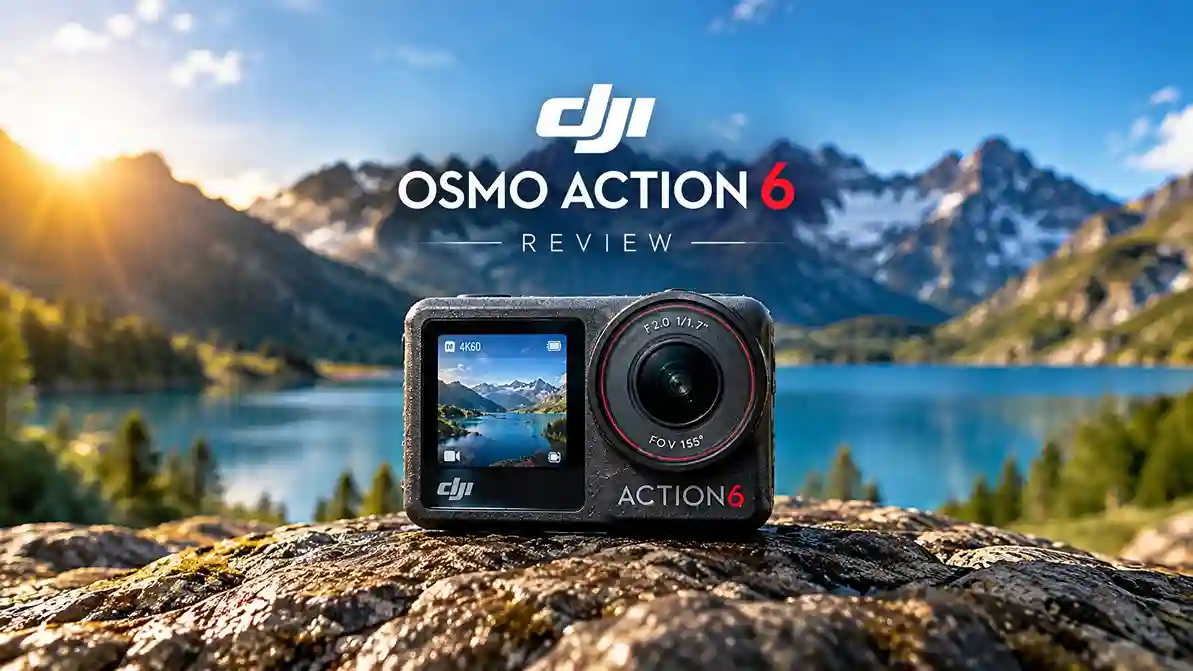
DJI Osmo Action 6 Review: Does the Creator-Focused Upgrade Earn Its Premium?
The DJI Osmo Action 6 review question is not whether DJI built a capable action camera. It did. The harder question is whether the square sensor, variable aperture, and creator-oriented workflow justify paying more than an older Action 5 Pro or choosing DJI over GoPro and Insta360. The answer depends less on headline resolution than on how the footage will be captured, reframed, edited, and paid for.
The DJI Osmo Action 6 vs Action 5 Pro comparison is therefore more useful than a simple specification contest, while the best action camera for creators is not necessarily the camera with the largest number on the product page. The Action 6 is a specialized upgrade. It makes the strongest economic case for people who publish in both horizontal and vertical formats, shoot in changing light, or need one small camera to produce more than one usable composition. For ordinary daylight 4K recording, the case is weaker.
What stands out to me is the gap between the product’s marketing shorthand and its actual value mechanism. DJI’s official announcement describes a first-of-its-kind variable-aperture action camera, a 1/1.1-inch square sensor, 4K custom capture, 50GB of built-in storage, and a 4-hour battery claim. Those are real product decisions. But they do not all solve the same problem. The square sensor can reduce reframing risk. The aperture can manage incoming light. The 8K mode can provide cropping headroom. None of those benefits is universal, and none removes the compromises of a small fixed-focus action-camera system.
The same production-cost logic appears in Michael’s Take’s analysis of AI video generation pricing and the hidden economics of content production, where the headline feature is separated from the real cost of producing usable output.
This article examines what the public record supports, what independent users report, how the bundle economics work, and which buyer is most likely to recover the premium through a better workflow.
A product designed around flexibility rather than one spectacular specification
The Action 6’s central hardware change is a 1/1.1-inch CMOS sensor with a square geometry. DJI lists a native 4K Custom mode at 3,840 by 3,840 pixels, alongside conventional 16:9, 4:3, and 9:16 modes. That matters because a square capture can preserve a composition that is later cropped for a horizontal video, a vertical short, or both.
That is not the same as recording every format at the highest possible resolution. DJI’s own specification page restricts 8K to 16:9 at 24, 25, or 30 frames per second. The 8K mode also has narrower stabilization and field-of-view choices than the camera’s broader set of recording modes. DJI says that downloading and editing 8K footage in Mimo is currently supported only on iPhone 15 Pro models and later, with support for other devices subject to future updates.
This distinction changes the economic meaning of “8K.” For most owners, it is not a default delivery format. It is a reserve of pixels that can be used to crop, stabilize, or reframe while still exporting at 4K. That can be valuable for client work or a creator who cannot predict the final platform at the time of capture. It is much less valuable to someone who records a finished 16:9 clip, uploads it without heavy cropping, and watches it on a conventional screen.
The square mode may actually be more important than the 8K mode for the creator audience DJI is targeting. A vertical mount, a moving subject, or an unexpected change in platform can make the original framing wrong. A square capture gives the editor more room to choose later. That flexibility can reduce reshoots, but only when the creator really publishes across formats. A traveler filming family memories in standard 4K may never use it.
The second differentiator is the variable-aperture lens. DJI lists an aperture range from f/2.0 to f/4.0 and describes the wider setting as useful for low-light capture and the narrower settings as useful for brighter scenes and exposure control. In photographic terms, the aperture is the opening through which light enters the lens. A wider opening admits more light; a narrower opening admits less.
It is important not to overread the feature. A small action camera does not behave like a large interchangeable-lens camera. The physical sensor and lens combination limits the dramatic background blur that buyers may associate with a wide aperture. In a long-term review based on travel and YouTube use, Roman Fox found the aperture useful mainly for controlling light rather than creating a cinematic shallow depth of field. He also described the square recording mode as highly valuable for people producing both vertical and horizontal footage, while saying it was largely irrelevant for buyers who do not need those formats.
That is a more credible value proposition than the vague claim that variable aperture makes the camera “professional.” It gives the operator another exposure control. On a bright day, f/4.0 can reduce the amount of light without relying entirely on an external neutral-density filter. In dimmer conditions, f/2.0 can help the sensor collect more light. But it does not turn an action camera into a cinema camera, and many casual users will leave the camera in an automatic mode.
What DJI’s own specifications prove and what they do not
The official specification record is strong on capability. The camera weighs 149 grams and measures 72.8 by 47.2 by 33.1 millimeters. It includes three microphones, a microSD slot supporting cards up to 1TB, and 50GB of usable internal storage from 64GB of physical storage. It records 8K at up to 30 frames per second, 4K at up to 120 frames per second, and 1080p at up to 240 frames per second. It also supports RockSteady stabilization, HorizonBalancing, HorizonSteady, D-Log M, and subject-centering features.
The camera’s built-in storage is more than a convenience. It reduces the risk of turning up to an activity with no memory card. It does not eliminate the need for removable storage, however. High-resolution video fills space quickly, and the camera’s official list recommends U3/A2/V30 microSD cards. A buyer planning long trips or repeated 8K capture should treat a card as part of the system, not as an optional luxury.
DJI also claims up to 240 minutes of operating time in a controlled 1080p/24 test and a 4-hour battery headline in its product materials. The test condition matters. Battery life at 1080p/24 is not equivalent to battery life at 4K/120, 8K/30, high stabilization settings, cold temperatures, or repeated wireless transfers. The Action 5 Pro page uses the same 240-minute maximum operating-time figure while also describing specific cold-weather and recording conditions.
This is where a specification can be true and still mislead if the reader silently changes the conditions. A 4-hour claim tells the buyer something about endurance under a defined test. It does not tell the buyer how long the camera will last during a high-frame-rate ski run, a long 4K cycling session, or a winter shoot with the screen and wireless functions active.
Water resistance has a similar structure. DJI lists 20 meters without the Waterproof Case and 60 meters with it. The specification page says the battery and USB-C covers must be closed, the glass lens cover must be tightened, and the case is recommended for long-term underwater shooting or environments with high water impact. It also excludes hot springs, extreme underwater conditions, and corrosive or unknown liquids.
The reasonable conclusion is not that the camera is unsafe in water. It is that “20 meters waterproof” is a conditional operating capability, not insurance against every seal failure, impact, maintenance mistake, or use outside DJI’s stated conditions. A diver or surf user should budget for the case and the time required to inspect seals. A casual rain user may not need it.
The independent evidence is positive, but narrower than the marketing
Independent testing is useful because it shows which specifications become visible in actual workflows. Oscar Liang’s FPV-focused comparison of the Action 6 and GoPro HERO13 found that the DJI had an advantage in dynamic range and low-light performance, while the GoPro could retain more close-detail sharpness in bright scenes. He considered the Action 6’s 1:1 mode particularly useful for creators who want both horizontal and vertical footage.
That review also illustrates the cost of carrying the hardware. At roughly 150 grams, the Action 6 is a meaningful payload on a small FPV drone. Liang recommended at least a 3.5-inch drone to lift it comfortably and preferred a 5-inch or larger platform if the pilot wanted to avoid a major effect on flight performance. He also described the 8K mode as useful for cropping but not his default choice because it is limited to 30 frames per second, consumes more storage, and increases editing demands.
Those observations do not establish a universal laboratory ranking. They do show how the product’s advantages depend on the activity. A low-light FPV pilot may recover the premium through cleaner footage and flexible reframing. A pilot who prioritizes flight time may see the 149-gram body as a cost rather than a benefit. The same physical camera creates different value for different users.
This broader question—how technology products convert technical capability into economic value—is also central to Michael’s Take’s Tech, AI & Digital Markets coverage.
Fox’s long-term travel-and-YouTube review provides a second perspective. He reported no freezes, corrupted files, or unusual behavior in his use, but explicitly limited the scope of his evidence: the camera had not been subjected to extreme physical conditions beyond a brief snorkeling use. That is useful negative evidence, but it is not proof of system-wide reliability across all users, climates, water conditions, or firmware versions.
He also reported that the Action 6 is larger and heavier than the Action 5, that the built-in microphones are vulnerable to wind noise, and that effective fixed focus makes close-up footage less sharp. These are not fatal flaws. They are reminders that the product’s premium features coexist with ordinary action-camera limitations.
The evidence supports a modest conclusion: the Action 6 appears especially strong in mixed light and mixed-format production, but the public record does not prove a dramatic image-quality leap in every scene. Its most defensible upgrade story is workflow flexibility.
The price is only the beginning of the purchase
DJI’s November 2025 launch announcement listed the Action 6 Standard Combo at €379 and the Adventure Combo at €479. The €100 difference is approximately 26.4% of the Standard Combo price. The Adventure package adds two batteries, another quick-release adapter, another locking screw, a multifunctional battery case, and a 1.5-meter extension rod.
That is a useful calculation because bundle pricing is often treated as a simple discount. It is not automatically a discount. The extra €100 buys hardware only if the buyer needs those specific items. For a traveler who needs multi-day battery capacity, the Adventure Combo may be economically rational. For a user who will record short clips near a power source, it may be unnecessary capital tied up in accessories.
The Action 5 Pro provides a separate price anchor. DJI’s U.S. store lists the Standard Combo at $319 and the Adventure Combo at $419, although the captured page marks the configurations out of stock. The $100 difference is approximately 31.3% of the Standard Combo price. The older camera still offers a 1/1.3-inch sensor, 47GB of built-in storage, 240 minutes of maximum operating time, 20-meter caseless waterproofing, and direct DJI microphone connectivity.
These figures cannot be converted into a precise Action 6 premium without using a common currency, common region, and comparable stock status. They do establish the opportunity-cost problem. A buyer may be choosing between a newer camera with creator-focused features and an older camera whose core endurance, stabilization, waterproofing, storage, and audio ecosystem remain substantial.
The action camera total cost is higher than either headline price. The buyer may need a V30-rated microSD card, a waterproof case, extra batteries, a charging case, mounts, adhesive bases, wind protection, an external microphone, and possibly DJI Care Refresh. The official Action 6 announcement lists a separate waterproof case and multiple dedicated accessories, while DJI Care Refresh adds an optional replacement and protection service.
A practical cost model therefore looks like this:
| Cost layer | Why it matters | Who is most likely to need it |
| Camera and standard bundle | The initial capital outlay | Every buyer |
| microSD card | Needed for sustained high-resolution recording | Travelers, creators, frequent users |
| Extra batteries and charging case | Reduces downtime | Multi-day travelers and action-sports users |
| Waterproof Case | Extends the stated depth capability to 60 meters and adds protection in high-impact water | Divers and serious water-sports users |
| Mounts and adhesive bases | Connects the camera to helmets, bikes, vehicles, and body rigs | Action-sports users |
| Wind protection or external microphone | Addresses the practical risk of wind noise | Cyclists, motorcyclists, hikers, and vloggers |
| DJI Care Refresh | May reduce the financial impact of accidental damage, subject to terms | High-risk users |
The table is not a shopping list for every buyer. It is a warning against treating the lowest advertised camera price as the cost of a reliable system. A creator may already own compatible mounts. A diver may consider the case non-negotiable. A family traveler may need only a card and one spare battery.
The ecosystem is convenient, but it is not frictionless
The Action 6 is primarily a hardware purchase rather than a required subscription product. DJI’s launch materials emphasize the camera, batteries, cases, accessories, microphones, and optional protection plan. That is preferable for buyers who do not want a recurring cloud bill for basic recording.
The camera is nevertheless ecosystem-dependent. DJI’s support material says a new Osmo Action must be activated before use and gives a process that requires the DJI Mimo app, Bluetooth, Wi-Fi, and an internet-connected mobile device during activation. The app is also used for control, syncing, editing, and sharing. That creates a switching cost even when no monthly payment is required.
For many consumers, this is routine. For buyers working in restricted networks, organizations with strict device policies, or locations with weak connectivity, it is a practical ownership issue. The camera can record to removable storage, but first-use activation and some convenience features still depend on the broader DJI workflow.
DJI’s privacy policy adds another layer. The policy says DJI may collect account, contact, payment, location, device-related, and technical information in specified circumstances. It also says DJI does not automatically collect photos or videos without consent and affirmative action, but may collect and store content when users choose to upload it.
That does not prove abusive data practices, and it does not mean that every owner’s footage is automatically uploaded. It does mean the buyer should distinguish between local recording and connected services. A person who never uploads footage has a different exposure from a person who uses cloud or social-sharing functions. Privacy is therefore part of the product’s total cost—not a cash charge, but a condition of using the ecosystem.
The Action 6 versus Action 5 Pro decision is about avoided compromise
The most rational way to analyze the DJI Osmo Action 6 vs Action 5 Pro is to ask which compromise the buyer is willing to accept.
The Action 6 asks the buyer to accept a higher or newer-generation purchase position, a somewhat larger body, more demanding high-resolution files, and the possibility that its distinctive features will be used only occasionally. In return, it offers the square sensor, variable aperture, 8K capture, 50GB of usable internal storage, and a more flexible reframing workflow.
The Action 5 Pro asks the buyer to accept an older sensor design and the absence of the Action 6’s square capture and variable aperture. In return, the official store record shows a lower price anchor, 47GB of built-in storage, 4-hour operating-time positioning, strong stabilization, dual OLED screens, and a broad accessory ecosystem.
If the buyer records mainly daylight 4K footage, the Action 5 Pro can be the better value when discounted or available through an authorized retailer. The new features may improve the image in difficult conditions, but not necessarily enough to change the finished video. The older camera’s capabilities are already sufficient for many travel, family, and sports clips.
That distinction resembles the cost analysis in Michael’s Take’s article on AI video pricing, credits, and production-unit economics: the advertised feature is only one input in the cost of producing a usable final result.
If the buyer creates both vertical shorts and horizontal long-form videos, the Action 6’s square sensor can reduce the chance of losing a subject or repeating a shoot. That is a real productivity benefit. A creator who publishes frequently may value the saved editing time and avoided reshoots more than the raw image-quality difference.
If the buyer needs the best possible bright-scene micro-detail, GoPro remains relevant. Liang’s comparison found that the HERO13 could look sharper in close detail under good lighting, even while the Action 6 held an advantage in dynamic range and low light. A GoPro owner also faces switching costs in mounts, batteries, software habits, and accessory compatibility.
Insta360 is a rational alternative for a buyer who prioritizes reframing and software creativity but prefers a different editing ecosystem. The important point is that these cameras are substitutes, not identical products. The “best” choice is a function of the workflow, not a single leaderboard.
A buyer-specific test is more useful than a universal verdict
A prospective buyer can test the premium with five questions.
First, will the footage be published in more than one aspect ratio? If the answer is no, the square sensor loses much of its economic value. If the answer is yes, it may be the strongest reason to choose the Action 6.
Second, will the camera be used in mixed or low light? Independent evidence points to an advantage over the GoPro in difficult conditions, while the larger sensor and f/2.0 aperture support the mechanism behind that advantage. The camera still cannot eliminate noise in very dark scenes, and Fox reports that low-light image quality and stabilization decline noticeably.
Third, will 8K be used for a specific purpose? If the answer is cropping, stabilization, or client reframing, the feature may be valuable. If the answer is simply “because 8K sounds better,” the buyer may pay for storage and editing demands without receiving a visible benefit in the final delivery.
Fourth, is the camera’s physical size compatible with the mount? The 149-gram body is manageable for many uses but significant for small FPV drones and noticeable for some body-mounted setups. The buyer should price the performance cost of the payload, not only the purchase price.
Fifth, what does the complete system cost in the buyer’s country? Prices, taxes, stock, bundles, warranty coverage, and regional availability change. The official Action 5 Pro page, for example, showed relevant U.S. prices while marking the displayed configurations out of stock. A low listed price is not a real option if the product cannot be obtained with reliable warranty support.
What the public record does not establish
The available evidence does not establish product-specific revenue, unit sales, market share, or profitability for the Action 6. Retailer rankings, review counts, and promotional language cannot substitute for those figures. The camera’s commercial success may be real, but it should not be inferred from a product page.
The sources also do not establish exceptional long-term reliability across all environments. One owner reports a trouble-free experience, but that is an individual observation. DJI’s waterproof rating is documented, but it is conditional and not a guarantee against damage in every use.
The evidence does not prove that the Action 6 is the best action camera for every buyer. It does support a narrower claim: DJI has built a credible premium camera around a square sensor and flexible exposure control, and those decisions have a rational connection to multi-format creator work and difficult lighting.
That narrower claim is more useful than a universal ranking because it tells the reader when the product’s premium can be recovered. If a creator avoids one reshoot, preserves a client deliverable, or turns one capture into both a horizontal video and a vertical short, the square sensor can have economic value. If the camera is used for occasional daylight 4K clips, the same feature may sit unused.
The decision: buy the workflow, not the specification sheet
The Action 6 is a credible premium action camera, but its most economically meaningful innovations are not the words “8K” or “flagship” on the box. They are the square capture option and the variable-aperture control. The first changes how a creator frames for multiple platforms. The second changes how the camera manages light. Both are useful, but only for particular workflows.
The buyer who records horizontal and vertical content, works in changing light, uses the camera at dusk or at night, or needs cropping headroom has a defensible reason to pay the premium. The buyer who wants ordinary daylight 4K, the smallest possible body, or the lowest complete-system cost should compare the Action 5 Pro and competing cameras before purchasing.
My conclusion is therefore conditional rather than promotional. The Action 6 is worth its premium when its new capabilities solve a specific production problem. It is not worth the premium merely because it is newer, heavier, or capable of recording 8K. The public record supports a strong specialized recommendation—not an unconditional “best camera” claim.
Sources and Methodology
This analysis used public, checkable material available by September 19, 2026. Official DJI product, specification, announcement, store, support, and privacy pages were prioritized for product identity, technical capability, pricing, activation, and data practices. Independent reviews were used only for practical observations that specifications cannot establish, and their stated use cases and limitations were preserved. Calculations are simple comparisons of published bundle prices; they are not estimates of total ownership cost because taxes, storage, accessories, regional pricing, and stock status vary.
No verified Michael’s Take article on action cameras, creator hardware, or camera ownership economics was identified during the site search. No internal link is therefore inserted rather than fabricating a relevant URL. The site’s editorial policy is available, but it does not materially explain the camera analysis and is not used as a substantive internal link.
Financial disclaimer
This article is provided for educational and informational purposes only. It is not financial, investment, tax, legal, career, purchasing, or other professional advice. The analysis is based on publicly available information believed to be reliable at the time of publication, but prices, stock status, software support, warranty terms, regional availability, and technical data may change, and no guarantee is made as to their accuracy or completeness. Readers should conduct their own due diligence and consult a qualified professional where appropriate before making decisions involving money, contracts, or other significant commitments.
References
[1] DJI Breaks Through the Limits of Fixed Aperture with Osmo Action 6
[2] DJI Osmo Action 6 official specifications
[3] DJI Action 6 Long Term Review by Roman Fox
[4] DJI Store Osmo Action 5 Pro pricing and specifications
[5] Review: DJI Osmo Action 6 vs GoPro Hero 13 Black by Oscar Liang
[6] DJI Support for Osmo Action activation and operation
[7] DJI Privacy Policy, updated March 1, 2025
[8] DJI Osmo Action 6 official product page



Comments
Loading comments...