





iPhone Duo’s Launch Creates a Price Question, Not Just a New Product Category
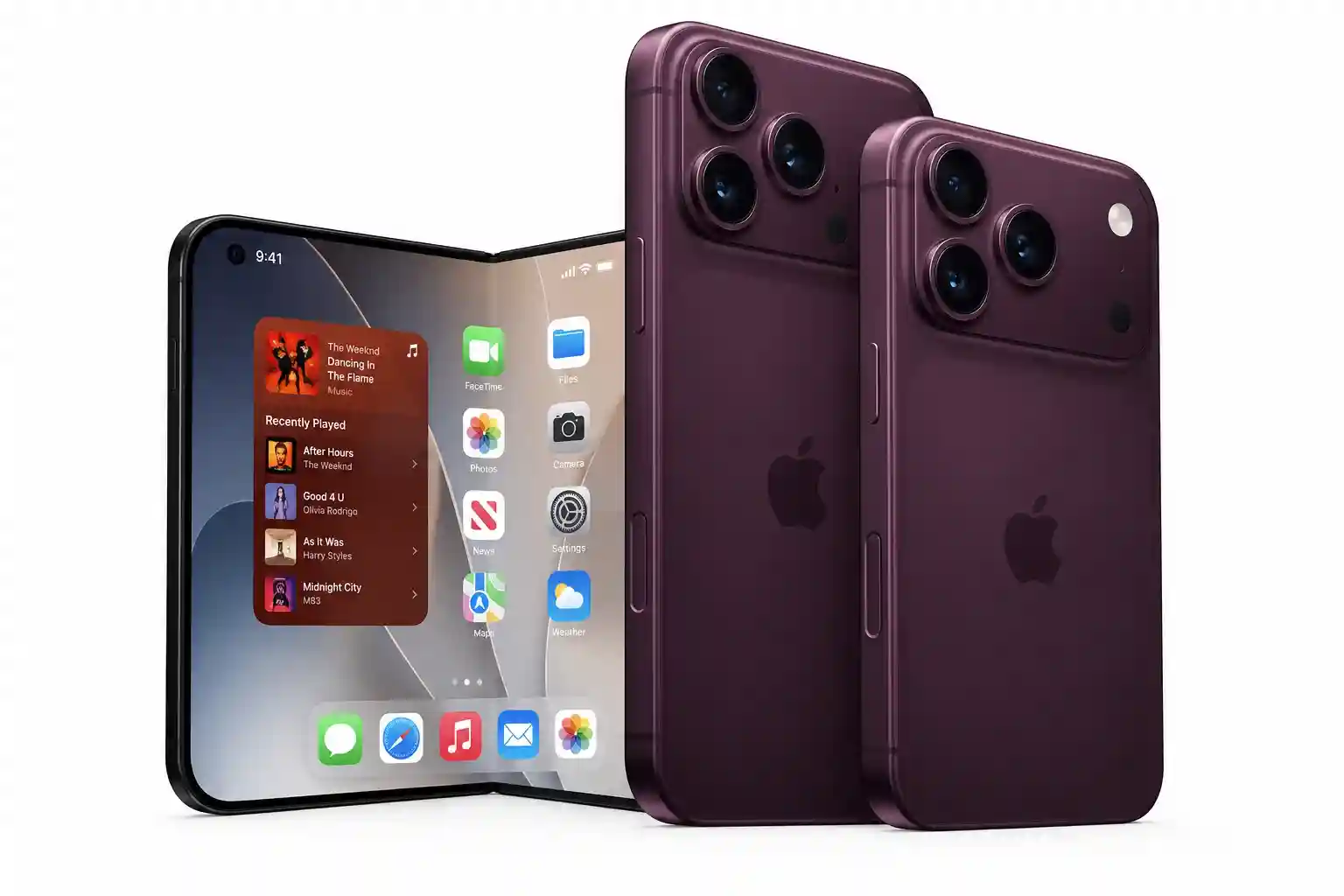
iPhone Duo is now official, and the iPhone 18 Pro and iPhone 18 Pro Max arrived with it as something more consequential than supporting cast. Apple has launched its first foldable iPhone at $1,999 while keeping a conventional premium phone at $1,199 and a larger conventional model at $1,299. That makes the foldable iPhone price question impossible to avoid: what, precisely, is the extra $700 to $800 buying?
Apple announced all three products on September 9, 2026. The Duo is scheduled to become available in the first markets on October 23, while the iPhone 18 Pro and Pro Max are scheduled for September 18. Apple’s official launch announcement describes Duo as its first foldable iPhone, with a 7.6-inch inner display, a 5.4-inch outer display and a new software model built around the device’s open and closed states. The company’s separate announcement for the Pro models emphasizes the A20 Pro chip, a variable-aperture main camera, improved thermal management and longer battery life. Apple’s launch announcement for iPhone Duo and its announcement of the iPhone 18 Pro and Pro Max establish what Apple intends to sell. They do not yet establish which model will create the most value for every buyer.
That distinction matters. A launch proves existence, specifications and price. It does not prove hinge life after years of folding, the cost of repairing an inner display, resale value, actual battery performance in mixed use, or whether buyers will use the larger screen often enough to justify the premium. The most defensible conclusion at this stage is therefore not that one model is universally “best.” It is that Apple has designed three different premium propositions and attached very different forms of risk to them.
The central finding from the available evidence is straightforward. Duo is a specialist product that sells a new physical format and a new interaction model. The iPhone 18 Pro is the lower-cost conventional premium option and, for many buyers, the most balanced proposition. The Pro Max is the conventional choice for people who prioritize display size and battery life without adding a hinge and a large foldable inner panel. Duo may be worth the premium for a particular workflow. The launch alone does not show that the premium is economically rational for a typical phone user.
The launch lineup is segmented by use, not simply by size
Apple’s pricing makes the portfolio easier to understand. The iPhone 18 Pro starts at $1,199. The Pro Max starts at $1,299, only $100 more. Duo starts at $1,999, which is $800 above the Pro and $700 above the Pro Max.
| Model | Starting U.S. price | Premium over iPhone 18 Pro | Main proposition |
| iPhone 18 Pro | $1,199 | Baseline | Conventional premium phone, advanced camera and A20 Pro platform |
| iPhone 18 Pro Max | $1,299 | $100 | Larger conventional display and strongest battery positioning |
| iPhone Duo | $1,999 | $800 | Foldable phone, larger inner workspace and fold-specific software |
The arithmetic is simple but revealing. Duo costs approximately 66.7% more than the iPhone 18 Pro: $800 divided by $1,199. It costs approximately 53.9% more than the Pro Max: $700 divided by $1,299. Those percentages measure price, not usefulness. They tell us how much more Apple is asking, not how much more time, productivity or enjoyment a buyer will receive.
The $100 gap between the two conventional models also reveals Apple’s segmentation strategy. A customer who wants a larger phone and more battery capacity does not have to move into an entirely new category. The Pro Max creates a relatively modest upgrade path. Duo sits somewhere else: it is not merely the largest iPhone, but a different mechanical object that opens into a larger canvas.
This is why a direct specification contest can mislead. Duo’s central advantage is not that every component is superior. Its advantage is that one device can be used as a normal phone when closed and as a tablet-like workspace when open. Its value depends on how frequently that transformation changes what the owner can do.
A person who reads long documents, watches video, uses two applications side by side, reviews spreadsheets or wants a larger view for group camera functions may experience the inner screen as a daily benefit. A person who messages, browses, photographs, calls and consumes short-form content may open the device less often than the marketing proposition assumes. The same hardware can therefore be either a productivity tool or an expensive unused capability.
What Apple is charging for in the Duo
Apple says the Duo has a 7.6-inch inner Super Retina XDR display and a 5.4-inch outer Super Retina XDR display. Both support ProMotion and Always-On functionality, with up to 3,000 nits of peak outdoor brightness. The inner display uses a nano-texture finish intended to reduce reflections and make the crease less noticeable. Independent launch coverage from Macworld’s iPhone Duo specifications and pricing report and Tom’s Guide places the phone at approximately 164.6 by 117.8 by 5.2 millimeters when open and 84.1 by 117.8 by 11.3 millimeters when closed, with a reported weight of about 254 grams.
Those dimensions explain the economic trade. Folded, the phone is substantially thicker than a conventional slab. Open, it is unusually thin for a device with two display surfaces and a hinge. The customer is paying not only for screen area but for the engineering required to make that screen area portable.
Apple describes a grade 5 titanium enclosure, a precision hinge with more than 100 components, Ceramic Shield materials, internal support ribs, ceramic-fiber antenna inserts, custom adhesives and an IP68 rating. The company also claims that Ceramic Shield 2 provides three times better scratch resistance than the previous generation. These details establish the architecture Apple chose. They do not independently establish how the architecture will age.
The hinge is simultaneously the product’s defining asset and its defining exposure. Without it, Duo would not be a foldable iPhone. Because it exists, the device has more moving parts than the Pro models and a larger internal display whose protection and repair economics may differ from those of a conventional phone. IP68 is not a promise against every form of physical damage. It does not eliminate the effects of a drop, pressure, contamination, manufacturing variance, hinge wear or ordinary aging.
That is not an accusation against Apple. It is a limitation of launch evidence. No September announcement can produce years of independent hinge-fatigue data. Buyers should separate a company’s durability design and test claims from observed failure rates. At the research cutoff, the latter were unavailable.
The software is the case Apple must make for the hardware
The hardware creates a larger surface. The software has to make that surface useful often enough to justify the price.
Apple’s iOS 27 introduces Split View, two-window use in applications such as Safari, adaptive content behavior and interface changes that respond to whether the phone is open or closed. Duo also adds functions such as Duo Preview, Kid Cue, Duo FaceTime and Dual Capture. These features use the two-display format for framing, group participation, hands-free use and simultaneous front- and rear-camera feeds.
This is a more serious proposition than simply putting a larger screen behind a hinge. Apple is attempting to make the physical transformation part of the operating system. If the software transitions are reliable and applications take advantage of the additional space, Duo could reduce the need to carry a phone and a small tablet for some users. The economic value would then come partly from substitution: one device doing the work of two.
But substitution has to be demonstrated in behavior, not inferred from screen dimensions. A buyer who already owns a tablet may not replace it. A user whose work is conducted primarily on a laptop may find Split View interesting but not essential. A larger screen can improve a task without changing the total number of devices in a household.
The key post-launch questions are practical. How many major applications will use the inner display well? Does reopening an application preserve context? Does the crease remain unobtrusive after months of use? Does the outer screen feel comfortable for routine typing? Do people keep the device open at a desk, or do they repeatedly close it because the conventional interface is faster? These are not questions that an announcement can settle.
Duo’s software can therefore create genuine value, but its value is conditional. Apple has supplied the framework. Developers and users will determine whether it becomes a daily workflow or a launch-period novelty.
The Pro models preserve a reason not to buy the most expensive iPhone
Apple could have made Duo the undisputed top specification model and used the Pro line as a lower tier. Instead, the iPhone 18 Pro and Pro Max retain meaningful conventional advantages.
All three devices use the A20 Pro family. Apple describes a six-core CPU, a seven-core GPU, a dual 16-core Neural Engine, 2-nanometer process technology and 50% more unified memory bandwidth than the A19 Pro. For Duo, Apple claims up to 35% better sustained performance than the iPhone 17 Pro with a custom vapor chamber. For the Pro models, Apple describes a next-generation vapor chamber with three times more surface area than the prior generation and claims up to a 40% gain over the iPhone 17 Pro in sustained performance.
These are Apple’s comparative claims, not independent benchmark results. Actual performance will vary with application, software, temperature, network conditions and workload. Still, the product strategy is visible: Apple is not treating the foldable as a slower experiment. It is giving the premium lineup a common chip platform while differentiating the phones through form factor, camera architecture and battery positioning.
The Pro camera system is particularly important. Apple introduces a 48-megapixel Fusion Main camera with variable aperture. Its six laser-cut blades can transition between apertures and provide automatic and manual control over depth of field and lighting. Apple also describes a new sensor, improved low-light performance, upgraded photographic controls and advanced video capabilities.
Duo has a 48-megapixel Fusion Main camera and a 48-megapixel Fusion Ultra Wide camera. It supports an optical-quality 2x telephoto option, macro photography, sensor-shift optical image stabilization, computational imaging and 4K video at 120 frames per second in Dolby Vision on the main camera. Its fold-specific functions can make it easier to frame a subject or include other people in a FaceTime call.
The difference is the kind of camera value being offered. Duo’s cameras exploit the physical format. The Pro models emphasize imaging control and a dedicated telephoto configuration. For a buyer who values camera reach, aperture control and conventional photographic flexibility, the most expensive phone may not be the obvious choice. The product that costs more is not automatically the product with the strongest camera proposition.
Duo also replaces Face ID with Touch ID and is eSIM-only, according to the available product analysis. Those changes may be acceptable or even preferable to some users, but they are not neutral. They affect authentication habits, carrier compatibility and the transition cost for buyers accustomed to existing iPhone behavior.
Battery claims are useful, but they are not a promise of daily life
Battery life is another area where the launch numbers need careful labeling.
Apple claims up to 31 hours of video playback for Duo when using the inner display, up to 44 hours using the outer display and up to 24 hours when both displays are used equally. The company claims wired charging to 50% in about 20 minutes and wireless charging to 50% in about 30 minutes with compatible equipment.
Apple claims up to 36 hours of video playback for the iPhone 18 Pro and up to 45 hours for the Pro Max. It describes the Pro Max as having the largest increase in battery life in iPhone history.
These are controlled video-playback metrics. They are useful for comparing the manufacturer’s test conditions, but they are not guarantees of mixed use. A user who spends the day on the inner display with high brightness, cellular data, gaming, camera activity and on-device AI workloads may see a different result.
The public record also contains a battery-capacity disagreement for Duo. Tom’s Guide reports a figure of 4,883 mAh, while Macworld says Apple has not disclosed the combined capacity and that earlier estimates of roughly 5,000 to 5,500 mAh remained unconfirmed. A cautious analysis should therefore use Apple’s usage-based claims and classify the milliamp-hour figure as uncertain.
The Pro Max’s advantage is less complicated. It offers the largest conventional body and the strongest stated battery position without the additional power and mechanical considerations of a foldable system. Buyers who want a large display but do not need a screen that opens may find that the Pro Max captures most of the practical benefit with less design complexity.
The storage ladder changes the meaning of the headline price
Duo starts at $1,999 with 256GB of storage. Macworld reports U.S. prices of $2,199 for 512GB, $2,599 for 1TB and $3,199 for 2TB. The starting configuration is therefore not merely a low-storage headline designed to make the entry price look smaller. But the upper tiers increase the financial exposure quickly.
| iPhone Duo storage | Reported U.S. price | Increase over 256GB model |
| 256GB | $1,999 | Baseline |
| 512GB | $2,199 | $200 |
| 1TB | $2,599 | $600 |
| 2TB | $3,199 | $1,200 |
The 2TB Duo is $1,000 more than the Pro Max’s reported starting price. That comparison does not mean the capacities are equivalent in value; it shows how far the purchase can move once storage becomes part of the decision.
The minimum practical cost may also exceed the device price. Apple lists a $79 case and a $129 Folio with Kickstand. Depending on the buyer, AppleCare+, insurance, a cellular plan, cloud storage and charging equipment may add to the ownership cost. None of these items is unique to Duo, but the more expensive the device, the more consequential the protection and replacement decision becomes.
Apple also describes an Apple Upgrade lease. A monthly payment should not be confused with the purchase price. Apple’s disclosures indicate that approval, creditworthiness, damage, loss, early termination, insurance and end-of-term purchase obligations can affect total cost. The correct comparison is the full contractual cost over the relevant period, not the most attractive monthly figure.
This is the same analytical issue that appears in other technology markets: a headline unit price can obscure the structure around it. Michael’s Take’s analysis of AI video generation pricing and the business model behind credits makes a related point in a different category. The visible price is often only the entry point; the real economic question is what the user receives, what additional commitments are required and how the vendor captures value over time.
Apple’s economics extend beyond the phone in the box
Apple does not disclose a model-level margin or revenue forecast for Duo, Pro or Pro Max in the public sources reviewed for this analysis. It would therefore be speculative to claim that the $1,999 Duo is more profitable per unit than a $1,199 Pro.
The direct model is straightforward: Apple earns hardware revenue when the device is sold or financed. The wider relationship can include AppleCare, iCloud, Apple One, accessories, financing, leasing, app distribution, replacement purchases and other services. A customer who already owns an Apple Watch, AirPods, has an iCloud account, uses Apple Pay, subscribes to family services or relies on a large application library may value continuity beyond the phone’s retail price.
Those ecosystem effects support Apple’s pricing power. They also complicate any simple buyer calculation. A customer is not choosing only between three isolated pieces of hardware. The choice may affect accessories, insurance, support, storage, resale and the cost of switching away from iOS.
The company’s 2025 Form 10-K identifies iPhone and Services as major sales categories and discusses competition, supply-chain dependence, component availability, manufacturing, demand and regulation. The filing does not provide a product-level forecast for the 2026 models. It does, however, provide the appropriate context: Apple’s hardware economics depend on a broader system of design, distribution, supply-chain execution and recurring services.
Duo may raise average selling price by adding a novel format. Pro Max may do so through size and battery positioning. The regular Pro creates a premium entry point that preserves core chip and camera features at the lowest price of the three. Apple does not need every buyer to choose Duo for the launch to be strategically useful. It can use the foldable to extend the premium ceiling while maintaining conventional alternatives for a much wider customer base.
That strategy also creates a cannibalization question. Some Duo buyers may have purchased a Pro Max. If so, the headline revenue per unit may rise while the mix changes. Whether that is economically attractive depends on manufacturing cost, warranty exposure, repair costs and service attachment—not numbers disclosed in the launch record.
The broader business lesson is familiar from other large technology companies: revenue is not profit, and a high selling price is not proof of high unit economics. Michael’s Take’s analysis of Meta’s $60.8 billion quarter and its collapse in free cash flow illustrates why the money left after investment and operating commitments matters more than a headline sales figure. For Duo, the corresponding unknowns are component cost, production yield, repair reserves, returns and actual demand.
Apple is entering a category that already has competitors
Foldable smartphones were not invented by Apple. Samsung’s Galaxy Z Fold line and products from Google, Huawei, Honor, Motorola and others established the category before Apple entered it. Samsung markets a book-style foldable around a large inner display, multitasking, AI features and Android integration. Apple’s advantage is not first-mover status.
Apple’s advantages are different: a large installed base, retail distribution, control over hardware and software, a mature developer ecosystem, a service network and strong brand recognition. Those assets may help Apple avoid some of the adoption barriers faced by earlier foldable makers. The company can introduce a new form factor to customers who already trust its operating system and retail support.
Its disadvantages are equally clear. It is entering late, at a high price, with no long-term public reliability record for its own foldable hardware. Production may be constrained by the complexity of flexible displays, hinges, protective layers, dual batteries and a thin titanium enclosure. A consumer may also decide that Apple’s conventional Pro Max is sufficient.
A Counterpoint Research projection cited in the report estimated approximately 20% growth in the foldable smartphone market in 2026 and suggested Apple could capture a substantial share. That is a forecast, not evidence of actual shipments, market share, satisfaction or profitability. It may support the case that Apple is entering a growing category, but it cannot tell us whether Duo’s economics will work at $1,999.
The more useful competitive question is not whether Duo has more screen area than a normal phone. It is whether Apple’s software adaptation, app support, privacy positioning, service infrastructure, resale expectations and ecosystem integration justify its premium over competing foldables and over Apple’s own Pro Max.
What the launch proves—and what it leaves open
The public record supports several conclusions with high confidence.
First, Apple is not replacing the conventional iPhone. It is adding a high-priced format while preserving conventional Pro products. Second, Apple is using the A20 Pro family across the three models to keep the foldable inside the premium performance story. Third, Apple is reserving meaningful camera advantages for the Pro models, especially variable aperture and the dedicated telephoto proposition. Fourth, software adaptation is central to Duo’s case because the hardware alone creates a larger screen but not necessarily a better workflow. Fifth, the later Duo release date separates the foldable launch from the September Pro release. The operational reason for that timing is a reasonable inference, not an official explanation.
The unresolved questions are just as important.
There is not enough public evidence to determine hinge reliability, inner-display failure rates, crease visibility after extended use, water-related failures, repair costs, warranty reserves or resale values. There is not enough evidence to calculate unit profitability. There is no mature evidence showing how often owners use Split View, Dual Capture or other fold-specific features after the first month. There is no independent test record yet establishing whether the battery claims translate into a meaningful advantage in mixed use.
This is where a skeptical buyer should resist two opposite mistakes. The first is assuming that every manufacturer claim is false because it comes from Apple. The second is treating every manufacturer claim as a demonstrated long-term outcome. Apple has provided a detailed product proposition. Independent testing and market behavior will determine how much of that proposition survives contact with ownership.
The practical comparison for different buyers
For a buyer focused on camera control, conventional ergonomics and price discipline, the iPhone 18 Pro is the strongest default candidate. It retains the A20 Pro platform, variable aperture and the conventional premium experience at $800 below Duo’s starting price. That does not make it superior for every use case; it makes the economic burden of choosing it much lower.
For a buyer who wants the largest conventional phone and long battery life, the Pro Max is the more direct alternative. Its $100 premium over the Pro may be easier to justify than Duo’s $700 to $800 premium if the buyer’s priority is simply more screen and endurance rather than a folding workspace.
For a buyer who regularly works across two applications, consumes large-screen content, uses a phone as a mobile workspace or would otherwise carry a small tablet, Duo may offer a benefit the Pro models cannot replicate. But that buyer should evaluate the feature as a repeated workflow, not as a novelty. The relevant question is not “Would I enjoy opening this?” It is “What recurring task would become materially easier, and how often would I perform it?”
For an existing Apple customer, the decision should also include the wider ecosystem. Accessories, AppleCare, cloud storage, financing terms, trade-in value and switching costs can change the effective cost. A device that fits an established setup may have a different practical value than one evaluated in isolation.
For anyone considering the Duo primarily as a status purchase or an investment-like asset, the public record offers no support for assuming exceptional resale value. Foldable devices carry a different risk profile, and the product is first-generation for Apple. Resale, repair and depreciation should be treated as uncertain until real transaction data exists.
What should we learn from the launch?
The most useful lesson is that Apple has priced physical transformation as a premium capability, not as a minor feature. The $1,999 Duo is asking buyers to fund a new format before the market has supplied long-term evidence about durability, repair and resale. That can be a rational trade for someone whose daily work depends on the inner display. It is a difficult trade to justify for a buyer who will use the phone like any other iPhone.
The conventional lineup makes that decision easier, not harder. The iPhone 18 Pro offers the premium chip and advanced camera proposition at the lowest price. The Pro Max offers a larger conventional phone and stronger battery positioning for only $100 more. Duo offers the only foldable workspace, but it also carries the largest price premium and the most unresolved ownership questions.
My conclusion is therefore segmented rather than absolute: Duo is the most differentiated model, the iPhone 18 Pro is the most broadly defensible value, and the Pro Max is the clearest conventional upgrade for size and battery. Confidence is high on the price and product segmentation because those are documented by the launch. Confidence is lower on long-term value because the evidence that matters most—repair rates, reliability, real-world battery performance, app adoption and resale—does not yet exist.
The rational next step is not to dismiss the foldable or to assume it is the future. It is to identify the repeated use that the inner screen would replace, calculate the full ownership cost rather than the monthly payment, and wait for independent durability and repair evidence if those risks matter to the decision.
Financial disclaimer: This article is provided for educational and informational purposes only. It is not financial, investment, tax, legal, career or other professional advice. The analysis is based on publicly available information believed to be reliable at the time of publication, but data may change and no guarantee is made as to its accuracy or completeness. Readers should conduct their own due diligence and consult a qualified professional before making decisions involving money, employment, contracts or investments.
Sources and Methodology
The article treats the September 9, 2026 product announcements as the primary evidence for existence, pricing, launch timing, display claims, chip claims, camera features, software functions and Apple’s stated battery and performance figures. The principal primary sources are Apple’s iPhone Duo announcement and Apple’s iPhone 18 Pro and Pro Max announcement.
The report uses Macworld’s coverage of Duo’s design, price, specifications and release date for independently reported dimensions, storage pricing and discussion of the undisclosed or disputed battery-capacity figure. Tom’s Guide was used in the underlying research for reported dimensions and the 4,883 mAh figure; that figure is presented as uncertain rather than as an established fact.
The broader market context comes from the underlying report’s references to Samsung’s Galaxy Z Fold product page and Counterpoint Research’s 2026 foldable-market projection. The projection is explicitly treated as a forecast, not as evidence of realized market share or profitability.
Apple’s supply-chain, competition, demand and product-category context is grounded in Apple’s 2025 Form 10-K. The filing does not disclose model-level economics for the 2026 phones, so no unit margin or profitability claim is made.
Calculations in the article are plain arithmetic from the stated starting prices: $1,999 minus $1,199 equals $800; $1,999 minus $1,299 equals $700; $1,299 minus $1,199 equals $100; $800 divided by $1,199 is approximately 66.7%; and $700 divided by $1,299 is approximately 53.9%.






Comments
Loading comments...