






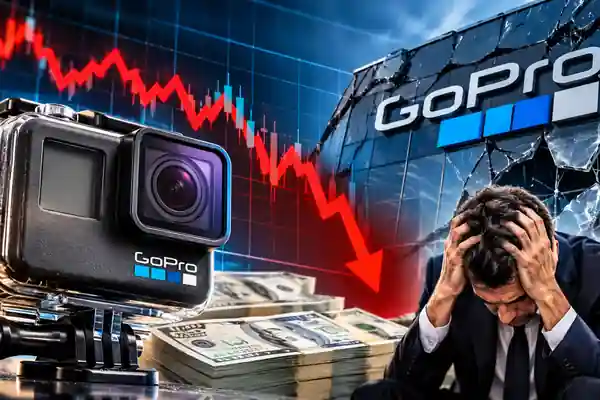
My Analysis of GoPro Financial Crisis: From $1.6B to Collapse
GoPro financial struggles become clearer through a revealing contradiction: annual revenue reached $1.62 billion in 2015, yet the company’s net income had already fallen sharply from its 2014 level, according to the company’s 2015 results and 2014 annual report. That GoPro revenue history is not simply a rise-and-fall story. It is a case study in a GoPro business model that paired distinctive cameras with mounts, software and subscriptions, but never made those adjacent businesses large enough to offset a prolonged hardware slump. The public record now points to a more immediate question: can a proposed corporate reset arrive before financing and reporting risks overwhelm the camera business?
GoPro began with a clear customer problem. Surfers and other athletes wanted to record themselves without carrying a camera operator or holding a camera. The company turned that use case into a product category, a recognizable brand and a global camera business. Its later difficulty was not a lack of product recognition. It was the challenge of turning an exceptional product cycle into durable economics while smartphones improved, competitors expanded, product launches missed their windows and subscriptions remained a minority of sales, pressures GoPro itself discusses in its 2025 annual report.
The evidence supports both sides of that account. GoPro created a genuine consumer-electronics success. It also entered November 2026 with a proposed merger still unclosed, $27.3 million in cash at June 30, covenant pressure, restated statements and a delayed quarterly filing, according to its amended Q2 filing, late-filing notice and merger amendment. Those facts do not prove that the original strategy was foolish or that the merger will fail. They do show why revenue growth, operating profit, cash and corporate survival have to be examined separately.
A camera designed around the person using it
The idea came before the public company. GoPro’s 2026 proxy statement recounts that founder Nicholas Woodman’s online gaming venture Funbug failed in 2001 and that he conceived a wrist-worn film camera while preparing for a surf trip. An interview-based history in IEEE Spectrum describes the early prototype: a disposable waterproof camera attached to an improvised wrist strap made from a broken surfboard leash and rubber bands. The insight was practical. A small camera was useful, but a camera that could be mounted securely to a participant or piece of equipment created a distinctive point of view.
The company’s 2014 Form 10-K establishes the corporate chronology. Woodman Labs, Inc. was incorporated in California on February 14, 2004, began doing business as GoPro that month, reincorporated in Delaware in 2011, and adopted the GoPro, Inc. name in February 2014. The filing dates the original wrist-mounted waterproof 35mm camera to 2004, Digital HERO to 2006 and HD HERO to 2009. The concept may date to 2001 or 2002; the documented company start is 2004. These dates describe different events rather than a contradiction.
The early product was more than a camera body. It came with a mount and a use case: capture an activity from the participant’s perspective. Accessories extended that proposition to helmets, surfboards, vehicles and other equipment. As digital recording improved, the footage became easier to view, edit and share. The camera did not need to win every imaging category. It needed to work where a phone or conventional camera was inconvenient or unsafe to hold.
That clarity helped the business scale. GoPro’s 2014 Form 10-K reported revenue of $64.5 million in 2010, $234.2 million in 2011, $526 million in 2012, $985.7 million in 2013 and $1.394 billion in 2014, when net income was $128.1 million. The same filing said the company had generated substantially all of its revenue from cameras and accessories, even as it described a longer-term ambition to become a media company. That admission is crucial: GoPro’s brand and user-generated footage were strategically valuable, but the money still came overwhelmingly from hardware.
The IPO extended the growth phase and preserved founder control. GoPro’s 2014 Form 10-K says the company’s first public offering closed July 1 at $24 a share. It sold 8.9 million new shares and received $200.8 million in net proceeds after underwriting discounts and commissions. Existing holders sold 11.57 million shares, so total offering proceeds should not be confused with capital raised by GoPro itself. The company also used a dual-class share structure, giving Class B shares ten votes each compared with one vote for Class A. Public investors supplied capital, while insiders retained substantial voting power.
Early private-company financing figures are less certain. A Forbes profile of Woodman and GoPro reported specific founder and family contributions, an $88 million 2011 round and a $200 million Foxconn investment in 2012 for an 8.88% stake. GoPro’s own 2011 strategic-investment announcement named investors but did not state the amount. The reported sums are therefore useful historical accounts, not a complete audited financing record.
Revenue peaked after profitability had begun to weaken

The most revealing feature of GoPro’s arc is that revenue kept growing after earnings had deteriorated. According to GoPro’s 2015 annual results, revenue reached $1.62 billion in 2015, about 16% above 2014. But net income fell from $128.1 million in 2014 to $36.1 million in 2015, a decline of roughly 72%. Gross margin also fell from 45.0% to 41.6%, and fourth-quarter 2015 gross margin was 29.4%. The company had reached its revenue high-water mark, but the economics of converting sales into profit were already under strain.
The following snapshot uses nominal U.S. dollars. Financials come from GoPro filings and company releases; the 2025 earnings and financing figures were subsequently amended for accounting errors, as discussed below. Q3 2026 values are preliminary estimates, not final results.
| Period | Revenue | Operating result | Net result | Primary source |
|---|---|---|---|---|
| 2010 | $64.5 million | — | $11.6 million profit | 2014 Form 10-K |
| 2014 | $1.394 billion | — | $128.1 million profit | 2014 Form 10-K |
| 2015 | $1.620 billion | — | $36.1 million profit | 2015 results |
| 2016 | $1.185 billion | $373.0 million loss | $419.0 million loss | 2016 Form 10-K |
| 2021 | $1.161 billion | $113.2 million income | $371.2 million profit | 2021 results |
| 2024 | $801.5 million | $135.0 million loss | $432.3 million loss | 2024 Form 10-K |
| 2025 | $651.5 million | $83.3 million loss | $92.6 million restated loss | 2025 Form 10-K/A |
| Q3 2026 | About $96 million | Not final | Not final | Form 12b-25 |
The first five-year expansion was extraordinary: revenue in 2015 was about 25 times its 2010 level. But a rapid increase in sales can conceal falling unit economics. GoPro’s 2015 result is the clearest evidence. The company sold more cameras and generated more revenue, yet margins and net income deteriorated. This does not identify one cause by itself. It does show that the sales peak was not the same as a durable profit peak.
The reversal became unmistakable in 2016. Revenue declined 26.8% to $1.185 billion. GoPro reported an operating loss of $373 million and a net loss of $419 million. Its 2016 Form 10-K discussed delayed HERO5 production, the Karma drone recall, product-line decisions, restructuring and the difficulty of meeting holiday demand. These events overlapped; the filing does not prove that any one decision caused the year’s entire loss. But they illustrate how a camera business exposed to seasonal launches can suffer when product availability and customer demand fail to line up.
In 2017, revenue was almost flat at $1.18 billion, but gross margin fell to 32.6%; the company still recorded an operating loss of $163.5 million and a net loss of $182.9 million. GoPro’s 2017 results reported operating expenses down 34% year over year. That narrowed losses, but did not restore the earlier profit model. Revenue remained near its peak while the margin structure was markedly weaker.
From 2018 through 2020, annual revenue hovered around $1.1 billion before falling to $891.9 million in 2020 during the pandemic period. Operating results ranged from a $94 million loss in 2018 to near break-even in 2019 and a $36.8 million loss in 2020, according to GoPro’s 2020 Form 10-K. Then came a strong rebound. Revenue rose 30% to $1.161 billion in 2021, gross margin improved to 41.1%, and operating income reached $113.2 million. That was a real operating recovery. The headline $371.2 million net profit, however, included a $281.1 million deferred-tax benefit, as GoPro’s 2021 results release shows, so it should not be read as recurring operating earnings.
The downward pattern resumed: revenue was $1.094 billion in 2022, $1.005 billion in 2023, $801.5 million in 2024 and $651.5 million in 2025, according to GoPro’s 2024 annual report and amended 2025 annual report. Compared with the 2015 nominal peak, 2025 revenue was about 60% lower: ($1.620 billion − $651.5 million) ÷ $1.620 billion. This is a nominal comparison, not an inflation-adjusted measure. GoPro attributed the pressure to a mix of delayed launches, competition and macroeconomic conditions, and reported that the price of critical memory components had risen by more than 80% in the period described.
Net income needs separate treatment from operating performance. GoPro’s 2024 annual report says the $432.3 million net loss included a $294.9 million valuation allowance against U.S. deferred tax assets. That accounting charge contributed to the GAAP loss, but it does not explain the operating loss of $135 million or the negative $125.1 million operating cash flow. Similarly, the 2021 results release attributes a large deferred-tax benefit to the reported net profit. Readers who focus only on net income can misread both the rebound and the downturn. Any assessment of GoPro financial performance should separate taxes, operating results and cash generation.
The business model had a flywheel—but hardware stayed in the center
GoPro’s economic logic connected four activities. Cameras and accessories generated most of the sales, as the company’s 2014 annual report explicitly acknowledged. User footage promoted the products and brand. Free and paid software helped people edit and share what they had captured. Subscriptions added recurring services such as cloud storage and editing tools. In theory, a strong camera experience could bring users into the software and subscription ecosystem, while the footage itself helped attract future buyers.
The flywheel is plausible, but public disclosures do not reveal enough to prove that it became self-sustaining. GoPro does not publish customer-acquisition cost, subscription lifetime value, detailed product-level profit or full retention curves. A high subscription attach rate tells us that many camera buyers take a subscription offer; it does not establish how long they remain, what they pay over time, or whether subscription gross profit covers the cost of storage, support and acquisition.
There is evidence of progress. By the end of 2020, GoPro reported 761,000 subscribers, up 145% year over year, and GoPro.com revenue of $283 million, double the previous year, in its 2020 results release. In 2021, GoPro reported $52.9 million in subscription revenue, up 131%, and about 1.6 million subscribers in its 2021 results release. In 2025, subscription and service revenue reached $106.3 million, roughly 16% of total revenue; hardware generated about $545.3 million, or 84%, according to the amended 2025 Form 10-K.
That is meaningful diversification, but it did not change the company’s center of gravity. Subscription and service revenue in 2025 was almost flat year over year while total revenue fell 18.7%. In Q2 2026, service revenue reached $29 million, around 28% of quarterly revenue, and GoPro reported a record 69% attach rate; the company’s Q2 results release and amended Q2 filing provide those figures. But quarterly camera sell-through fell 38%, and hardware revenue fell to $76 million. The services share rose in part because the hardware denominator shrank. A larger percentage is not automatically proof that the recurring business is replacing lost camera dollars.
The same caution applies to channel mix and camera-volume statistics. GoPro’s amended 2025 Form 10-K reports that retailers contributed 74% of revenue and GoPro.com 26%, while ten third-party customers accounted for 49% of revenue. The filing reported 1.826 million camera shipments; GoPro’s 2025 results release separately described around 2.0 million sell-through. Shipments into a channel and consumer sell-through are not the same metric, and the public figures do not fully reconcile their timing or scope. GoPro also reported average selling price of $357, up 8.2%, even as shipments fell 24.9%. Higher price and premium product mix cushioned the revenue decline, but could not offset lost volume.
The distinction between an attached service and a scaled service business matters in other creator markets, too. Michael’s Take’s analysis of YouTube revenue and what Alphabet does not disclose about YouTube’s standalone profit is a useful comparison for readers separating top-line activity from unit economics. YouTube and GoPro are not the same business; the parallel is the discipline of asking what revenue actually establishes—and what it leaves unknown.
What GoPro’s strategy failures do—and do not—show
GoPro’s failures are easiest to understand as a series of bets with different degrees of adjacency. Some extended the camera proposition. Others asked a camera company to build capabilities in media production or drones. Their outcomes do not prove that the original decisions were irrational. They do show how strategic logic can fail to produce sustainable economics.
The HERO4 Session is a small but revealing pricing case. GoPro’s launch announcement described a camera 50% smaller and 40% lighter than its HERO4 Black and Silver models, with a $399.99 suggested price. Contemporaneous Bloomberg reporting described weaker-than-expected demand and a $100 price reduction after roughly two months. The product solved a real convenience problem, but buyers may not have viewed the size reduction as worth a premium close to more capable cameras. That is an inference from the market response, not a conclusion that compactness itself was a bad idea.
Portfolio simplification also had costs. GoPro discontinued its entry-level HERO line in early 2016, and its 2016 Form 10-K recorded product-alignment charges. Simplifying a confusing line can improve focus. It can also remove an entry price point and create write-downs if existing inventory or components become less useful. Public filings document the charge; they do not provide the counterfactual needed to know whether keeping the entry-level camera would have produced more value.
The Karma drone was a larger adjacency. GoPro recalled about 2,500 consumer-purchased Karma units in November 2016 after reports that some units lost power during operation. The company offered refunds and said no injuries or property damage had been reported. Its recall announcement described the corrective action; the 2017 annual report later described the 2018 exit from the aerial market, citing low margins, intense competition and anticipated regulatory constraints. A reported strong sales ranking within a price tier could not guarantee attractive economics. The strategic lesson is not “never diversify”; it is that market position and product quality do not substitute for viable unit economics, dependable operations and a right to win.
Content was another mixed result. GoPro’s large library of user-generated footage made a media ambition understandable. Content could demonstrate what the cameras captured and create an organic marketing loop. But producing original entertainment is different from encouraging customers to make footage. In late 2016, GoPro closed its entertainment division and cut about 200 roles, according to Reuters’ contemporaneous report. GoPro continued to use community and user footage as part of its marketing and software ecosystem. The retreat was from a more costly stand-alone content operation, not from the idea that content helped sell cameras.
These episodes came alongside launch and inventory exposure. GoPro’s 2016 Form 10-K discussed delayed HERO5 production and the withdrawal of Karma during a holiday-sensitive period. In a seasonal consumer-electronics business, a device that ships late may miss the time when consumers are most ready to buy. Unsold inventory can also require discounts or write-downs as a new model arrives. The record shows the timing and subsequent results; it does not establish exactly how much of GoPro’s decline each launch issue caused.
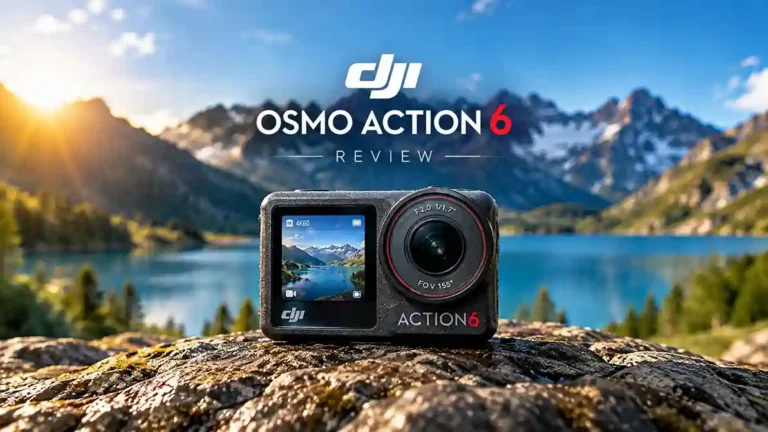
Readers comparing the current action-camera choice can explore Michael’s Take’s DJI Osmo Action 6 review, which evaluates the trade-off between specifications, creator workflow and price. It is a companion article about a competitor, not a source for GoPro’s financials. GoPro’s 2025 filing identifies smartphone substitution and market-share pressure, but does not provide a reliable current share figure. For a separate look at how premium phone hardware and camera features shape consumer price choices, Michael’s Take also examines the iPhone Duo’s launch economics. These internal links broaden the topic cluster without treating adjacent articles as evidence about GoPro.
A product repositioning cannot solve a financing problem by itself
GoPro did not simply abandon product development. It continued to refine HERO and MAX cameras, accessories, mobile editing and cloud services. In 2026 it launched the MISSION 1 compact-cinema line, an attempt to move beyond the traditional action-camera customer. GoPro’s product announcement describes a 50-megapixel, one-inch sensor and GP3 processor, and positions the line toward filmmakers and creators. Those are company-stated specifications and ambitions. By the research cutoff, public reports did not show MISSION 1’s product-level sales, margins or customer retention. The launch may be strategically sensible, but there is not enough evidence to call it a financial turnaround.
The operating backdrop was harsh. For full-year 2025, GoPro’s amended annual filing reported $651.5 million revenue, $83.3 million operating loss, 33.6% gross margin, negative $20.7 million operating cash flow and $49.7 million in year-end cash. By June 30, 2026, the amended second-quarter filing reported $27.3 million in cash. It also described limited availability under a credit facility, debt and covenant pressure, and substantial doubt about the company’s ability to continue as a going concern. These details matter more immediately than whether a new camera’s sensor is technically impressive.
Reporting reliability also became a material issue. GoPro’s 2025 Form 10-K/A and amended Q2 2026 Form 10-Q describe errors in accounting for warrants and convertible-debt features. The company said the corrections changed warrant liabilities, debt discounts, interest expense and net losses, but did not change revenue, gross margin, operating loss, cash or operating cash flows. It also disclosed an unremediated material weakness in internal controls over accounting and valuation for financing features. That distinction should be preserved: the accounting problem affects confidence in financing-related and bottom-line figures; based on the company’s own disclosure, it did not alter camera revenue or operating cash flow.
Then came a late filing. In its November 10, 2026 Form 12b-25 notice, GoPro said additional work was needed to complete the accounting and valuation of financing arrangements. The notice gave preliminary Q3 revenue of about $96 million, compared with $163 million a year earlier, gross margin of about 12.7%, compared with 35.1%, and operating expenses of about $60 million. The figures were still under review and subject to change. The same notice said the quarter’s statements would continue to reflect substantial doubt about going concern and that unreceived lender waivers could permit debt acceleration and affect a merger closing condition. These are the most serious current facts in the public record, but the Q3 numbers are estimates rather than filed final results.
Founder support adds another layer. Nicholas Woodman remained CEO and chairman, and GoPro’s 2026 proxy reported his beneficial voting power at 63.08% as of March 31 through the dual-class structure. GoPro announced $20 million in secured notes and warrants from Woodman-affiliated entities in July 2026 in its financing release. That financing may have provided needed liquidity; it also creates related-party, collateral and potential dilution questions that belong in any fair analysis. The evidence supports neither treating founder financing as purely altruistic nor implying wrongdoing. It is a financing choice with both benefits and trade-offs.
Starman: a potential reset, not a completed rescue
On September 1, 2026, GoPro announced a merger agreement involving Action Acquisition LLC and Starman Optical, Inc. The preliminary proxy says existing GoPro shareholders would receive $1.14 in cash plus 0.1 share of the surviving public company for each eligible share, subject to the terms and any adjustments. The buyer would own approximately 90% of the surviving company and existing GoPro holders approximately 10%. The plan is to keep the surviving business publicly traded on Nasdaq. The SEC preliminary proxy statement is the controlling source for those proposed terms; they were not a completed transaction at the cutoff.
The stated industrial rationale is a sharp expansion into optical transceivers and markets connected with AI infrastructure, government, defense, robotics and aerospace, while continuing consumer products and subscriptions, as described in GoPro’s merger announcement. That could supply capital and a different growth avenue. It would also place GoPro’s camera operations inside a much broader industrial strategy with new execution requirements. The strategic case is not proven simply because AI infrastructure attracts investor attention. It depends on financing, manufacturing capability, customer demand, integration and the future economics of both businesses.
The merger agreement’s outside date was extended from December 31, 2026, to March 31, 2027, in a November amendment filed with the SEC. At the same time, GoPro’s late-filing notice said lender waivers were still being sought and that certain covenant problems, if unresolved, could allow acceleration and potentially interfere with a closing condition. The agreement remained contingent on approvals and other terms. The correct description is therefore a distressed public company pursuing a contingent corporate reset—not a company already rescued by a merger.
What the numbers say about GoPro’s strategic choices
Three explanations for GoPro’s decline can all be true at once.
The first is market substitution and competition. Smartphones improved, and rival action-camera companies competed on sensors, stabilization, formats and price. GoPro’s 2025 filing identifies both smartphone substitution and recent market-share losses, but does not quantify how much demand shifted to phones versus competing dedicated cameras. It would be too strong to assign the entire decline to any one competitor or product category.
The second is execution and product-cycle exposure. GoPro’s camera business depended on launches arriving on time, at a price customers accepted, with enough differentiation to justify replacement. The Session price adjustment, HERO5 delays, Karma recall and inventory actions document real execution pressure. They do not prove that every setback was avoidable. They do show that a focused hardware company has few cushions when several product-cycle problems arrive together.
The third is a business model that never fully diversified. GoPro built subscriptions, software and direct sales, yet hardware remained about 84% of 2025 revenue. Services were growing strategically, but not large enough to offset an 18.7% decline in total revenue. This is not a failure of the subscription idea. It is evidence that the service layer had not reached the scale needed to change the company’s exposure.
A fourth issue is cost and capital structure. GoPro’s 2016 losses included an operating expense base that became too large for the shrinking revenue level. Subsequent cost cuts narrowed losses but did not guarantee sales recovery. In 2026, liquidity and covenant risks became central. Once the company’s ability to fund operations and meet debt obligations is in doubt, new product launches must be judged not only by customer appeal but by cash requirements, timing and contribution margins.
This way of separating causes avoids an easy but unsupported post-mortem: “GoPro failed because it did not become a media company,” or “GoPro failed because phones took over.” The record is more complicated. Media expansion was curtailed; phone cameras became stronger; competitors advanced; launch and inventory issues mattered; and recurring services remained smaller than hardware. Public disclosures do not permit a precise causal allocation among those factors. The phrase GoPro strategy failures is useful only if it describes documented outcomes, not a claim that every decision was unreasonable when made.
What a reader should take from the case
For a customer, the practical question is whether a dedicated camera does something a phone cannot do well enough: remain mounted during movement, work in rough conditions, provide the needed point of view, or fit an editing workflow. The answer depends on use. The financial distress of the company adds uncertainty about corporate continuity and support, but it does not by itself prove that a currently purchased camera will stop functioning.
For a business partner or employee, the more relevant signals are liquidity, filing timeliness, covenant waivers and transaction status. A signed merger is not the same as funded, closed and integrated. For an investor or student, the analytical lesson is to separate revenue from profit, GAAP net income from operating performance, and percentage mix from absolute dollars. A 69% subscription attach rate, for example, is not a measure of subscriber lifetime value. A rise in services as a share of quarterly sales can occur while hardware revenue collapses.
The strongest interpretation of GoPro’s history is not that the product lacked value. The company created a distinct category and monetized it at scale. Rather, the initial advantage proved difficult to renew across successive product cycles and difficult to extend into adjacent businesses with enough scale to counter hardware volatility. Its user community and brand were valuable, but they did not automatically become a high-margin media company. Its software and subscription ecosystem became meaningful, but not dominant. Its product innovations were real, but real innovation alone could not repair liquidity.
As of November 16, 2026, the conclusion is conditional but clear: GoPro had built a successful camera company, but the publicly available numbers did not show that it had built a financially resilient one. The Starman deal might change that assessment, but only if it closes, resolves immediate financing issues and produces sustainable economics. Until then, the evidence supports a story of a strong original product, a long period of strategic and operational strain, and a corporate future that remains uncertain.
What should we learn from this? A differentiated product can create a remarkable growth curve, but durable value depends on what happens after the first wave of adoption. A company must keep the product relevant, make launches reliably, price the value correctly, manage inventory and build adjacent revenue that is large enough—not merely promising enough—to absorb the next downturn.
Financial and informational disclaimer
This article is provided for educational and informational purposes only. It is not financial, investment, tax, legal, career or other professional advice. The analysis is based on publicly available information believed to be reliable as of November 16, 2026, but data may change and no guarantee is made as to its accuracy or completeness. Readers should conduct their own due diligence and consult a qualified professional before making decisions involving money, employment, contracts or investments.
Sources and Methodology
This article reconstructs GoPro’s documented history and financial position using company filings, SEC submissions, company announcements and selected reporting. SEC filings take priority for corporate history, financial results, ownership, restatements, risk disclosures and proposed merger terms. Company releases are used for company-reported product and operating claims. Those claims are identified as such where they have not been independently tested. News reporting is used for contemporaneous context where primary documents do not provide the full story. Links are placed beside the claims they support; this short list identifies the principal records rather than repeating every article link.
- GoPro’s 2014 Form 10-K supports its corporate chronology, early product lineup, IPO proceeds and selected financial figures from 2010 onward.
- GoPro’s 2016 Form 10-K and 2017 Form 10-K document the revenue contraction, product-cycle issues, Karma context and restructuring.
- GoPro’s 2025 Form 10-K supplies current business, risk, product, channel and FY2025 operating information. The 2025 Form 10-K/A and Q2 2026 Form 10-Q/A control for the subsequent financing-accounting restatement and related disclosures.
- GoPro’s November 10, 2026 Form 12b-25 supports the filing delay, preliminary Q3 estimates, going-concern statement and lender-waiver uncertainty.
- The SEC preliminary proxy statement and November 12, 2026 merger-amendment filing support the proposed transaction terms and extended outside date.
- The origin account draws on GoPro’s 2026 proxy statement, IEEE Spectrum’s technical history and Forbes’ profile. The latter is attributed reporting for early private financing details, not audited data.
- The discussion of price and product setbacks draws on GoPro’s Karma recall announcement, Reuters’ report on the entertainment-unit closure and Bloomberg’s HERO4 Session coverage.
- Internal links to Michael’s Take’s DJI Osmo Action 6 review, iPhone Duo pricing analysis and YouTube revenue analysis are included as related editorial reading. They are not cited as evidence for GoPro-specific facts.
All amounts are nominal U.S. dollars unless noted. Calculations are simple arithmetic from cited company figures. GoPro’s camera shipments and consumer sell-through are distinct measures and are not reconciled here. GoPro’s Q3 2026 figures were preliminary as of the cutoff. No current market-share estimate is asserted because the available public measures do not support a clean, GoPro-specific comparison.



Comments
Loading comments...