






Netflix MLB Deal: How Much Did Netflix Pay for Baseball Rights?
Netflix MLB deal looks simple on the surface. Behind it, the reported Netflix MLB rights fee and the wider Netflix live sports strategy reveal one of the stranger financial stories in modern television: a company that booked $45.2 billion in revenue in 2025 paid for the rights to roughly three baseball events a year, has never publicly confirmed the price, and by August 2026 was generating audience numbers that looked impressive or concerning depending on which part of the spreadsheet you examined.
Here is the detail that should make you pause. On the same weekend Netflix streamed a Phillies-Twins game from a cornfield in Dyersville, Iowa, to a reported 1.66 million viewers, the company was projecting full-year revenue between $51.0 and $51.4 billion with an operating margin above 31 percent. The baseball itself was almost invisible in the financial statements. Yet Netflix executives continue to describe live programming as one of the most strategically valuable things they buy.
That gap between accounting insignificance and strategic importance is the real story. So let’s follow the money.
Where the Financial Story Really Started
To understand the Netflix MLB deal, you have to understand what Netflix actually sells and how it makes money, because it is not what most people assume.
Netflix’s own annual report for the fiscal year ended December 31, 2025, describes a business whose revenue is derived primarily from monthly membership fees. It operates as a single reporting segment. It sells series, films, games, and, more recently, live programming. That single-segment structure is not a technicality. It is the reason this entire investigation runs into a wall at a certain point: Netflix does not, and is not required to, tell you how much money any individual show, film, or sports property makes or loses.
By the end of 2025, the company reported more than 325 million paid memberships, $45.2 billion in annual revenue, a 29.5 percent operating margin (up from 26.7 percent the prior year), and advertising revenue of more than $1.5 billion. That advertising line matters enormously to the baseball story, and we will come back to it.
On the other side of the table sits Major League Baseball, which is not a public reporting issuer and does not publish audited consolidated financials that would let anyone trace where a rights payment goes after it arrives. MLB’s national media rights are not one asset. They are a bundle of separable windows: regular-season packages, postseason inventory, special events, out-of-market streaming through MLB.TV, international rights, and ancillary programming. Each has different scarcity, different audience profile, and different price.
The relationship between the two companies did not begin with live games. According to MLB’s own November 2025 announcement, Netflix had already distributed the 2024 documentaries The Turnaround and The Comeback: 2004 Boston Red Sox, plus the eight-part series The Clubhouse: A Year With the Red Sox. That is a documented content history. What it is not, and this distinction matters, is evidence of any contractual right of first refusal, option, or pre-negotiated path to live rights. The two parties knew how to work together on baseball storytelling. Nothing in the public record shows that this created a financial claim on anything.
The First Money and the Moment the Economics Changed
The real trigger was not something Netflix did. It was something ESPN did.
According to CNBC’s reporting, ESPN opted out of its existing Sunday Night Baseball arrangement, which forced MLB to break up and redistribute its national inventory. That single decision created the market opening. Without it, there is no Netflix MLB deal.
On November 19, 2025, MLB announced three-year agreements with three partners for the 2026 through 2028 seasons. NBCUniversal took Sunday Night Baseball, Sunday Leadoff, and the Wild Card Series. ESPN took a national midweek package plus the right to sell MLB.TV. Netflix took the narrowest slice of all: one Opening Night game per season, the T-Mobile Home Run Derby, and one additional special-event game each year.
Now the price ladder, which is where the financial story gets genuinely interesting. MLB did not disclose deal values. Reuters said so explicitly. But reporting from ESPN’s own newsroom, CNBC, The Wall Street Journal, Sports Business Journal, and Axios converged on a consistent structure: ESPN paying in the range of $550 million annually, NBCUniversal around $200 million annually, and Netflix around $50 million annually.
Treat that $50 million as reported information and estimate, not verified fact. No cited source publishes the executed contract, the payment schedule, whether the figure is a guaranteed minimum, whether it escalates across the three seasons, or whether it includes production costs. Multiple reputable outlets repeating a number improves confidence that it was the prevailing market understanding. It does not promote it into a contract term.
But even as an estimate, it tells you something sharp. If MLB was collecting roughly $750 million to $800 million a year across the three new national packages, Netflix was contributing something in the neighborhood of six to seven percent of that money for something like three events. It bought the cheapest seat in the room. That was almost certainly deliberate.
What Netflix Actually Bought, and What It Didn’t
This is the part that gets misreported constantly, so let’s be precise about the asset.
Netflix did not buy MLB. It did not buy a club. It did not acquire a stake in MLB Network, MLB Advanced Media, or the league’s underlying media-rights business. It acquired no shares, no board seats, no equity, and no residual claim on league value. The public record contains zero evidence of any ownership interest.
What it bought is a time-limited contractual license to distribute specified programming for three seasons. That is a fundamentally different asset class from equity. A license expires. A license has renewal risk. A license does not appreciate on your balance sheet when the underlying property becomes more valuable, which is precisely the situation Netflix will face when MLB’s national rights come back to market after 2028.
The production arrangement reinforces how bounded this was. MLB’s announcement states that MLB Network’s Emmy-winning production team would produce the events in partnership with Netflix. Netflix did not build a baseball production operation from scratch. It rented one from the league it was paying. The public record does not reveal who bears technical costs, talent costs, insurance, or overruns, which is one of several reasons no honest event-level return calculation is possible.
The list of things the public record does not establish is long and consequential: the exact legal licensor entity, the territory matrix, exclusivity carve-outs, advertising inventory allocation between the parties, revenue-sharing mechanics, service-level obligations, force majeure treatment, termination rights, renewal options, and how proceeds flow to individual clubs. Any confident statement about the profitability of this deal is therefore guesswork dressed up as analysis.
How the Income Machine Was Supposed to Work
If Netflix isn’t selling pay-per-view baseball, and it isn’t building a sports channel, how was this supposed to pay for itself?
The most revealing document in the entire file is Netflix’s Q2 2026 shareholder letter, published July 16, 2026. In it, management stated that live programming was expected to account for just over 5 percent of the company’s 2026 content spend but only about 1 percent of view hours. Read that again. By the most obvious metric in streaming, engagement, live programming looks like a bad trade: five times the cost share for one-fifth the hours share.
Then came the justification. The same letter noted that live events had accounted for six of Netflix’s ten largest new-member sign-up days over the preceding five years.
That is management’s thesis in one sentence: live events are not bought for hours, they are bought for acquisition spikes, cultural relevance, advertising inventory, and pricing power. It is a coherent argument. It is also, crucially, a company-wide claim. It does not identify which events drove those sign-up days, and it attributes precisely nothing to baseball. Nobody outside Netflix knows whether MLB Opening Night was one of those top ten days or nowhere close.
There are five plausible value channels here, and only two of them are even partially observable from outside.
Subscriber acquisition is the first. Live events are time-sensitive, which creates urgency that a back-catalog film never will. The evidence for the mechanism is management’s own statement. The evidence for baseball specifically is absent.
Retention is the second. Netflix’s annual report is explicit that member retention depends on providing compelling content choices, and it notes that content costs are largely fixed in nature. That fixed-cost characteristic cuts both ways: if the baseball helps keep members, the marginal economics are excellent, and if it doesn’t, the money is spent regardless.
Advertising is the third and probably the most underrated. Netflix projected roughly $3 billion in company-wide advertising revenue for 2026, up from more than $1.5 billion in 2025, and specifically cited strong advertiser interest in its live-event lineup. Live sports produce scarce, time-sensitive, brand-safe inventory that cannot be skipped or time-shifted the way an on-demand episode can. Against that $3 billion forecast, a $50 million rights fee equals about 1.67 percent. That is not a break-even calculation, because you cannot allocate a company-wide ad forecast to one property, but it frames the scale of what would need to be true.
Brand and promotional value is the fourth. Netflix reported that Opening Night generated 200 million global owned social impressions and six million engagements. Those are real marketing outputs. They are not revenue. Impressions do not pay rights fees.
The fifth channel is the one that probably explains the deal best, and it is the one Netflix never claims publicly: option value. Buying three events instead of a full season lets you learn production workflows, streaming reliability at scale, ad operations, international feeds, and audience composition, all with a three-year exit built in. That is an inference from the structure of the package, not a disclosed strategy. But it is consistent with every visible fact.
The Scorecard: Three Games, Three Very Different Answers
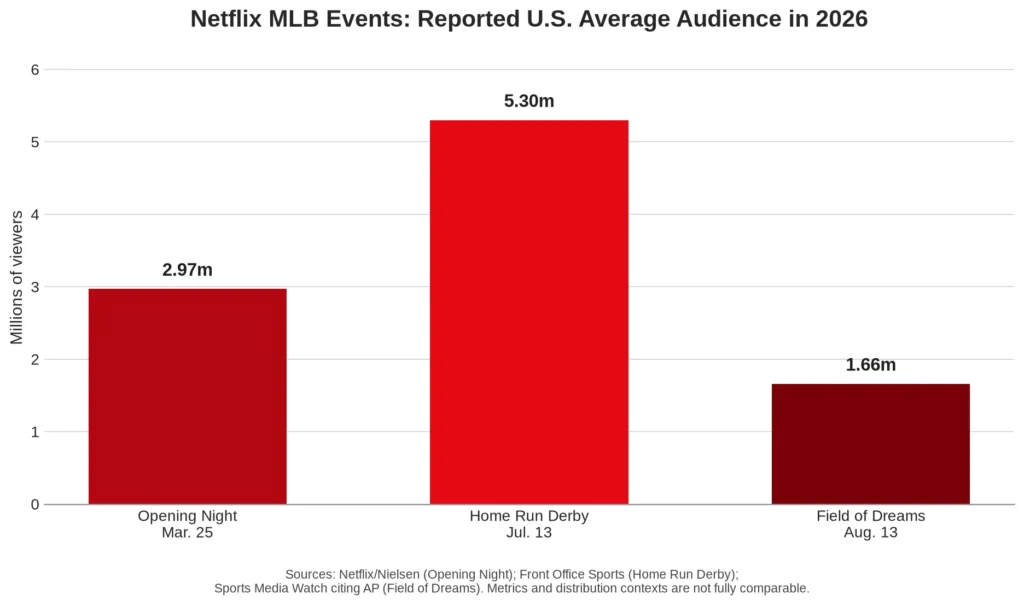
By the August 2026 cutoff, three events had aired. The results do not tell one story. They tell three.
Opening Night, March 25, 2026. Netflix streamed a standalone Yankees-Giants game and reported an estimated 3.0 million U.S. viewers on a Live+Same Day average-minute basis, citing Nielsen Big Data + Panel. Sports Media Watch and The Hollywood Reporter put the figure at 2.97 million, which is normal rounding rather than a contradiction. Netflix also claimed its highest primetime Opening Day audience among adults 18-49 (1.38 million) and 18-34 (636,000) since 2017. For a first live baseball broadcast on a subscription service with no linear carriage, three million average viewers is a legitimate result.
Home Run Derby, July 13, 2026. This is where it gets uncomfortable. Netflix reported 5.3 million average viewers, its largest baseball audience of the year. But the Derby had averaged 5.73 million across ESPN and ESPN2 in 2025, making the Netflix number a roughly 7.5 percent decline. Worse for the optics, multiple outlets including the New York Post noted it was the lowest Home Run Derby audience since 2003. The counterweight: Front Office Sports reported a median viewer age of 44.3 and stronger performance in younger demographics. So Netflix delivered a younger audience and a smaller one. Which of those matters more depends entirely on internal advertising and retention data that nobody outside the company has seen.
Field of Dreams, August 13, 2026. The Phillies-Twins game in Dyersville averaged a reported 1.66 million viewers, down about 46.5 percent from the 3.10 million that FOX drew for the 2022 edition. That is the single worst data point in the file. Sports Media Watch also reported that the 2027 Field of Dreams game would move to NBC and Peacock, with Netflix retaining an annual special-event entitlement but not that specific property.
Before anyone declares this a verdict, note what these comparisons are not. They are not controlled experiments. Different teams, different years, different calendars, different competing programming, different measurement contexts, and in the Field of Dreams case a four-year gap between editions. A percentage change describes two numbers. It does not identify what caused the difference.
Still, one pattern is hard to dismiss. Move a marquee, casually-discoverable event from linear television to an exclusive subscription platform, and measured reach appears to fall. Reports also noted viewer complaints about access and production around the Netflix broadcasts, which should be read as customer-experience signals rather than quantified operational failures. Linear TV delivers incidental audience: people who were already on the couch, already had the channel, and stumbled in. Streaming requires intent. Netflix bought events whose historical value was built partly on accident, and accidents do not migrate.
The $100 Million Detail Almost Everyone Misses
Here is the number that reframes the entire Netflix MLB deal, and it has nothing to do with MLB’s domestic rights.
Separately, Netflix acquired exclusive Japanese rights to all 47 games of the 2026 World Baseball Classic. Sports Business Journal reported that deal at $100 million, and The Athletic reported it as worth over $100 million according to people with knowledge of the transaction.
Sit with that. Netflix reportedly paid roughly twice as much for a single tournament in a single country as it paid annually for MLB’s Opening Night, the Home Run Derby, and a special event across its entire global service.
Do not add those two numbers together. Different rights, different geography, different counterparty, different transaction. Combining them would badly misstate the cost of the package under examination. But the comparison is analytically useful because it shows what Netflix is willing to pay when it believes the audience math works. Japan is a market where baseball is a genuine mass-culture event and where Netflix had a concentrated subscriber growth opportunity. The domestic MLB package, by contrast, was priced like an experiment. Netflix’s own checkbook suggests it valued the two propositions very differently.
Where the Money Went, and What It Bought at Corporate Scale
Let’s do the scale arithmetic honestly, with all the caveats attached.
Using the reported $50 million annual estimate against Netflix’s reported 2025 revenue of $45.2 billion, the fee equals 0.110619 percent of revenue. A hypothetical three-year total of $150 million, assuming a flat annual fee that has never been publicly confirmed, equals 0.331858 percent. Against the projected $3 billion in 2026 advertising revenue, the annual fee is about 1.67 percent.
These are scale ratios. They are not measures of total cost, and they are certainly not measures of profitability. The reported rights fee excludes production, technical operations, marketing, talent, ad-sales costs, and opportunity cost. It is a line item, not an investment total.
And this is the analytical trap most coverage falls into: concluding that because the fee is small relative to revenue, the deal is obviously cheap and therefore obviously smart. That does not follow. A rounding-error expenditure can still be inefficient if it produces no incremental value. Conversely, a smaller audience can still be economically attractive if it delivers high-value subscriptions, premium ad rates, or measurable churn reduction. Revenue is not profit. A rights fee is not total investment. Impressions are not cash.
Netflix’s consolidated numbers improved through this period. Q2 2026 revenue came in at $12.56 billion with a 33.4 percent operating margin, and full-year guidance sat at $51.0 to $51.4 billion with a 31.5 percent margin. None of that improvement can be attributed to baseball, and anyone who tries is confusing correlation with causation on a spectacular scale. The rights package started in 2026. Netflix’s margin expansion started years earlier.
If you want a purely illustrative sense of what the money bought in raw attention: three events, roughly $16.7 million apiece at the reported fee, delivering combined average audiences of roughly 10 million. That works out to about $5 per average viewer. Average-minute audiences are not additive across events and this figure should not be treated as a real unit cost, but it does put the transaction in human scale.
The Turning Points That Changed the Trajectory
Seven moments moved this story, and each one shifted the financial logic.
The first was Netflix’s entry into streaming in 2007, which built the billing relationships and distribution platform that made a live rights purchase even conceivable eighteen years later. Without 325 million paid memberships, nobody sells you the Home Run Derby.
The second was Netflix’s move into live events beginning in 2023, which converted live programming from an idea into an operational capability and a measurable budget category. By 2026, management could quantify it: just over 5 percent of content spend.
The third was the 2024 documentary collaboration with MLB, which established a working relationship. The financial effect was probably modest and the causal link to live rights is unproven, but relationship familiarity plausibly lowered execution risk on both sides.
The fourth, and the most important, was ESPN’s opt-out from Sunday Night Baseball in 2025. Netflix did not create this opportunity. It walked through a door that ESPN opened.
The fifth was the November 19, 2025 announcement, which converted opportunity into a defined three-season term with defined inventory and a reported price roughly one-eleventh of ESPN’s.
The sixth was March 25, 2026, the first live broadcast, which produced the first real evidence: three million estimated viewers and a genuinely younger audience.
The seventh was the July-August 2026 stretch, when the Derby came in below its linear baseline and Field of Dreams came in at half its 2022 level, followed by news that Field of Dreams would move to NBC and Peacock for 2027. The financial consequence is not a loss. It is an unresolved question about whether exclusive streaming distribution structurally shrinks marquee events.
The Financial Decisions That Look Smart, and the Ones That Look Risky
Three decisions hold up well on the available evidence.
Choosing a bounded, event-led package rather than a full season limited both financial exposure and operational complexity. Netflix got a clear promotional calendar without committing to weekly production, weekly technical risk, or nine-figure annual spending. Compared to ESPN’s reported $550 million a year, Netflix’s reported $50 million looks like a well-priced call option on the sports vertical.
Partnering with MLB Network on production was similarly disciplined. Pairing your distribution strength with the incumbent’s operational expertise is a textbook way for an entrant to reduce launch risk. The cost allocation is undisclosed, so this is a design principle rather than a proven saving.
Making the games available to all active subscribers across every plan, as Netflix stated in its Opening Night materials, maximized member value and avoided the friction of a paywall-within-a-paywall. It also forfeited any direct transactional revenue, which is a real trade-off with no public data to settle it.
The risks are equally clear. Concentration is the sharpest: with only three events a year, one bad matchup, one weather problem, or one technical failure disproportionately shapes the annual narrative. Fixed content costs mean the money is committed whether the audience shows up or not. Rights-renewal risk arrives in 2028, when MLB’s national inventory returns to a market where Netflix will have either proven the thesis or handed the league leverage. And fan-friction risk compounds across the sport: the more national baseball fragments across ESPN, NBC, Peacock, Netflix, and MLB.TV, the harder it becomes for a casual viewer to find any of it.
What the record does not support is calling this a financial failure. There is no disclosed impairment, no audited event-level loss, no reported subscriber shortfall, no contractual dispute. Lower cross-platform ratings are a warning signal, not a verdict.
What the Public Story Doesn’t Explain
The most honest finding of this entire exercise is a negative one.
Netflix reports as a single segment and does not disclose deal-level economics. MLB does not publish consolidated audited financials. Neither party has released the contract. As a result, there is no reliable public figure for MLB-attributable subscriber acquisition, MLB-attributable churn reduction, event-level advertising revenue, CPMs, fill rates, production cost, or profit contribution. Not one of those numbers exists in the public record.
That opacity is not unique to Netflix. YouTube’s reported revenue has grown into the tens of billions, yet Alphabet also withholds the platform’s standalone costs and operating profit. In both cases, the public can measure scale without being able to calculate the return on the individual asset.
That absence is not proof that Netflix lacks such analysis internally. It almost certainly has it, in granular detail. It only marks the boundary of what anyone outside can legitimately claim. And it should make you deeply skeptical of any headline confidently declaring the Netflix MLB deal a triumph or a bust.
What the Money Story Actually Teaches
There are three lessons here that travel far beyond baseball.
The first is the difference between owning and renting. Netflix obtained strategic relevance in a new category through a contract rather than an acquisition. The upside is low capital commitment, defined duration, and reversibility. The cost is expiry, renewal risk, and zero claim on the underlying asset’s appreciation. If MLB’s rights are worth substantially more in 2029, Netflix captures none of that gain. Anyone choosing between licensing and ownership should map exactly what they own, what they rent, and what happens the day the contract ends.
The second is that a single metric will mislead you. Netflix explicitly told shareholders that live programming consumes five times its share of view hours in content spend, and then explained why it buys it anyway. Ratings alone cannot value this package. Neither can sign-up spikes, nor impressions, nor demographic median age. A serious scorecard needs audience, technical performance, acquisition, retention, advertising yield, brand effect, and fully-loaded cost. Netflix appears to run that scorecard internally. The public runs one number and draws conclusions.
The third is about buying scarce attention selectively. Netflix did not need to own baseball to benefit from baseball. It bought the moments that market themselves and skipped the 2,400 games that don’t. That is a genuinely transferable idea for anyone allocating capital toward attention: you rarely need the whole value chain, only the moments that give people a reason to show up right now.
The most defensible verdict on the Netflix MLB deal as of August 2026 is unsatisfying and correct. Strategically coherent. Economically unproven. Operationally three games into a nine-game sample. MLB used a post-ESPN reshuffle to spread premium events across partners and collect roughly three-quarters of a billion dollars a year. Netflix used the cheapest available entry point to extend its live-events strategy into baseball without betting the content budget on it.
The relationship has moved from documentaries to live events. It has not moved to ownership. And the question that actually matters, whether $50 million a year buys more value than it costs, remains locked inside two organizations that have no obligation to tell you the answer.
Financial disclaimer: This article is journalism and analysis based on publicly available records, including official league announcements, SEC filings, issuer communications, and reputable media reporting. It is not financial, investment, legal, or tax advice, and it is not a valuation opinion or a recommendation to buy, sell, or hold any security. The reported $50 million annual rights fee and the reported audience figures discussed here are estimates published by third parties and have not been confirmed by the executed contract or by either party's financial disclosures. Figures described as reported or estimated should not be treated as verified facts. Readers should conduct their own research and consult a qualified professional before making any financial decision.
Sources
Major League Baseball, “MLB announces new 3-year rights deals with ESPN, NBC, Netflix,” November 19, 2025.
Netflix Tudum, “MLB on Netflix: Opening Night, the Home Run Derby, and Field of Dreams,” November 19, 2025.
Netflix, Inc., Form 10-K for the fiscal year ended December 31, 2025 (SEC filing).
Netflix, Inc., Q4 2025 Shareholder Letter, January 20, 2026.
Netflix, Inc., Q2 2026 Shareholder Letter, July 16, 2026. https://s22.q4cdn.com/959853165/files/doc_financials/2026/q2/FINAL-Q2-26-Shareholder-Letter.pdf
Reuters, “MLB signs three-year media deals with Netflix, NBCUniversal, ESPN,” November 19, 2025.
CNBC, “Major League Baseball announces new media rights deals for NBC, ESPN and Netflix,” November 19, 2025. https://www.cnbc.com/2025/11/19/mlb-media-rights-deals-nbc-espn-netflix.html
ESPN, “ESPN, MLB reach new 3-year media rights agreement,” November 2025. https://www.espn.com/mlb/story/_/id/47026249/espn-mlb-reach-new-3-year-media-agreement
The Wall Street Journal, “Major League Baseball Signs New Rights Deals With ESPN, NBCU and Netflix,” November 2025.
Sports Business Journal, “Netflix looks to ‘eventize’ MLB Home Run Derby with new format,” July 13, 2026.
Netflix, “MLB Opening Night on Netflix Scores 3 Million US Viewers,” April 1, 2026. https://about.netflix.com/news/mlb-opening-night-on-netflix-scores-3-million-viewers
The Hollywood Reporter, “Baseball’s New TV Partners Deliver Solid Audiences on Opening Day(s),” March 2026. https://www.hollywoodreporter.com/tv/tv-news/mlb-opening-day-ratings-netflix-nbc-1236553967/
Front Office Sports, “Home Run Derby Ratings Drop 7% on Netflix,” July 17, 2026. https://frontofficesports.com/home-run-derby-ratings-drop-7-on-netflix/
New York Post, “2026 Home Run Derby draws worst ratings in over two decades,” July 16, 2026. https://nypost.com/2026/07/16/sports/2026-home-run-derby-draws-worst-ratings-in-over-two-decades/
Sports Media Watch, “Netflix MLB opener just shy of three million mark,” April 2026.
Sports Media Watch, “MLB Field of Dreams returns with steep viewership decline in Netflix debut,” August 2026. https://www.sportsmediawatch.com/2026/08/field-of-dreams-viewership-steep-decline-netflix/
Awful Announcing, “MLB Field of Dreams Game viewership craters on Netflix,” August 2026. https://awfulannouncing.com/mlb/netflix-field-of-dreams-game-viewership.html
MLB.com, “Netflix to become Japan’s exclusive home for ’26 World Baseball Classic.” https://www.mlb.com/news/world-baseball-classic-netflix-announce-partnership-for-2026-tournament-in-japan
The Athletic, “How much do WBC winners get? Thanks to Netflix dollars, payouts rise,” March 17, 2026.
CNBC, “Netflix (NFLX) earnings Q2 2026,” July 16, 2026. https://www.cnbc.com/2026/07/16/netflix-nflx-earnings-q2-2026.html

Comments
Loading comments...