







Fixed Operations Manager Salary: Why This Clarksburg Job Pays $151K–$200K
Fixed Operations Manager salary numbers this high almost never show up next to a small West Virginia city. Yet that is exactly what a confidential automotive dealership job in Clarksburg, WV is advertising right now: a $151,000–$200,000 job offer.
Federal wage data for May 2025 puts the top 10% of comparable supervisors across the entire northern West Virginia region at about $121,870. The bottom of this posted range starts nearly $30,000 above that 90th-percentile mark. In a town where the median household income sits under $50,000, the gap is hard to ignore.
Either this is the strongest fixed-operations role in the region, or the number still needs explaining. Let’s dig into which one it is.
Introduction: What We’re Actually Looking At
The job is titled “Fixed Operations Manager — Automotive Dealership,” located in Clarksburg, West Virginia, ZIP 26301. It’s full-time and on-site. The posting is published by a recruiting firm on behalf of an unnamed client. There is no visa sponsorship, and relocation assistance is described as limited. The advertised pay is $151,000 to $200,000 per year.
Everything after that gets murkier, and the murkiness is the story.
Before we go further, let’s define the job title, because “fixed operations” is industry shorthand that means nothing to most people. A car dealership has two economic halves. The first half sells vehicles — that’s “variable operations,” because the inventory and the revenue swing wildly with the market. The second half fixes and maintains vehicles and sells parts — that’s “fixed operations,” because the work is steadier and more predictable. People buy a car once every several years. They need oil changes, brakes, tires, and warranty repairs constantly.
A Fixed Operations Manager runs that second half. In this posting, that means both the Service department (technicians, service advisors, repair work) and the Parts department (inventory, ordering, pricing). Add budgets, payroll, hiring, customer complaints, safety, compliance, and the department’s profit-and-loss results. The posting asks for seven to ten or more years of dealership fixed-operations experience and prior experience managing other managers. Education level is flexible.
So: two departments, multiple managers, real financial accountability. That’s not a shift supervisor. That’s an operating executive with a modest title.
What This Job Actually Offers
The posting is unusually specific about how performance will be measured, which is genuinely useful. It names repair order count, labor hours, effective labor rate, parts sales and gross profit, technician productivity, customer-pay business, and service retention.
Translated into plain English:
A repair order (RO) is the paperwork ticket for one customer visit — so “RO count” is simply how many jobs come through the shop. Labor hours are the billable hours of technician work sold. Effective labor rate is what the dealership actually collects per billed hour after discounts, warranty work at manufacturer-set rates, and internal work — which is almost always lower than the price posted on the wall. Gross profit is revenue minus the direct cost of what was sold (the technician’s wage, the part’s cost), before overhead. Technician productivity measures how much of a technician’s available time turns into billable output. Customer-pay business is work the customer pays for out of pocket, which matters because it’s the highest-margin and most competitive category — warranty work is paid by the manufacturer at controlled rates, and internal work is just moving money between departments. Service retention is whether customers come back.
One more term you’ll need: fixed absorption. That’s the percentage of the dealership’s total overhead — rent, utilities, administration, salaries — that the Service and Parts gross profit alone can cover. If absorption is high, the store survives a bad sales month. If it’s low, the whole business depends on selling cars. A good fixed operations manager is, functionally, the person who makes the dealership recession-resistant.
That’s what makes this a legitimately senior job. It’s also what makes the pay number less shocking than it first appears.
The same salary-versus-scope test appears in a different profession in our Senior Tax Manager salary audit from Plymouth, Michigan, where the title also hides several jobs inside one salary range. The comparison matters because a “manager” label tells you far less than the decisions, people, revenue, and risk the employer expects one person to carry.
The Salary: Is It Competitive?
Here’s where the receipts come out.
Documented fact: the posting advertises $151,000–$200,000 per year. The midpoint is $175,500. The spread is $49,000, meaning the top of the range is 32.45% above the bottom. That’s a wide gap, and wide gaps usually mean one of three things: a genuinely broad experience band, a performance-based component, or an aspirational ceiling almost nobody reaches.
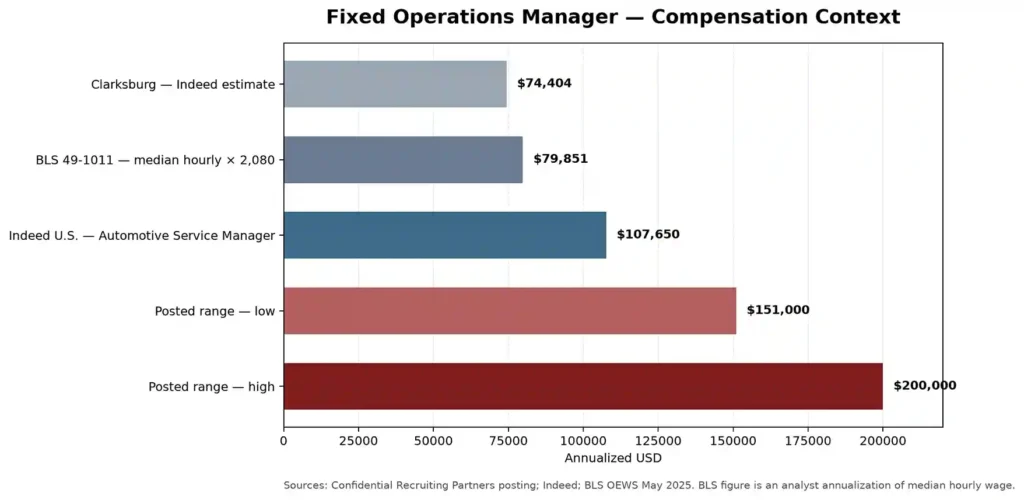
Market data. Let’s start with the most rigorous source available: the Bureau of Labor Statistics Occupational Employment and Wage Statistics program (OEWS), May 2025 data. Its closest occupation code is 49-1011, “First-Line Supervisors of Mechanics, Installers, and Repairers.” Nationally, the median wage is $38.39 an hour, or $79,860 a year. A quick definitional note, because it matters: the median is the middle — half earn more, half earn less. The mean is the arithmetic average, which gets pulled upward by high earners. The document under review annualized the national median hourly figure at 2,080 hours to get roughly $79,851, which is close to the published $79,860.
Now the local layer, which the original analysis left as a gap. Harrison County — where Clarksburg sits — falls into the Northern West Virginia nonmetropolitan area for BLS wage purposes. For that specific area, occupation 49-1011 in May 2025 looks like this:
| Percentile | Annual wage (Northern WV nonmetro) |
|---|---|
| 10th | $44,610 |
| 25th | $53,630 |
| Median (50th) | $76,760 |
| 75th | $100,150 |
| 90th | $121,870 |
Statewide, West Virginia’s median for the same occupation is $71,360, with a 90th percentile of $121,420.
Our calculation: the bottom of the posted range, $151,000, is about 96.7% above the regional median of $76,760 and about 24% above the regional 90th percentile. The top of the range, $200,000, is roughly 2.6 times the regional median and 64% above the 90th percentile.
Before anyone declares this suspicious, an honest caveat: BLS occupation 49-1011 covers first-line supervisors across all industries — HVAC crews, industrial maintenance, fleet shops — and it excludes people classified as general or operations managers. A combined Service-and-Parts executive who manages other managers arguably sits above this occupation code entirely. So the comparison tells us the role is priced well above frontline supervision. It does not prove the number is inflated.
Aggregator data gives a second, softer read. Indeed reports about $107,650 as a national average base salary for “Automotive Service Manager,” built from roughly 6,100 salaries pulled from job postings over three years. Against that, $151,000 is 40.3% higher and $200,000 is 85.8% higher. ZipRecruiter puts “Automotive Fixed Operations Director” nationally at about $107,680. Glassdoor, using self-reported salaries for “Fixed Operations Director,” shows a range of roughly $138,791 at the 25th percentile to $229,421 at the 75th — which lands the posted range squarely mid-pack for the director-level title. Salary.com’s model puts a Fixed Operations Director average around $205,282.
The lesson there is not “the market pays X.” It’s that title inflation and title deflation are rampant in this industry, and the aggregators are measuring different jobs under similar names. Analysis: the posted range is high for a “Service Manager,” normal for a “Fixed Operations Director,” and the posting’s actual scope reads like the latter.
One data point deserves to be thrown out entirely. Indeed’s Clarksburg-specific page shows $74,404 for Automotive Service Manager — but the same page reports “-1 salaries” as its sample size and a last-updated date of January 1, 1970. That date is the Unix epoch, the zero point computers use when no real timestamp exists. In plain terms: that number is an automated placeholder with no local data behind it. It should not be used to argue anything, in either direction.
Finally, comparable postings. Public listings in the same space include a Charleston, West Virginia service manager role advertised at $100,000–$150,000, and national fixed-ops leadership postings at $130,000–$180,000, $150,000–$225,000, and $190,000–$240,000. Comparative analysis: $151,000–$200,000 is inside the normal band for advertised fixed-ops leadership nationally, and toward the top of what appears publicly in West Virginia.
The Reverse Math: Can a Dealership Actually Pay This?
This is the test most candidates skip. Instead of asking whether the number is generous, ask whether the store can afford it.
Cox Automotive reported average dealership Service and Parts revenue of roughly $9.23 million in 2025, up 33% over eight years. Industry pay-plan consultants describe fixed-operations management compensation commonly landing somewhere in the range of 5% to 10% of department gross profit — that’s practitioner guidance, not audited data, so treat it as directional.
Our calculation, with a clearly labeled assumption: if a manager were paid 6% of fixed-operations gross profit, earning $175,500 would require about $2.93 million in department gross profit, and $200,000 would require about $3.33 million. If we assume service-and-parts gross profit runs somewhere near 45% of service-and-parts revenue — an illustrative industry rule of thumb, not a verified figure for this store — that implies roughly $6.5 million to $7.4 million in annual Service and Parts revenue.
That’s below the $9.23 million average store. Which means the advertised range is economically plausible at a merely average-sized dealership, and comfortable at an above-average one. The number is not fantasy. It is, however, a number that a normal pay plan would deliver only if the department performs.
That distinction is the entire game.
What the Benefits Are Really Worth
Nothing. Not because they’re bad — because they aren’t disclosed. The posting lists no health insurance, no retirement plan, no paid time off, no vehicle allowance, no bonus structure.
This is a bigger hole than it looks. Total compensation — the full economic value of employment — is base pay plus bonus plus employer-paid benefits plus everything else quantifiable. Here’s what typical employer-paid benefits are worth, using the KFF 2025 Employer Health Benefits Survey, the most authoritative annual source on the subject: average family premiums hit $26,993, with workers contributing $6,850 and employers covering roughly $20,143. Average deductible for single coverage was $1,886.
On retirement, Vanguard data indicates the average promised maximum employer 401(k) match among its plans in 2025 was about 4.7% of pay, with a median of 4.0%.
Our estimate: if this employer offers typical benefits, the package at the $175,500 midpoint could look like roughly $175,500 in cash, plus about $20,000 in employer-paid family health premium, plus roughly $7,000–$8,250 in retirement match — total economic value in the neighborhood of $203,000. If the employer offers weak benefits, high-deductible coverage with minimal subsidy and no match, that same $175,500 stays $175,500 and the worker absorbs $6,850 or more in premiums out of pocket.
That’s a swing of $25,000 to $28,000 a year in real money, entirely invisible in the posting. The public information does not establish which scenario applies.
What the Employer Is Asking For
Flip the perspective. What is this dealership actually buying?
It’s buying accountability for two interdependent departments, supervision of other managers, financial analysis skill, hiring and retention capability in the middle of a documented labor shortage, customer-escalation absorption, safety and compliance ownership, and seven to ten-plus years of dealership-specific experience that cannot be faked or trained quickly.
On the labor shortage: NADA estimates roughly 39,000 new service technicians graduate from U.S. training programs annually against a need to replace nearly 76,000 — an annual shortfall of about 37,000. Analysis: that means a chunk of this job’s performance targets depend on an input the manager may not be able to buy at any price. You cannot bill hours you don’t have technicians to produce.
On the competitive picture: Cox Automotive reported that dealer share of service visits fell from 33% to 29% even as revenue climbed. The Auto Care Association and MEMA, using an S&P Global Market Intelligence forecast released June 12, 2025, projected the U.S. light-duty aftermarket at $435 billion in 2025 and above $500 billion by 2028, while noting the dealer channel had lost 1.4 percentage points of share since 2017.
Read those two facts together and you get the honest job description: grow customer-pay revenue and retention in a market where dealerships are collectively losing customers to independent repair shops, while short-staffed.
That’s a hard job. It’s supposed to be well paid.
The Hidden Cost of Taking This Job
Now the part nobody puts in the offer letter.
Overtime doesn’t exist here. A role at this level is almost certainly classified as exempt under the Fair Labor Standards Act — meaning salaried, with no legal entitlement to overtime pay no matter how many hours are worked. The posting doesn’t state hours, and that omission is expensive.
Our calculation of effective hourly compensation — annual pay divided by actual hours worked:
| Hours worked per week (50 weeks) | At $151,000 | At $200,000 |
|---|---|---|
| 40 (2,080 hrs) | $72.60 | $96.15 |
| 50 (2,500 hrs) | $60.40 | $80.00 |
| 55 (2,750 hrs) | $54.91 | $72.73 |
| 60 (3,000 hrs) | $50.33 | $66.67 |
Here’s the receipt that should shape the interview: the Northern West Virginia 90th-percentile hourly wage for comparable supervisors is $58.59. At 60 hours a week, the bottom of this range works out to about $50.33 an hour — below that regional 90th percentile. The premium in this job is real, but a meaningful slice of it can be consumed by hours if the schedule includes six-day weeks, Saturday service hours, and after-hours availability. Dealership fixed-ops leadership commonly involves all three. The posting doesn’t say, so ask.
Commuting. The role is on-site, no remote option. Our estimate, using stated assumptions: six commuting days a week for 50 weeks is 300 trips; a 20-mile round trip yields 6,000 miles a year. Using the IRS standard business mileage rate as a proxy for total per-mile vehicle operating cost — 72.5 cents for the first half of 2026 and 76 cents from July 1 — that’s roughly $4,350 to $4,560 a year in vehicle cost, plus about 150 hours of unpaid time. To be precise about the tax point: commuting to your regular workplace is not deductible. The IRS rate is used here only because it’s a credible published estimate of what driving a mile actually costs.
Relocation. The posting says assistance is limited and there’s no visa sponsorship. For an out-of-state candidate, moving costs, temporary housing, travel, and the gap between selling and buying are real and unfunded. There’s no public figure to attach here, so no figure will be invented — but this belongs on the ledger.
The Local Market Comparison: Where Clarksburg Helps
This is where the offer starts looking genuinely strong.
Documented facts: the Census Bureau estimates Clarksburg’s population at 15,562 as of July 1, 2025, down 4.7% from the 2020 base. Median household income for the city (2020–2024, in 2024 dollars) is $47,386, with a 23.5% poverty rate. Harrison County overall is healthier at $60,377 median household income.
Important definitional caution: median household income is not an individual salary benchmark. A household can include two earners or none. It’s a purchasing-power indicator, not a wage comparison.
And as a purchasing-power indicator, it’s striking. Our calculation: $151,000 is 3.19 times the city’s median household income; $200,000 is 4.22 times.
Housing is the clincher. Zillow data for 2026 shows an average home value in Clarksburg of about $122,306, a median sale price of $128,483 as of May 31, 2026, and an average home value in ZIP 26301 of about $119,649. Analysis: a typical Clarksburg house costs less than one year of the low end of this salary range. That relationship essentially does not exist in most American metro areas.
Cost-of-living aggregators put Clarksburg roughly 5% below the national average overall, with rents around 15% below national. Our estimate: adjusting for that, $151,000 in Clarksburg carries purchasing power roughly equivalent to $159,000 in an average-cost U.S. city, and $200,000 behaves like roughly $211,000. Aggregator cost-of-living indexes use varying methodologies and should be treated as approximations.
What the Worker Could Actually Take Home
Our estimate. These are illustrative calculations for a single filer with no dependents, one West Virginia personal exemption, no 401(k) deferrals, and no pre-tax benefit deductions. Your actual result will differ.
At $151,000: federal income tax of roughly $24,974 using the 2026 brackets and the $16,100 single standard deduction; Social Security and Medicare taxes of about $11,552 (Social Security applies to the first $184,500 in 2026); West Virginia income tax of about $6,027 under the 2026 rate schedule, which tops out at 4.58% on income above $60,000 after a $2,000 personal exemption. Total roughly $42,553, leaving about $108,447 a year, or $9,037 a month.
At $200,000: federal of about $36,734; payroll taxes of about $14,339; West Virginia of about $8,271. Total roughly $59,344, leaving about $140,656 a year, or $11,721 a month.
Now stack that against local housing. A $130,000 home with 20% down leaves a $104,000 mortgage. At an illustrative 6.5% on a 30-year fixed — a rate assumption, not a verified quote — principal and interest run about $657 a month, and Harrison County’s effective property tax rate of roughly 0.54% adds about $58 a month, plus insurance. Call it under $900 all-in. That’s under 10% of the low-end monthly take-home.
Financial planners commonly warn against exceeding 30% of income on housing. This job, in this town, at the bottom of its range, lands near a third of that threshold. That is the strongest single number in this entire analysis.
The Total Compensation Calculation
Putting it together at the $175,500 midpoint, under the assumption of typical benefits:
Base and variable cash of $175,500, plus roughly $20,143 in employer-paid family health premium, plus roughly $7,020 in a 4% retirement match, for an estimated total annual compensation of about $202,663. Subtract the commuting cost estimate of roughly $4,500 and you land near $198,000 in net economic value before taxes.
Every benefit figure in that stack is a market average substituting for information the employer did not provide. Change the benefits assumption and the answer moves by $25,000 or more. That’s not a rounding error — that’s the difference between a very good job and a merely good one.
The Career Value
This is the underrated upside. Moving from single-department Service Manager to combined Service-and-Parts leadership is one of the few genuine step-changes available in dealership operations. It builds full profit-and-loss fluency, manager-of-managers experience, and inventory-capital responsibility — the exact résumé that leads to General Manager, multi-store fixed-ops director, or dealer-group roles.
NADA’s current service guidance emphasizes fixed absorption, capacity alignment, technician efficiency, effective labor rate, throughput, and expense control. Cox’s 2025 findings associate high performance with digital scheduling, electronic estimate approval, repair photos and videos, and tight parts-service integration — though association isn’t proof of causation. Analysis: a candidate who genuinely gets to touch those levers here will be more employable in three years, regardless of how this specific job turns out. That option value is real, and it’s not in the salary number.
The Risks and Red Flags
Let’s be direct about what’s wrong with this offer as presented.
The employer is anonymous. No legal entity, no dealership name, no brand, no ownership group, no facility address. Confidential searches are legitimate and common — employers use them to avoid signaling a leadership change. But confidentiality shifts the entire due-diligence burden onto the candidate. You cannot check financial condition, employee reviews, litigation history, manufacturer standing, or turnover on a company you can’t name.
The range isn’t defined. Base salary? Base plus bonus? On-target earnings? A ceiling only a top performer hits? Given that industry pay plans for this role are typically percentage-of-gross arrangements, there’s a meaningful chance that a large share of that $151,000–$200,000 is performance-dependent. The public information does not establish the split.
Responsibility may exceed authority. The posting is emphatic about accountability and silent about decision rights. Who sets technician pay plans? Who approves the labor rate? Who controls parts purchasing, hiring, marketing, and capital spending? If you own the numbers but not the levers, you own the downside only.
Availability is contradictory. The recruiter’s page listed the role as open while LinkedIn showed “no longer accepting applications.” That may just be platform lag, but confirm the requisition is live before investing time or travel.
The operating baseline is unknown. No repair order count, no bay count, no technician headcount, no gross profit, no absorption rate, no retention figures, no customer satisfaction scores, no warranty chargeback history. A premium range can signal seniority — or it can signal a turnaround nobody local wants to take.
Two departments, one person. Combining Service and Parts is strategically coherent, since parts availability directly drives technician productivity and customer satisfaction. It’s also a genuine span-of-control risk if support and staffing are thin.
None of these are proof of a bad job. All of them are questions with dollar values attached.
Is This Job Actually a Good Deal?
On the evidence: yes, probably — conditionally.
The cash is well above every credible regional benchmark. The local cost structure, especially housing, converts that cash into unusual purchasing power. The scope builds genuine career capital. The reverse math shows an average-sized dealership can actually fund this range.
Against that: the benefits are unknown, the pay structure is undefined, the employer is unnamed, and the hours are unstated. Those four gaps could each move the real value by tens of thousands of dollars a year.
Final Financial Score
A transparent framework, not a scientific measurement. Reasonable analysts would score this differently.
| Category | Weight | Score | Reasoning |
|---|---|---|---|
| Salary | 25 | 21 | Well above regional data; structure undefined |
| Benefits | 15 | 5 | Nothing disclosed; cannot credit what isn’t stated |
| Market competitiveness | 15 | 14 | Above the regional 90th percentile at the low end |
| Requirements vs. compensation | 10 | 7 | Very broad scope, but priced accordingly |
| Work-life / time economics | 10 | 5 | On-site, exempt, two departments, hours unstated |
| Job-related costs | 10 | 6 | Cheap local living offsets limited relocation help |
| Career growth | 5 | 4 | Strong step toward director and GM tracks |
| Job stability | 5 | 2 | Unnamed employer; nothing verifiable |
| Overall economic value | 5 | 4 | Attractive if verification holds up |
| Total | 100 | 68 |
Verdict: GOOD OFFER — CONDITIONAL.
Not “excellent,” and the reason is entirely about information, not economics. Verify a guaranteed base near the low end plus real benefits, and this reasonably scores in the low 80s. Discover it’s a thin base with an aggressive commission ceiling at an underperforming store with no benefits, and it drops toward high-risk. The evidence supports pursuing it. It does not support accepting it, resigning, or relocating yet.
What Went Right / What Went Wrong
The employer did three things well. It named its performance metrics specifically instead of hiding behind “manage operations,” which gives a candidate something concrete to negotiate against. It published a salary range at all, which many dealerships still refuse to do. And it accepted adjacent prior titles — Service Director, Parts Director, Fixed Operations Director — recognizing that dealership titles are inconsistent and that talent shouldn’t be filtered out by vocabulary.
Three things went wrong. Publishing a $49,000-wide range with zero explanation of its structure invites candidates to imagine a guaranteed $200,000 and creates predictable friction later. Listing no benefits at all leaves a five-figure hole in the value proposition. And staying anonymous while asking for a relocation-grade commitment loads the risk onto the person with the least information.
Financial Lessons for Job Seekers
Compare against local percentile data, not national averages — the regional 90th percentile told us more in one line than three aggregator averages combined. Divide by real hours, not 2,080, because an exempt salary at 60 hours is a different job than the same salary at 45. Treat undisclosed benefits as zero when comparing offers, then ask; roughly $20,000 in employer-paid health premium and a 4% match are worth negotiating for explicitly. Reverse-engineer whether the employer can afford the number, because a range that requires above-average department performance is a range you’ll be working for, not receiving. And never let an unnamed employer stay unnamed past the second conversation — a legitimate confidential search will disclose the client before asking you to uproot your life.
The questions that matter most here are short: What is the guaranteed base? What’s the bonus formula, and what did the last person actually earn under it? What are the trailing twelve months of repair order count, gross profit, and absorption? What are the service hours and how many Saturdays? Who approves the labor rate and the technician pay plans? What’s the benefits package in writing? And who, exactly, is the employer?
Financial Disclaimer: This article is for informational and educational purposes only. It is not financial, investment, tax, legal, employment, HR, career, or professional advice. Salary ranges, benefits, and job availability change without notice. All take-home pay, tax, commuting, benefit-value, total-compensation, and cost-of-living figures identified as estimates are illustrative calculations based on stated assumptions and published averages; actual outcomes depend on individual circumstances including filing status, dependents, deductions, elections, hours worked, and location. Job postings do not necessarily describe complete working conditions, compensation structures, or benefits. Market salary comparisons are estimates drawn from occupational data and aggregator sources with differing methodologies and job-title definitions. The employer in this posting is not publicly identified, and no representation is made about its financial condition, stability, or hiring practices. Readers should independently verify compensation, benefits, employment terms, and applicable laws before applying for or accepting any position, and should consult qualified tax, legal, and financial professionals about their own situations.
Sources
U.S. Bureau of Labor Statistics, Occupational Employment and Wage Statistics, May 2025, occupation 49-1011 First-Line Supervisors of Mechanics, Installers, and Repairers — national and West Virginia area detail, including the Northern West Virginia nonmetropolitan area, accessed via BLS and O*NET OnLine local wage tables (state and area percentile wages).
U.S. Census Bureau QuickFacts — Clarksburg city, West Virginia (population estimate July 1, 2025; median household income and poverty, 2020–2024 in 2024 dollars) and Harrison County, West Virginia (median household income, 2020–2024).
Indeed salary pages — Automotive Service Manager, United States (national average based on job postings) and Clarksburg, WV (noted here as unreliable due to a “-1 salaries” sample indicator and a January 1, 1970 update timestamp).
ZipRecruiter, Glassdoor, and Salary.com salary pages for Automotive Fixed Operations Director / Fixed Operations Director and Automotive Service Manager (self-reported and modeled estimates; methodologies vary).
Publicly advertised comparable fixed-operations and service management postings, including a Charleston, West Virginia service manager listing at $100,000–$150,000 and national fixed-ops leadership listings in the $130,000–$240,000 range.
KFF 2025 Employer Health Benefits Survey — average family premium $26,993, average worker contribution $6,850, average single-coverage deductible $1,886.
Vanguard research on 401(k) match formulas — average promised maximum employer match of approximately 4.7% of pay, median 4.0%, 2025.
Cox Automotive — 2025 dealership fixed operations ownership study findings on average service and parts revenue of approximately $9.23 million, 33% eight-year growth, and dealer service-visit share declining from 33% to 29%.
Auto Care Association / MEMA, forecast prepared by S&P Global Market Intelligence, released June 12, 2025 — U.S. light-duty aftermarket projected at $435 billion in 2025 and above $500 billion by 2028; dealer channel share down 1.4 percentage points since 2017.
NADA — NADA Data 2025 (16,990 franchised light-vehicle dealerships, 276 million-plus repair orders, $164 billion-plus service and parts sales), Fixed Operations training materials, Dealership Workforce Study, technician supply estimates (approximately 39,000 annual graduates against nearly 76,000 replacements), and “How Do I Fix My Service Department?” guidance dated May 8, 2026.
Internal Revenue Service 2026 standard mileage rates (72.5 cents per business mile January 1–June 30, 2026; 76 cents July 1–December 31, 2026) and 2026 inflation-adjusted federal brackets and standard deductions ($16,100 single; $32,200 married filing jointly).
Social Security Administration — 2026 contribution and benefit base of $184,500.
West Virginia State Tax Division — 2026 personal income tax rate reduction, top marginal rate 4.58%, effective retroactive to January 1, 2026; Tax Foundation state profile (graduated rates 2.11%–4.58%).
Zillow home value data for Clarksburg, WV and ZIP 26301, 2026; cost-of-living index estimates from Apartments.com, ExtraSpace, and RentCafe; Harrison County effective property tax rate via SmartAsset.
Automotive fixed-operations compensation consulting sources describing management pay plans in the range of roughly 5%–10% of department gross profit (practitioner guidance, not audited data).
Position filled.
This Fixed Operations Manager opportunity is no longer open. If you’re evaluating similar roles or want to stay informed about competitive compensation in fixed operations and dealership leadership, browse our latest career salary audits.




Comments
Loading comments...