







AI Video Generation Pricing: The Business Model Nobody Shows You
AI video generation pricing looks simple until you examine it closely. Strip away the marketing and you find that AI video credits are not a real currency, and the AI video business model underneath them only works if you never look carefully at what a single approved shot actually costs. That is exactly what happened to OpenAI’s Sora before it was switched off on April 26, 2026.
That shutdown is the cleanest evidence in this entire category. A product from the best-capitalized AI lab on earth launched to genuine global excitement, reached the top of the U.S. App Store, reportedly outpaced ChatGPT’s download growth, and then shut down within eighteen months. The Wall Street Journal reported that Sora was losing roughly $1 million per day. The models kept improving. The economics never caught up.
Meanwhile, the remaining players are selling Veo 3.1 for $4.99 a month.
Both of those facts are true at the same time, and the gap between them is where the real money story sits.
What You’re Actually Buying (Hint: It Isn’t Videos)
Start with a deceptively simple question: what does an AI video subscription buy?
Not videos. A subscription to Google Flow, Runway, Luma, Pika, Kling, or Adobe Firefly buys a metered claim on GPU time, dressed up in a proprietary points system, with a resolution ceiling, a model menu, a priority queue, an expiration date, and in Google’s and Adobe’s case a pile of unrelated software bundled on top so the video math becomes impossible to isolate.
Google’s AI Pro plan at $19.99 a month includes 1,000 Google Flow credits. It also includes 5 TB of storage, YouTube Premium Lite, Google Home Premium Standard, Google Health Premium, $10 in monthly Cloud credits, Gemini across Gmail and Docs, and 10,000 Google Flow Music credits. Try to compute a “cost per video” from that number honestly. You can’t. You can only compute a cost per credit and then argue about how much the rest is worth.
Adobe does the same thing from the other direction. Firefly Standard is $9.99 a month for 2,000 generative credits, and Adobe helpfully translates that into “up to 20 five-second AI videos per month.” Pro is $19.99 for 4,000 credits and up to 40 videos. Pro Plus is $49.99 for 10,000 credits and up to 100 videos. Premium is $199.99 for 50,000 credits plus, critically, unlimited generations on Veo 3.1 Fast, Kling 3.0, and all image models for the first year. Read that qualifier twice. “Unlimited” with an expiration date is a customer-acquisition instrument, not a cost structure.
This is the first thing the follow-the-money test surfaces: several of the largest players in AI video aren’t running an AI video business at all. They’re running a bundle business with a video feature that drives upgrades. Google monetizes Flow indirectly, through storage and subscription tiers. Adobe monetizes Firefly as a wedge into Creative Cloud. Kuaishou monetizes Kling partly as a standalone product and partly as an ad-creative factory inside its own marketplace the company disclosed that AI-generated short-video marketing materials accounted for 10% of total short-video marketing spend on its platform by March 2026.
Only Runway, Luma, Pika, and MiniMax are naked here. Their video product is the business.
A Credit Is Not a Currency
The single most important finding in this category is also the most boring-sounding: credits are not comparable across vendors, and often not comparable within a vendor.
Here’s what the same nominal action a five-second, 720p clip costs across published rate cards as of August 2026.
| Platform / model | Credit cost per 5s at 720p | Plan | Effective cost per clip |
|---|---|---|---|
| Pika 2.5 | 20 credits | Standard, $8/mo, 700 credits | ~$0.23 |
| Kling (720p reference) | 20 credits | Standard renewal, $8.80/mo, 660 credits | ~$0.27 |
| Luma Ray3.14, 720p | 100 credits (20/sec) | Plus, $30/mo, 10,000 credits | ~$0.30 |
| Adobe Firefly Video | vendor-published cap | Standard, $9.99/mo | ~$0.50 |
| Runway Gen-4 Turbo | 25 credits (5/sec) | Standard, $12/mo, 625 credits | ~$0.48 |
| Runway Gen-4.5 | 60 credits (12/sec) | Standard, $12/mo, 625 credits | ~$1.15 |
| Luma Seedance 2.5, 720p | 650 credits (130/sec) | Plus, $30/mo, 10,000 credits | ~$1.95 |
| Luma Veo 3.1 with audio, 720p | 1,400 credits (280/sec) | Plus, $30/mo, 10,000 credits | ~$4.20 |
Our calculation, assuming full quota consumption, one model, no retries. Estimates, not guaranteed prices.
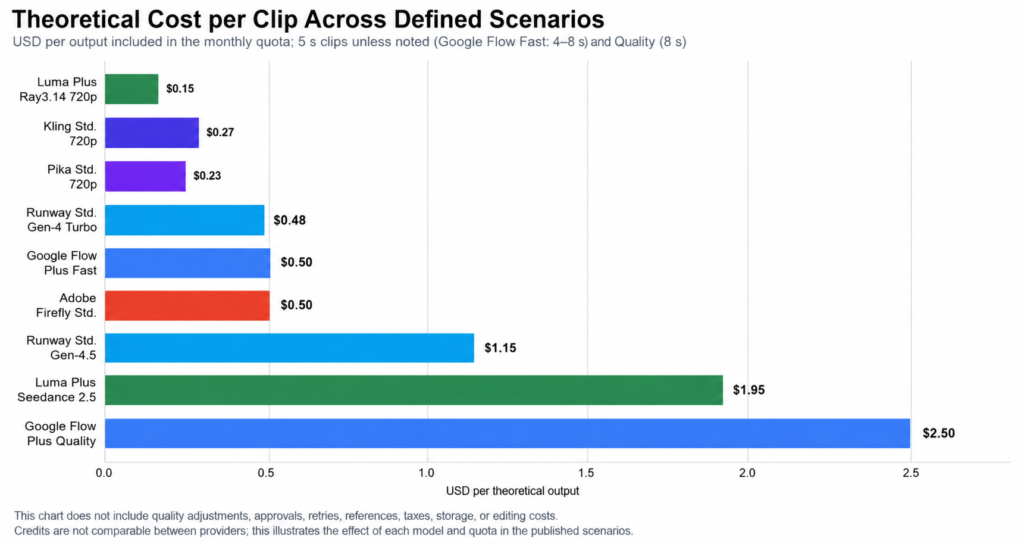
Look at the last three rows. Same subscription. Same $30. Same month. A fourteen-fold spread depending purely on which model you click. Luma’s own rate card confirms it: Ray3.14 runs 20 credits per second at 720p, Seedance 2.5 runs 130, and Veo 3.1 with audio runs 280.
One footnote on rigor, because it matters. The research document underpinning this piece listed Luma Plus + Ray3.14 at $0.15 per clip, based on 10 credits per second. Luma’s live pricing page lists 20 credits per second at 720p and the same document elsewhere correctly stated that 10,000 credits buys roughly 500 seconds of Ray3.14 at 720p, which is 100 five-second clips, not 200. Recomputed against the published rate, the figure is approximately $0.30. Small error, useful lesson: in a category where the unit of account changes every model release, even careful analysts double-count. Your finance team will too.
The Same Model, Four Different Prices
Now the part that should make anyone building on top of these platforms uncomfortable.
Veo 3.1 is one model, made by Google. It is sold through at least four storefronts, and the price varies by roughly a factor of five depending on which door you walk through.
Through Runway’s API, Veo 3.1 with audio costs 40 credits per second, and Runway API credits are $0.01 each. That’s $0.40 per second, or $2.00 for a five-second clip. Through Luma’s Plus plan, Veo 3.1 with audio at 720p costs 280 credits per second against credits that work out to $0.003 each roughly $4.20 for the same five seconds. Through Google Flow on the AI Pro plan, Veo 3.1 Quality costs 100 credits for an eight-second generation, and Pro credits price out around $0.02 about $2.00 for eight seconds. On Google AI Ultra at $199.99 for 25,000 credits, that same eight-second Quality generation costs roughly $0.80.
Per second of finished output: about $0.10 at the top Google tier, $0.25 at Google Pro, $0.40 through Runway’s API, and $0.84 through Luma Plus.
That is not a rounding error. That is a distribution margin, and it tells you precisely where value is being captured. Google sells its own model at close to cost inside a bundle it wants you locked into. Aggregators mark it up because they’re selling convenience, workflow, and a single pane of glass. Neither is wrong. But anyone budgeting a campaign on “we’ll use Veo” without specifying where is off by 5x before the first prompt.
The inversion also runs the other way. Kling’s developer pricing sets one unit at $0.14, with 720p at 0.6 units per second without audio ($0.084/sec, or $0.42 per five seconds) and 0.8 units with native audio ($0.112/sec). Kling’s consumer Standard plan works out to about $0.27 per 720p video. The API the professional, high-reliability, commercially licensed channel costs more per clip than the consumer subscription. That’s rational pricing (developers buy concurrency, SLAs, and terms, not just pixels), but it demolishes the assumption that scaling up gets you a volume discount.
Runway does something similar internally. API credits are $0.01. Standard subscription credits work out to roughly $0.019 – 625 credits a month for $12. Same company, same models, and the self-serve app charges nearly double the developer rate per credit. The app is the higher-margin product. That is almost always true in this category, and it explains a great deal about where these companies point their marketing.
Where the Revenue Actually Comes From
Here is what’s publicly documented, and it’s a genuinely wild spread.
Kling is the commercial standout, and it isn’t close. Kuaishou disclosed that Kling AI generated over RMB 650 million in revenue in Q1 2026 growth of more than 300% year over year and that Kling’s annualized revenue run rate hit approximately $500 million in March 2026. That makes Kling, by disclosed numbers, the largest pure AI video business in the world. It’s also the one attached to a profitable parent: Kuaishou posted RMB 33.7 billion in Q1 revenue and RMB 3.4 billion in adjusted net profit.
Runway is the Western leader. Sacra estimated roughly $90 million in annualized revenue by June 2025, with the company forecasting $265–300 million by end-2025 on the back of Gen-4 and its API push. In February 2026 Runway closed a $315 million Series E led by General Atlantic with NVIDIA, AMD Ventures, Adobe Ventures, Fidelity, and Premji Invest participating at a $5.3 billion post-money valuation, bringing total funding to roughly $1.05 billion. Revenue is a mix of self-serve subscriptions, enterprise contracts, API usage, and model-licensing deals with Getty Images and Lionsgate.
Adobe monetizes Firefly as part of a $26 billion ARR machine. In Q1 FY2026 Adobe reported the Firefly app crossing $250 million in ARR on total revenue of $6.4 billion. By Q2 FY2026, revenue hit a record $6.62 billion and “AI-first” ARR tripled year over year past $500 million. Firefly is meaningful and growing and still under 4% of Adobe’s business.
MiniMax, Hailuo’s parent, is the only one with an audited public record, and it is brutal reading. The company IPO’d in Hong Kong on January 9, 2026, raising about $620 million after a retail book oversubscribed 1,848 times. Revenue: zero in 2022, $30.5 million in 2024, $79 million in 2025 (up 158.9%). Losses: $73.7 million in 2022, $465 million in 2024, and a 2025 net loss of $1.87 billion inflated by fair-value movements, but sitting on top of roughly $1.3 billion in accumulated losses. Notably, 73.1% of MiniMax’s revenue came from overseas consumer app subscriptions and in-app purchases, not enterprise contracts.
Luma raised $900 million in a Series C led by Saudi Arabia’s HUMAIN in November 2025, at a reported valuation around $4 billion, tied to a 2-gigawatt AI supercluster partnership. It has published no revenue figures.
Pika has raised roughly $135 million total and was valued at $470 million after its 2024 Series B. Third-party databases estimate revenue under $5 million a low-confidence figure from a non-primary source that should be treated as directional at best. Pika reportedly held acquisition discussions with Meta in July 2025.
So: one business at roughly half a billion in ARR inside a profitable parent, one venture-backed leader in the low hundreds of millions, one enterprise incumbent using video as a feature, one publicly traded company losing more than twenty dollars for every dollar of 2025 revenue, and two companies whose economics are simply not disclosed.
The Cost Side, and Why Everyone Is Quiet About It
None of these companies publish gross margin on video generation. That silence is itself information.
What we can establish: video inference is dramatically more expensive per unit of output than text or images. Runway’s own documented history makes the point Sacra estimated roughly $44 million of recognized revenue in calendar 2024 against a $155 million EBITDA loss, driven by cloud compute and model training. That’s roughly $3.50 of burn per dollar of revenue. Runway has since contracted with CoreWeave for GB300 NVL72 systems and ported Gen-4.5 to Vera Rubin hardware in a day, which management frames as a path to lower per-unit inference cost. The migration speed is real and verifiable. Whether it produces software-grade gross margins is not yet demonstrated.
Kuaishou offers the only quasi-public read on AI video’s margin drag. Group gross margin fell from 54.6% in Q1 2025 to 51.2% in Q1 2026, and adjusted net profit declined 26.3% year over year during the exact quarter Kling’s revenue grew over 300%. Kuaishou does not attribute the margin compression specifically to Kling, and it would be irresponsible to claim causation from segment-free data. But it is the shape you would expect if a fast-growing, compute-heavy product were scaling inside a mature advertising business.
Reported estimates around Sora suggested each standard ten-second clip cost roughly $1.30 in compute, against consumer pricing that came nowhere near covering it. Those figures come from secondary aggregators rather than OpenAI, so treat them as unverified. The verified fact is simpler and more damning: OpenAI killed the product, and the WSJ-reported burn was about $1 million a day.
Now run the sensitivity yourself. Pika Standard is $8 a month for 700 credits 35 five-second 720p clips. If the fully loaded compute cost per clip were $0.10, gross margin is roughly 56%. At $0.15, it’s 34%. At $0.23, it’s zero. We do not know Pika’s actual cost per generation, and nobody outside the company does. But that’s the range where a $8 price point lives, before customer support, storage, moderation, payment processing, or R&D. This is illustrative arithmetic, not a claim about Pika’s books.
Contrast that with a normal SaaS business, where the cost of serving the marginal user rounds to nothing. In AI video, the marginal user costs real money every time they press generate and the free tiers cost money too. Google gives away 50 Flow credits per day to non-subscribers. Pika gives 80 credits a month. Kling gives 66 daily credits. Every one of those is a GPU bill with a customer-acquisition label taped to it.
The Unit Economics Nobody Can Calculate Including the Companies’ Investors
Here’s the honest part: CAC, LTV, churn, net revenue retention, and payback period cannot be computed for any of these platforms from public information. Not one of them discloses subscriber counts, conversion rates, or cohort retention for video specifically. Adobe reports ARR but not Firefly churn. Kuaishou reports Kling revenue but not Kling users or margins. MiniMax’s filings disclose group financials, not per-product economics.
What we can say is that the category’s retention profile looks structurally suspicious. Sora’s downloads fell 66% from their November 2025 peak by April 2026. Google Flow logged over 275 million generated videos in about five months up from 40 million in July 2025 which is a spectacular usage number that tells you nothing about paid conversion. Across all AI video platforms, monthly active users reportedly passed 124 million in January 2026. Enormous top of funnel. Undisclosed bottom.
There’s a well-documented pattern in generative creative tools: fast trial, weak habituation. Users show up for novelty and leave when the novelty resolves. If that pattern holds in video, then every dollar of CAC in this category is being spent against a lifetime value that hasn’t been proven and the free-tier compute is being spent against it too.
The Retry Tax: The Cost Line That Doesn’t Appear on Any Pricing Page
Every cost-per-clip figure in this article shares one fatal assumption: that the clip you generate is the clip you use.
In production, it isn’t. A scene with a specific product, a consistent character, dialogue, brand-approved color, a defined camera move, and correct physics almost never lands on the first generation. Kling’s own credit guidance says so explicitly, advising creators to budget for model choice, resolution, audio, references, duration, and review iterations, and to run a small test before scaling a campaign.
The math is unforgiving. If one in four generations is usable, your effective cost per approved shot is four times the sticker before a single hour of human labor. Runway Gen-4.5 at $1.15 per clip on a Standard plan becomes roughly $4.60 per approved shot at a 25% hit rate. Luma’s Veo 3.1 route at $4.20 becomes about $16.80. And that assumes your team’s prompt engineering, reference wrangling, and review time are free, which they are not.
Then come the surcharges that aren’t surcharges they’re just dimensions of consumption people forget to price. Runway’s API bills Seedance 2.5 at 68 credits per second of 1080p output plus 34 credits per second of input and reference video, with an 80-credit minimum per generation. Luma bills video-to-video, reframe, upscaling, audio, and image generation at separate rates from the same shared credit pool. Google charges 40 credits for a Gemini Omni Flash video edit and 50 credits for a 4K upscale that requires an Ultra plan. Pika doubles the credit cost from 720p to 1080p and doubles again from five seconds to ten.
None of this is hidden. All of it is on the rate cards. It just doesn’t fit on the pricing hero image.
Expiration Is a Revenue Line
The quietest profit driver in this category is unused capacity.
Google Flow’s free daily credits don’t roll over. Its monthly subscription credits don’t roll over either. Runway’s Standard and Pro credits reset within 24 hours of the billing date; only Max carries a single month forward. MiniMax’s API packages start at $1,000, are valid for one month, and reset to zero at expiry. Hailuo’s membership credits expire after a month.
Do the MiniMax math, because it’s the starkest version. The entry package is $1,000 for 3,760 video points. A Hailuo 2.3 Fast clip at 768p and six seconds consumes 0.7 points, which prices out at roughly $0.19 per clip genuinely cheap. To actually realize that price you must generate about 5,371 clips inside thirty days. That’s 179 clips a day, every day, or you’re subsidizing someone else’s inference. For anything less than continuous industrial volume, the effective cost per clip climbs toward absurdity.
Breakage is not a scandal; gyms and gift cards have run on it for a century. But it is a material part of why headline per-credit prices look competitive, and it’s the reason irregular producers are often better served by pay-as-you-go APIs even at a higher nominal rate.
Valuation Versus Reality
Runway raised at $5.3 billion against roughly $300 million in annualized revenue about 17–18x ARR. That’s rich but not insane for a company growing this fast with NVIDIA, AMD, and Adobe on the cap table, and with Adobe naming it a preferred API creativity partner (converting the most obvious competitor into a distribution channel arguably the single smartest business decision anyone in this category has made).
MiniMax listed at roughly $6.5 billion against $79 million of 2025 revenue north of 80x while carrying $1.3 billion in accumulated losses. Retail investors oversubscribed it 1,848 times.
Luma raised $900 million at a reported $4 billion with no public revenue at all, in a deal structurally tied to building a 2-gigawatt supercluster in Saudi Arabia. That is not a video-tools valuation. That’s an infrastructure and sovereign-compute bet with a creative product attached.
Pika sits at $470 million with, by third-party estimate, single-digit-million revenue.
The pattern: valuations in this category are being set by model capability and strategic scarcity, not by unit economics. Which is fine while capital is abundant. Sora is what it looks like when the sponsor decides the capability isn’t worth the burn.
Who Actually Captures the Value
Follow the dollar all the way down and it lands in a familiar place.
A creator pays $30 to Luma. Luma pays Google for Veo 3.1 inference, ByteDance for Seedance, Kuaishou for Kling, ElevenLabs for audio because Luma’s rate card openly resells all of them. Those model providers pay NVIDIA, AMD, and cloud operators like CoreWeave. Runway’s Series E included NVIDIA and AMD Ventures as investors, which is the tell: the chip vendors are funding the customers who will buy the chips.
The same question sits underneath the creator economy: how much stays with the platform, how much reaches the creator, and what costs sit in between? YouTube’s revenue story shows how difficult that answer remains even when the top-line numbers are public.
The application layer captures a distribution margin real, defensible, roughly 2x based on the Runway app-versus-API spread. The model layer captures the capability rent. The silicon and cloud layer captures the rest, reliably, in cash, regardless of whether any AI video startup ever turns a profit.
And the customer? The customer captures a genuine, large saving on a specific class of content explainers, product promos, B-roll, variations, previz where reported cost reductions of 70–90% versus traditional production are plausible. On a brand film with actors, the saving is closer to zero, because that isn’t the job these tools do well.
What Could Go Right, What Could Go Wrong
The bull case is that inference costs keep collapsing while quality keeps improving, so gross margins expand without price cuts. Each GPU generation delivers meaningfully more throughput per dollar; Runway’s one-day hardware migration suggests the porting cost of chasing that curve is falling. If approval rates rise fewer retries per usable shot the effective cost per approved asset drops far faster than the sticker price, and the value proposition against traditional production becomes overwhelming. Kling at $500 million ARR growing 300% is the existence proof that consumers and professionals will pay real money.
The bear case is commoditization plus retention failure. Model quality is converging; one 2026 tracker put Veo 3.1 at 96.4% of measured generations, which if anything argues that the interface layer is fungible. Switching costs are minimal prompts port, references port, and nobody has a data moat in a market where everyone resells everyone else’s models. If free and bundled tiers from Google and Adobe absorb the casual segment while retention stays weak in the middle, the standalone players get squeezed from both ends, exactly as Sora was.
The base case, on current evidence, is bifurcation. Platforms attached to a profitable parent or a large existing customer base Kling inside Kuaishou, Firefly inside Adobe, Flow inside Google One can afford to run video at thin or negative margin because it defends and expands something bigger. Standalone platforms need either genuine enterprise contracts with real switching costs (Runway’s Getty and Lionsgate model licensing, its Adobe API partnership) or continued access to cheap capital.
The Financial Verdict
Is AI video generation a good business? The evidence supports a split answer, and anyone giving you a single word is selling something.
As a feature inside a large platform, it’s already working. Adobe tripled AI-first ARR past $500 million. Kuaishou built a half-billion-dollar run-rate business in under two years and is simultaneously using the same technology to cut its own advertisers’ production costs.
As a standalone product, it remains unproven. The category’s clearest disclosed financials are MiniMax’s, and they show $79 million of revenue against $1.3 billion of accumulated losses. The clearest disclosed failure is Sora’s. The clearest success, Runway, was still burning roughly $3.50 per revenue dollar as recently as 2024 and has raised over a billion dollars to keep going.
Revenue is growing fast. Costs scale with usage rather than falling away. Margins are undisclosed and probably uncomfortable. Growth is capital-intensive. Competition is intense and increasingly free at the entry point. Switching costs are close to nil. That combination reads as: strategically compelling, financially unresolved, and dependent on continued cheap capital plus a continued decline in inference costs.
The Lesson Worth Keeping
The durable insight here isn’t about video at all. It’s that software’s historical magic near-zero marginal cost is not a law of nature. It was a property of shipping bits. AI ships compute, and compute has a meter on it.
When the marginal cost of serving a customer is real, everything downstream changes. Free tiers become a cash expense instead of a marketing one. Heavy users become your worst customers instead of your best. “Unlimited” becomes a promotional liability with an expiry date. And the pricing page stops being a description of value and becomes a rationing mechanism dressed in friendly language.
So when you evaluate any AI product video, code, research, anything stop reading the monthly price. Read the rate card. Find out what one approved output costs after retries, at the model you’ll actually use, at the resolution you’ll actually ship, in the month you’ll actually work. Then ask who pays for the GPU when you press the button.
The answer to that last question tells you whether you’re looking at a business or a subsidy.
Financial Disclaimer: This article is provided for informational and educational purposes only. Pricing, credit rates, plan structures, and financial figures change frequently and may have changed since publication; all per-clip and per-second costs described here are estimates derived from published rate cards using stated assumptions, including full quota consumption and no retries. Public information about privately held companies is incomplete, and several figures cited are third-party estimates rather than audited disclosures. Nothing here constitutes financial, investment, legal, tax, accounting, or professional advice, and nothing here is a recommendation to buy, sell, invest in, use, or avoid any company, security, technology, product, or service. Readers should verify current pricing, terms, regional availability, and commercial-use rights directly with each provider before making financial or business decisions.
Sources
- Google Flow Help — “Manage your Google Flow credits,” accessed August 2026. https://support.google.com/flow/answer/16526234
- Google One — “Google AI plans,” accessed August 2026. https://one.google.com/about/google-ai-plans/
- Runway — “AI Image and Video Pricing,” accessed August 2026. https://runway.com/pricing
- Runway Developer Docs — “API Pricing,” accessed August 2026. https://docs.dev.runwayml.com/guides/pricing/
- Luma AI — “Plans & Pricing,” accessed August 2026. https://lumalabs.ai/pricing
- Pika — “Subscription Pricing,” accessed August 2026. https://pika.art/pricing
- Kling AI — “Kling 3.0 Credit Cost: 4K, Omni Audio, and Multi Shot Pricing,” July 28, 2026. https://kling.ai/blog/kling-video-3-0-credit-cost-guide
- Kling AI — Developer Pricing, accessed August 2026. https://kling.ai/dev/pricing
- Adobe — “Compare Firefly plans,” accessed August 2026. https://www.adobe.com/products/firefly/plans.html
- MiniMax — “Video Packages” API pricing documentation, accessed August 2026. https://platform.minimax.io/docs/guides/pricing-video
- OpenAI Help Center — “What to know about the Sora discontinuation,” accessed August 2026. https://help.openai.com/en/articles/20001152-what-to-know-about-the-sora-discontinuation
- Kuaishou Technology — “Kuaishou Technology Announces First Quarter 2026 Unaudited Results,” May 27, 2026. https://ir.kuaishou.com/news-releases/news-release-details/kuaishou-technology-announces-first-quarter-2026-unaudited
- Caixin Global — “MiniMax’s Hong Kong IPO Oversubscribed 1,848 Times as AI Frenzy Builds,” January 6, 2026. https://www.caixinglobal.com/2026-01-06/minimaxs-hong-kong-ipo-oversubscribed-1848-times-as-ai-frenzy-builds-102400879.html
- CNBC — “MiniMax doubles in Hong Kong debut,” January 9, 2026. https://www.cnbc.com/2026/01/09/minimax-hong-kong-ipo-ai-tigers-zhipu.html
- TechCrunch — “AI video startup Runway raises $315M at $5.3B valuation,” February 10, 2026. https://techcrunch.com/2026/02/10/ai-video-startup-runway-raises-315m-at-5-3b-valuation-eyes-more-capable-world-models/
- Sacra — “Runway revenue, valuation & funding,” accessed August 2026. https://sacra.com/c/runway/
- Sacra — “Pika valuation, funding & news,” accessed August 2026. https://sacra.com/c/pika/
- Businesswire — “Luma AI Raises $900 Million Series C Led by HUMAIN,” November 19, 2025. https://www.businesswire.com/news/home/20251119678010/en/
- CNBC — “Luma AI raises $900 million in funding led by Saudi AI firm Humain,” November 19, 2025. https://www.cnbc.com/2025/11/19/luma-ai-raises-900-million-in-funding-led-by-saudi-ai-firm-humain.html
- MarketScale — “Adobe’s AI-first ARR triples, Q2 revenue hits record $6.62B,” June 2026. https://www.marketscale.com/industries/software-and-technology/adobes-ai-first-arr-triples-year-over-year-surpassing-500-million-as-q2-revenue-hits-a-record-662-billion
- Tech Xplore — “Sora shutdown reveals costly limits of AI video generation and creative use,” April 2026. https://techxplore.com/news/2026-04-sora-shutdown-reveals-limits-ai.html
- Adwave — “AI Video Generation Statistics 2026,” July 5, 2026. https://adwave.com/resources/ai-video-generation-statistics-2026
- Google Blog — “Introducing Veo 3.1 and advanced capabilities in Flow,” October 2025. https://blog.google/innovation-and-ai/products/veo-updates-flow/


Comments
Loading comments...